Oct 5, 2026

Topical Mapping for Comprehensive SEO Coverage
DraftSEO Team
Ahrefs' own research found that 90.63% of pages get zero traffic from Google — mostly because they cover a keyword in isolation instead of a topic in full. That's the gap topical mapping is meant to close. Searchers looking into this usually already understand keyword research; what they need is a repeatable structure for organizing dozens of subtopics into something a search engine (and increasingly, ChatGPT) can recognize as authoritative.
The real problem isn't drawing the map. It's that most teams build a clean list of 50+ subtopics, feel good about the strategy session, then stall for months trying to actually write and publish all of it.
What Topical Mapping Actually Means
Topical mapping is the process of identifying every subtopic, question, and entity relationship connected to a core subject, then organizing them into a site structure built around full coverage rather than individual keywords. It's the planning layer that sits above keyword research.
A keyword list tells you what people type. A topical map tells you what a site needs to say to be considered the definitive source on a subject — covering the pillar topic (the broad entry point) and the cluster topics (the specific angles, questions, and comparisons underneath it).
The distinction matters because Google's systems, and large language models answering search-like questions, increasingly reward entity relationships and semantic completeness over exact-match keyword density. A site with 15 thin pages targeting "best running shoes for X" rarely outranks one with a pillar page and 20 clusters covering fit, injury prevention, terrain, and brand comparisons in depth.
Building the Map: From Seed Topic to Cluster List
Start with one seed topic per pillar — broad enough to anchor a site section, narrow enough to be ownable. From there, the map expands in a fixed sequence.
- Define the pillar topic and its core user intent (informational, commercial, navigational).
- Pull subtopics from SERP analysis — what's already ranking, what questions appear in "People Also Ask," what entities competitors reference repeatedly.
- Run a content gap analysis against the 3-5 sites already ranking well for your pillar, listing subtopics they cover that you don't.
- Cluster the raw keyword list by intent and entity overlap, not by search volume alone — two keywords with different intent belong in different articles even if they look similar.
- Assign each cluster topic a role: pillar, supporting cluster, or comparison/alternative page.
- Plan the internal link path between every cluster and its pillar before writing starts.
- Flag clusters that require updating as the topic evolves (pricing, regulations, product versions).
Skipping step 6 is the most common mistake. Pillar and cluster pages built without a planned internal linking structure don't pass topical authority signals between pages — Google has to infer the relationship instead of being told directly through anchor text and link placement.
Why Volume-Only Clustering Breaks Topical Authority
Treating topical mapping as a one-time keyword export is the first failure mode. Search intent shifts, new entities enter a topic (a new product category, a new regulation), and competitors publish content that changes what "complete coverage" even means. A map built in January and never revisited is stale by summer.
The second failure mode is clustering by search volume alone. A keyword with 8,000 monthly searches and one with 200 searches might serve completely different intents — one commercial, one purely informational — and jamming them into the same article dilutes both.
Intent Mismatch in Practice
Consider a site covering home insulation. "Insulation R-value chart" and "best insulation for a garage" look related but serve different readers: one wants a reference table, the other wants a buying decision. Mapping them as one article means neither reader gets what they came for, and the page satisfies no clear intent signal to Google.
Entity Gaps Competitors Miss
More content doesn't equal more authority if it skips the entities competitors already rank for. If three top-ranking insulation sites all mention spray foam R-value per inch and your map doesn't include it, you have a measurable gap — not a volume problem, a coverage problem.
Where Mapping Projects Actually Stall
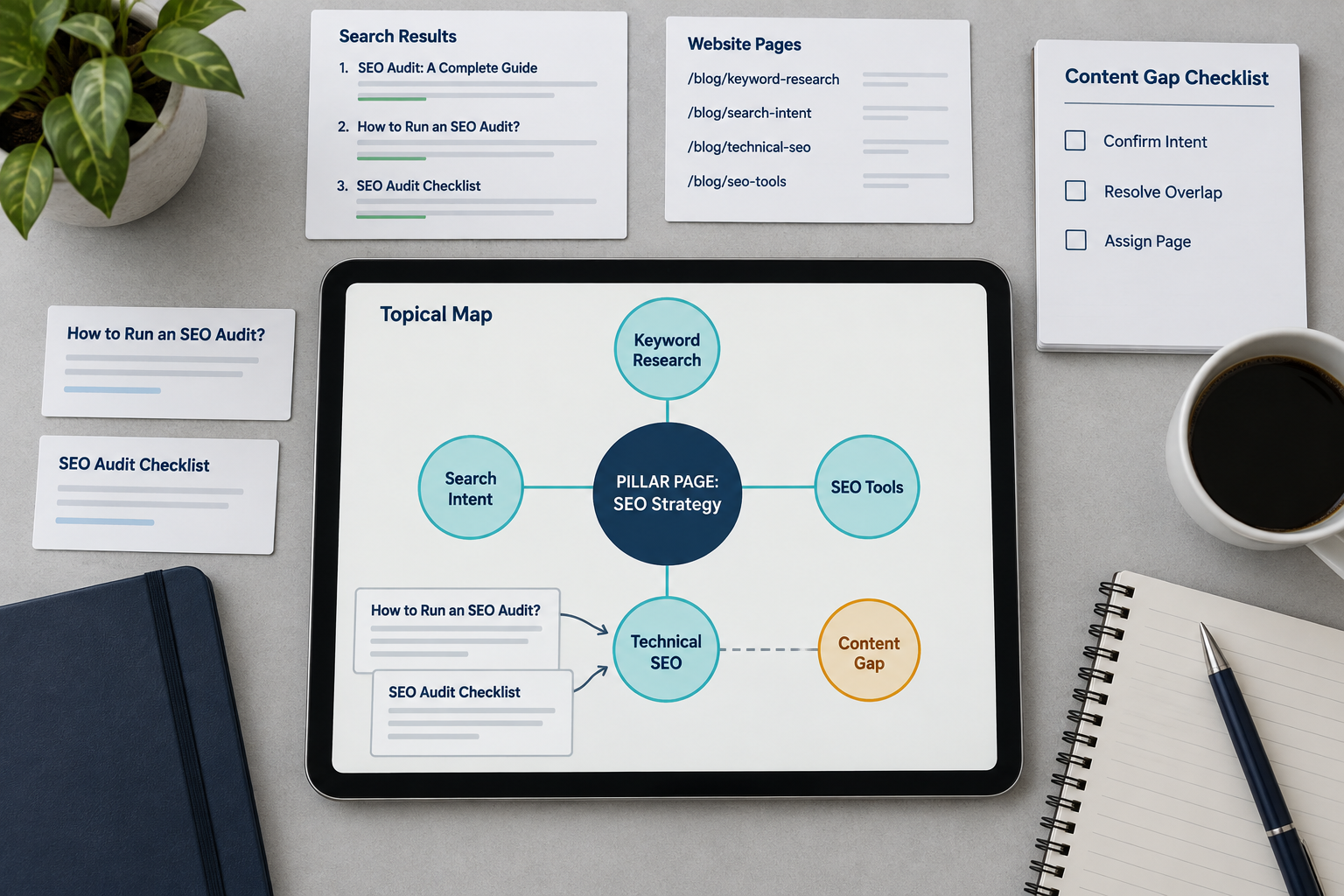
| Stage | Typical time | Common bottleneck |
|---|---|---|
| Research & SERP analysis | 1-2 weeks | Manual competitor review |
| Clustering & map structure | 3-5 days | Intent conflicts, entity overlap |
| Writing 50+ articles | 2-4 months | Writer bandwidth, inconsistent quality |
| Publishing & internal linking | Ongoing | CMS formatting, link upkeep |
The table above is where most "topical authority" strategies quietly die. A map with 60 planned articles is a spreadsheet, not a site, until someone writes and publishes all 60 — and most teams underestimate that this stage takes longer than the research.
This is the stage where turning the map into actual articles becomes the real constraint, not the strategy. DraftSEO.ai is built around that gap: once a topical map exists, the platform generates 30 articles a month for a connected site and publishes through integrations with popular CMS platforms, so the cluster pages a map calls for actually go live on a predictable schedule instead of sitting in a backlog.
Turning Coverage Into a Content Inventory You Can Track
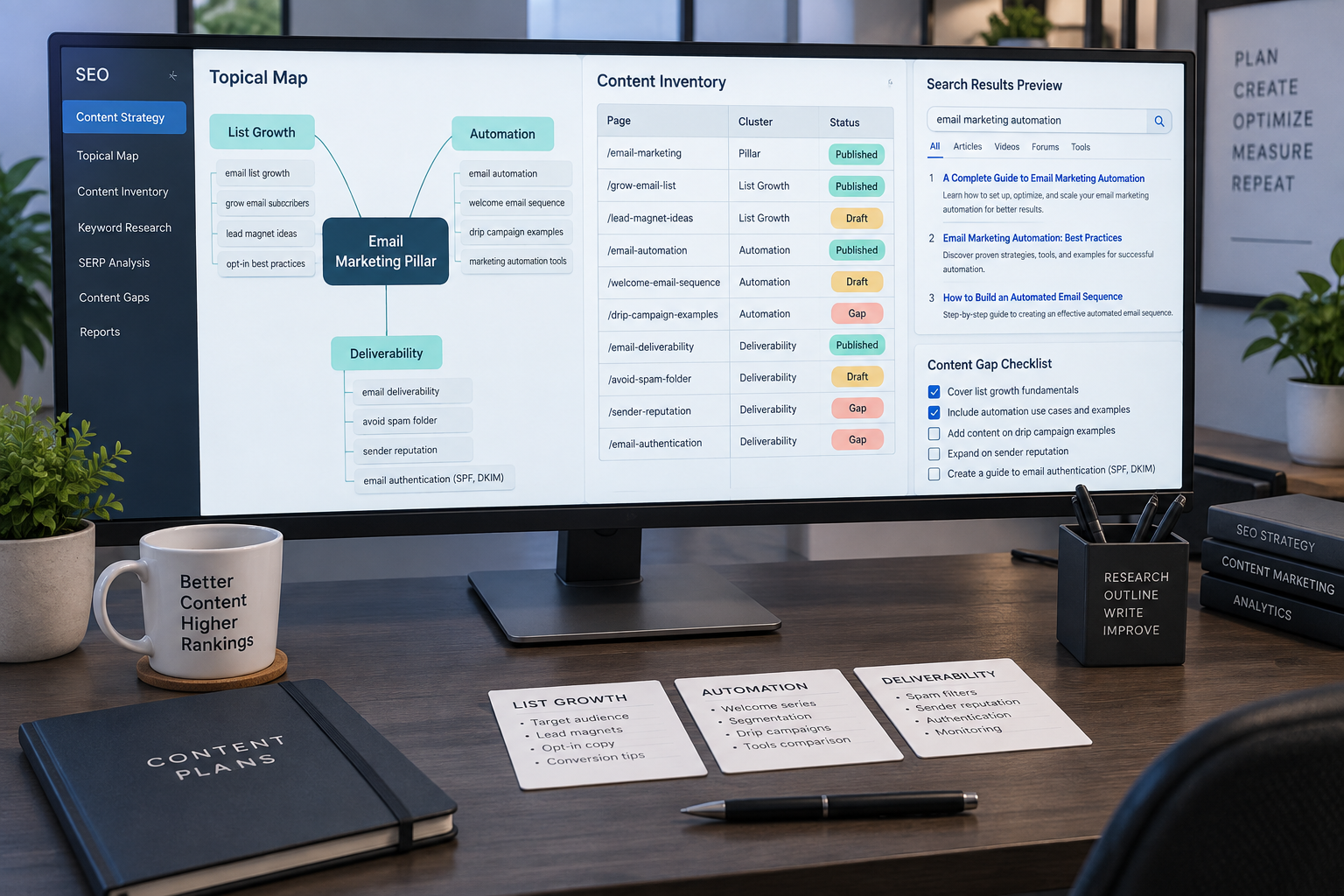
Once articles start publishing, the map needs a companion: a content inventory — a running list of what's live, what's planned, and what's outdated. Without it, teams republish the same subtopic twice or leave obvious gaps unfilled for months.
A simple inventory tracks four fields per page: the cluster topic, its pillar, publish date, and last-reviewed date. That's enough to spot stale pages and missing links without building a full content management system from scratch.
Mapping and production speed have to be planned together from day one. A 60-topic map that takes eight months to publish lets competitors fill the gaps you identified before you get there. Teams that pair mapping with faster, consistent publishing — including a free trial with starting credits to test the output on a real cluster before committing — tend to close that window instead of losing it; you can see current plans at the DraftSEO.ai pricing page.
Frequently Asked Questions
How many articles should a topical map include before I start publishing?
There's no fixed number, but most pillar topics need at least 8-12 cluster articles to show meaningful coverage. Start publishing once you've mapped a pillar plus its first 10 clusters, then expand based on what competitors add.
Is topical mapping a one-time project or ongoing work?
Ongoing. Topics evolve as new entities, products, or questions emerge, so revisit the map every 3-6 months and add clusters that cover new gaps competitors have filled since your last review.
Does topical mapping help with AI search tools like ChatGPT, not just Google?
Yes. AI answer engines favor sites that demonstrate full entity coverage of a topic over single keyword-matched pages, so the same clustering logic that builds Google authority also improves visibility in AI-generated answers.