Aug 27, 2026

How Many Keywords for SEO? 2026 Guide
DraftSEO Team
Google's John Mueller has said publicly, multiple times, that there's no ideal keyword density and no magic keyword count Google is checking for. Yet the question "how many keywords for SEO" still gets typed into Google thousands of times a month, because site owners want a rule they can apply. There isn't one number. There's a mapping problem, and once you see it that way, the whole question changes shape.
The honest answer: one primary keyword per page, a handful of closely related secondary terms, and as many pages as your topic actually supports. Scaling traffic is a publishing volume problem wearing a keyword-count costume.
Why "How Many Keywords per Page" Is the Wrong Question
Most SEOs asking this actually mean "how many keywords can I safely target on one page without diluting it." The real constraint isn't a count — it's search intent. Each page should satisfy one intent fully, then support it with secondary and semantic terms that reinforce, not compete with, that intent.
One Primary Keyword, One Job
A page ranking for "best running shoes for flat feet" and also trying to rank for "best running shoes for marathon training" is doing two jobs badly. Google reads mixed signals and often serves neither query well. Pick the primary keyword, write for that searcher, and let secondary keywords (long-tail variations, related questions, modifiers) ride along naturally in subheadings and body copy.
Keyword Density Is a Myth Worth Retiring
There's no 1-2% density target baked into Google's algorithm — that idea comes from early-2000s SEO folklore, not from any documented ranking factor. Stuffing a keyword to hit a percentage reads badly to users and can trip spam filters faster than it helps rankings. Write the phrase where it's natural: title tag, H1, first 100 words, maybe one subheading. After that, write for the reader, not a counter.
When One Page Tries to Do Too Much
Overloading a page with five unrelated keywords usually backfires through keyword cannibalization — you end up with two or three pages on your own site competing against each other in the same search results, splitting authority instead of building it. That's the single most common technical mistake I see on audits: a blog with 40 posts and three of them accidentally targeting the same query.
Search Volume and Difficulty Should Set Priority, Not Quantity
Search volume and keyword difficulty tell you which keywords deserve a page first, not how many keywords belong on a page. A term with 2,400 monthly searches and moderate difficulty is worth a dedicated page before a term with 40 searches, even if both are relevant to your niche.
Tools like Ahrefs, Semrush, or Google's own Keyword Planner give you volume and difficulty scores side by side. Use them to rank your keyword list, not to pad a single page with every variant that scores decently.
Long-tail keywords get skipped too often in this process. A single head term like "running shoes" might carry 90,500 monthly searches and brutal competition from Nike and Amazon. Twenty long-tail variations — "running shoes for flat feet women," "best trail running shoes under $100" — might each pull only 200-500 searches, but they convert better and rank faster because competition is thinner.
| Keyword Type | Example | Monthly Volume (approx.) | Competition |
|---|---|---|---|
| Head term | running shoes | 90,500 | Very high |
| Mid-tail | running shoes for flat feet | 2,400 | Moderate |
| Long-tail | best running shoes for flat feet women marathon | 90 | Low |
Keyword Mapping: Matching One Keyword to One URL
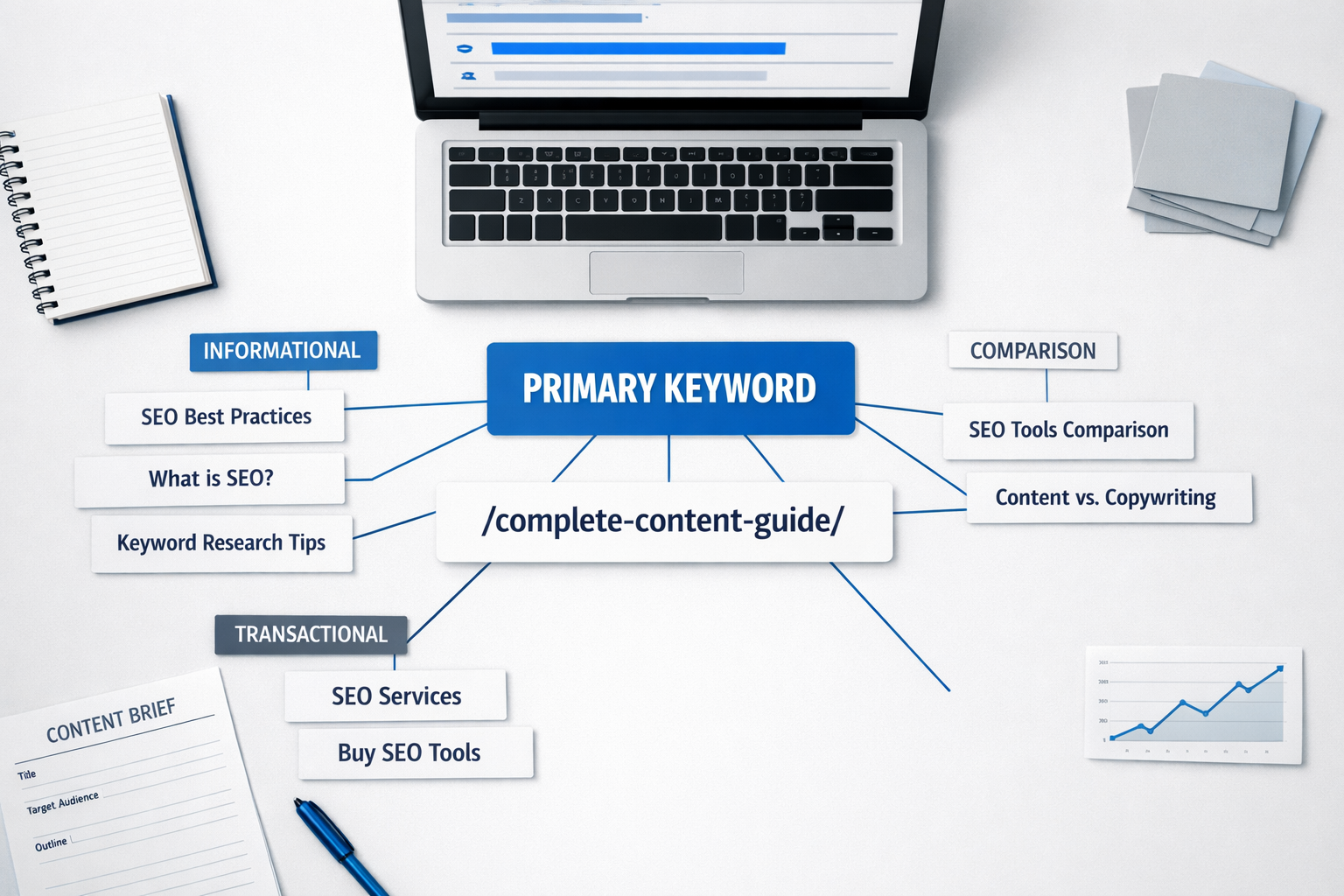
Keyword mapping is the practice of assigning each target keyword to exactly one existing or planned URL, so you never have two pages fighting for the same query. It's the single most useful exercise for answering "how many keywords for SEO" at a site-wide level.
Building a Topic Cluster Instead of a Keyword List
Rather than listing 200 keywords and wondering how to fit them on 10 pages, group them by topic. A cluster on "email marketing for ecommerce" might include a pillar page targeting the broad term, plus eight to twelve supporting pages each owning one long-tail variant: abandoned cart emails, welcome series timing, segmentation by purchase history. Semantic keywords — related terms and entities Google associates with the topic — get woven naturally across the cluster instead of forced into one page.
The Mapping Process, Step by Step
- Export your full keyword list from your research tool, sorted by volume and difficulty.
- Group keywords by shared search intent — informational, transactional, navigational.
- Assign each group to one URL, existing or new.
- Flag any keyword already ranking on two or more of your own pages — that's cannibalization to fix, not a bonus.
- Set a primary keyword and two to four secondary keywords per URL.
- Note content gaps where no page exists yet.
- Prioritize new pages by volume times difficulty, not by how many keywords you can technically stuff.
This is where scaling pages per keyword cluster becomes the actual growth lever. A site with 40 pages covering one broad cluster loosely will lose to a competitor with 40 pages, each mapped tightly to a distinct intent inside that same cluster — same page count, sharper targeting.
Content Length and Site Size: What the Data Patterns Actually Show

Longer content correlates with higher rankings in aggregate studies, but correlation isn't a target word count to hit on every page. Comprehensive pages tend to rank well because they cover more subtopics and satisfy more related queries in one place — length is a byproduct of depth, not a cause of ranking.
Site size follows a similar logic. A site with 500 well-mapped pages, each owning a distinct keyword and intent, will generally out-rank a site with 5,000 thin, overlapping pages. The question was never how many keywords — it's how many pages you can sustain at a quality bar high enough to rank, and whether your keyword map prevents them from competing with each other.
That's a production problem as much as a strategy problem. Teams that plan a tight keyword map but can't publish it fast enough watch competitors fill the gap first. DraftSEO.ai handles that production side directly: connect your site, feed it your keyword map or niche focus, and it generates 30 articles a month mapped to distinct keywords, publishing through your CMS without someone manually assigning URLs to terms. If you want to see how automating keyword-mapped content production works on your own site, there's a free trial with starter credits on the DraftSEO.ai pricing page.
Frequently Asked Questions
Is there an ideal number of keywords per blog post?
No fixed number exists — aim for one primary keyword plus two to four closely related secondary terms per post. Beyond that, added keywords usually signal you're covering two topics that deserve separate pages.
How many pages do I need to rank for a competitive niche?
It depends on the cluster, not a universal count — a competitive niche might need 20-50 mapped pages covering every intent variation, while a narrow niche could need under 10. Volume of unique, non-overlapping pages matters more than total keyword count.
Can targeting too many keywords hurt my rankings?
Yes, primarily through keyword cannibalization, where multiple pages on your own site compete for the same query and split ranking signals. Mapping each keyword to one URL prevents this before it starts.