Jul 25, 2026

What are article keywords? - Scholastica Help Desk
DraftSEO Team
Google processed over 8.5 billion searches a day as of recent public estimates, and every single one of those queries maps back to a keyword decision someone made when writing (or not writing) the page that answered it. If you've ever stared at a blank draft wondering where the keyword actually goes, a keyword article example makes the abstract rule concrete fast. This piece walks through what article keywords are, where they belong, and why matching search intent now matters more than repeating the exact phrase.
What Article Keywords Actually Are
An article keyword is the specific word or phrase a piece of content is built to rank for in search engines. It's not a tag you slap on after writing — it's the target you write toward from the first sentence.
Scholastica's help desk framing of "article keywords" comes from academic publishing, where authors submit keywords alongside a manuscript to help indexing systems and databases categorize the work. SEO uses the same core idea but applies it to web content: a keyword tells Google (and increasingly, AI systems like ChatGPT) what a page is about and who should see it in results.
Primary Keyword vs. Secondary Keywords
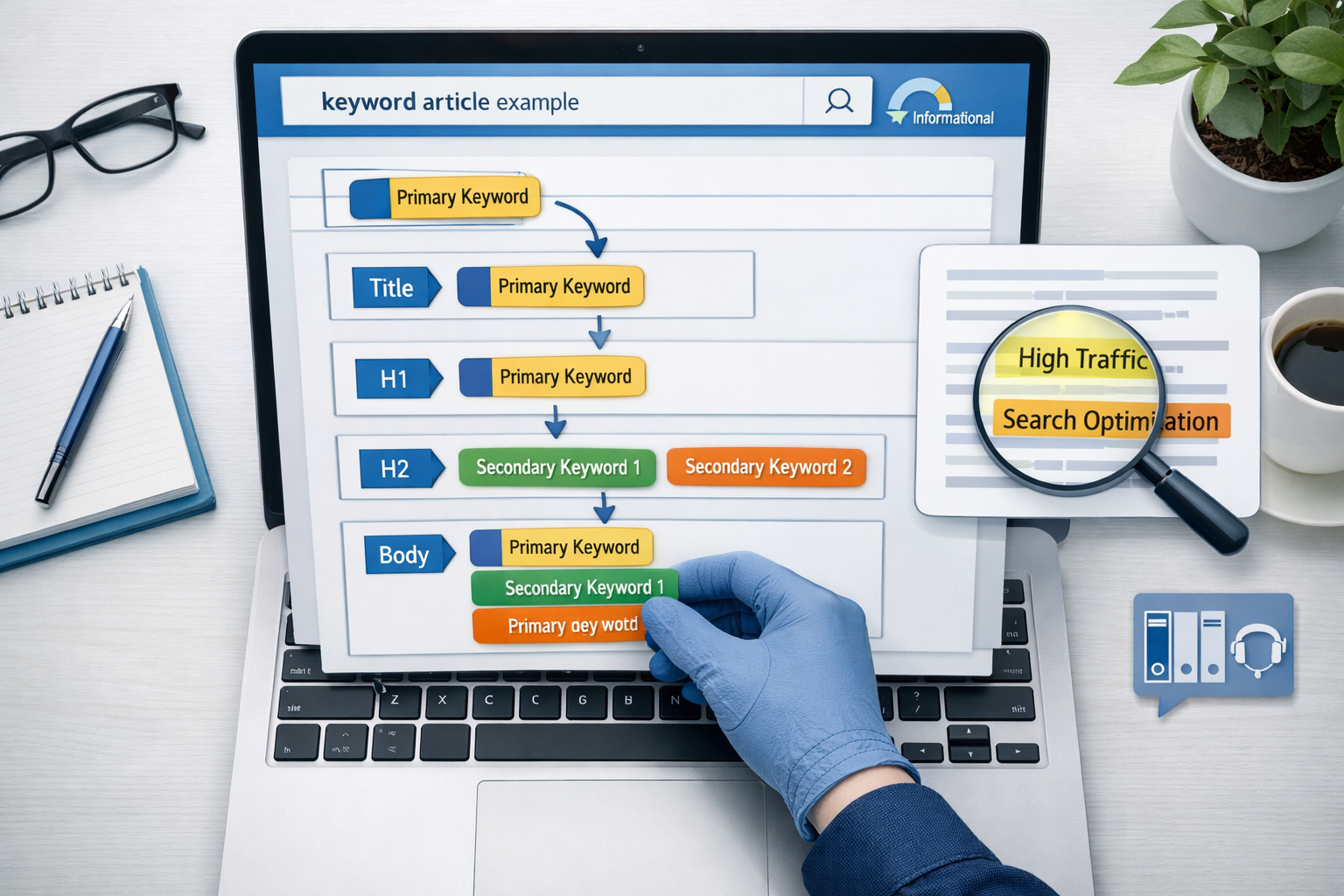
The focus keyword (also called the primary keyword) is the main phrase the article targets — think "keyword article example" for this piece. Secondary keywords are related terms and phrases that support the same topic without being the headline target: "focus keyword," "long-tail keyword," "keyword placement" would all qualify here.
Treating secondary keywords as optional is a common mistake. Google's ranking systems reward pages that cover a topic with depth, and secondary keywords are the mechanism that signals depth. A single-keyword article reads thin to both readers and algorithms.
Why This Distinction Trips People Up
Site owners frequently confuse the article's general topic with its actual target keyword. A post about "how to grow tomatoes indoors" might get written with the topic in mind but never actually targets a specific search phrase like "growing tomatoes indoors without sunlight." That gap — topic versus keyword — is where a lot of content underperforms despite being well-written.
The fix is simple in concept, harder in practice: pick the exact phrase a real person types into Google, then build the topic around answering that phrase completely. The keyword should be a decision, not an afterthought.
A Real Keyword Article Example, Broken Down
The fastest way to understand keyword usage is to look at a working example rather than a rule list. Take a hypothetical but realistic case: an ecommerce site selling home coffee equipment publishes an article targeting "best grinder for espresso."
That phrase becomes the focus keyword. It shows up in the title ("Best Grinder for Espresso: 7 Models Compared for 2024"), in the H1, in the first 100 words of the body, in at least one H2, and in the meta description. Secondary keywords woven through the body might include "burr grinder," "espresso grind size," "conical vs. flat burr," and "grinder for espresso under $200." None of those get forced — they appear because the article genuinely covers those subtopics.
Where the Keyword Physically Goes
Placement isn't decorative. Search engines still weight certain positions more heavily, even in an era of semantic ranking. A working keyword article example typically places the focus keyword in these spots:
- The page title (title tag), ideally within the first 60 characters
- The H1 heading, matching or closely mirroring the title
- The opening paragraph, within the first two sentences
- At least one H2 or H3 subheading, naturally phrased
- The URL slug, short and hyphenated
- The meta description, stated as a benefit or answer
- Image alt text, where a relevant image exists
Skipping any one of these rarely tanks a page on its own. But skipping three or four at once tells search engines the content is unfocused, and unfocused content struggles to rank against pages that did the placement work.
What Makes This Example Actually Work
The grinder article works because every secondary keyword corresponds to a real subtopic the buyer needs resolved before purchasing — not because the phrases were stuffed in for volume. That's the differentiator between an article built around search intent and one built around keyword count.
Search Intent Beats Exact-Match Repetition
Most keyword guides stop at "put the keyword in the title and header." That advice is not wrong, but it's incomplete, and treating it as sufficient is why so many keyword-optimized pages still fail to rank. The real leverage point is matching the keyword's search intent to the article's actual structure.
Search intent is the underlying reason someone typed a query. "Best grinder for espresso" carries commercial-investigation intent — the searcher is comparing options before buying, not looking for a grinder's history or a definition of burr. An article that opens with grinder history before getting to the comparison table is misreading the intent, no matter how many times "best grinder for espresso" appears in the text.
The Four Intent Types, in Practice
Google's own quality rater guidelines describe search behavior in terms roughly matching four buckets: informational, navigational, commercial, and transactional. A keyword article example only works if the content format matches the bucket the keyword falls into.
| Intent Type | What the Searcher Wants | Content Format That Matches |
|---|---|---|
| Informational | An answer or explanation | Guide, definition, how-to, FAQ |
| Navigational | A specific site or page | Landing page, brand page |
| Commercial | Comparison before buying | Roundup, "best X," comparison table |
| Transactional | To complete a purchase | Product page, pricing page |
Ignoring this mapping is one of the most common and costly keyword mistakes. A page stuffed with "best grinder for espresso" that's actually written as a brand history piece will lose to a thinner competitor that matches commercial intent correctly, because Google's ranking systems increasingly reward topical relevance and intent match over exact-phrase density.
Reading Intent From the SERP Itself
Before writing a word, check what's already ranking for the target keyword. If the top ten results are all comparison posts with tables, writing a single-product review is fighting the format Google has already decided works. If they're all short definitional answers pulled into a featured snippet, a 3,000-word deep dive may be solving a problem nobody has.
This is genuinely the step people skip most often. It takes ten minutes and saves weeks of writing content the wrong shape.
Keyword Density Rules Have Changed — Here's What Still Matters
Keyword density — the percentage of a keyword's appearances relative to total word count — used to be treated as a target metric, with advice ranging from 1% to 3%. That framing is largely outdated and can actively hurt rankings if followed rigidly today.
Google's algorithms, particularly since updates tied to natural language processing (systems like BERT), evaluate semantic relevance rather than raw repetition counts. Repeating "keyword article example" fifteen times in an 800-word post reads as manipulative to both a human editor and an algorithm trained to detect it. That's keyword stuffing, and it's a real penalty risk, not a hypothetical one — Google's spam policies explicitly list keyword stuffing as a violation that can lead to lower rankings or removal from results entirely.
What to Do Instead of Counting Density
Write the keyword where it belongs structurally — title, H1, intro, one subheading, meta description, maybe once more in the body — and then let synonyms, related phrases, and natural language carry the rest of the article. If the phrase feels forced reading it aloud, it's forced on the page too.
A reasonable working range in practice: 3 to 8 mentions of the exact focus keyword across a 1,500-word article, with secondary keywords appearing another 1 to 3 times each. That's a guideline, not a formula to hit mechanically — content that reads naturally and covers the topic thoroughly will land somewhere near that range on its own.
Long-Tail Keywords Carry Less Competition, More Precision
A long-tail keyword is a longer, more specific phrase — usually four or more words — that has lower search volume but higher intent match and lower competition. "Grinder" is a head term with enormous competition and vague intent. "Best grinder for espresso under $150 for beginners" is long-tail: fewer searches, but the person searching it is close to a decision.
Building an article around a long-tail variation of a primary keyword, then covering the broader head term as a secondary keyword, is a workable structure for newer sites that can't yet compete for high-volume terms. It's slower traffic growth, but it's traffic that converts at a meaningfully higher rate because intent is sharper.
Choosing Keywords With Research Tools, Not Guesswork
Picking a keyword by intuition alone is a common and expensive mistake — search volume and competition are things to check, not assume. Tools built for this exist specifically because guessing wastes writing effort on phrases nobody searches.
Google Keyword Planner, built into Google Ads, gives volume ranges and competition data directly from Google's own search data, and it's free with a Google account. Ahrefs and Semrush go further with keyword difficulty scores, click-through-rate estimates, and competitor keyword gaps, at a cost — Ahrefs' lowest paid tier runs around $129/month as of recent pricing, Semrush similarly priced in that range. Ubersuggest, from Neil Patel's team, offers a lighter free tier that's reasonable for smaller sites just getting started.
A Practical Research Sequence
- Start with the head term you'd naturally think of ("espresso grinder")
- Check its search volume and competition level in a keyword tool
- Pull the "related keywords" or "questions" list the tool generates
- Identify 2-4 long-tail variations with lower competition
- Check the current SERP for each candidate to confirm intent match
- Pick one primary keyword and 3-5 secondary keywords from the list
- Confirm no other page on your own site already targets the same primary keyword
That last step matters more than people expect. Keyword cannibalization — two pages on the same site competing for the same term — splits ranking signals and often means neither page ranks as well as one consolidated page would.
Applying This Across a Full Content Calendar
Doing this research well for one article is manageable manually. Doing it for thirty articles a month, across a full content calendar, is where most in-house teams and agencies start to struggle — not because the process is hard, but because it's repetitive and time-consuming at scale. This is the exact gap DraftSEO.ai is built to close: input a site's niche once, and the platform generates a batch of SEO-optimized articles monthly, each with a focus keyword, supporting secondary keywords, and structure already matched to search intent, without a writer manually repeating the research sequence above for every single piece.
Metadata and On-Page Elements That Reinforce the Keyword

Metadata is the set of fields that describe a page to search engines without appearing in the main visible content — title tags, meta descriptions, header tags, and structured data. Getting these right reinforces the keyword signal the body content is already sending; getting them wrong undercuts an otherwise solid article.
The meta description is the roughly 150-160 character snippet shown under a title in search results. It doesn't directly boost rankings, but it drives click-through rate, and CTR is a strong secondary ranking signal. A meta description that states a concrete benefit ("Compare 7 espresso grinders by burr type, price, and grind consistency") outperforms a vague one ("Learn about espresso grinders") because it answers the searcher's actual question before the click.
On-Page Elements Worth Auditing
Beyond title tags and meta descriptions, a handful of on-page elements matter for keyword reinforcement without being decorative add-ons.
Header tag hierarchy (H1 through H4) needs to follow a logical structure, not just contain the keyword randomly. One H1 per page, keyword-relevant H2s breaking the topic into subtopics, and H3s only where an H2 genuinely splits further. Search engines read header structure as a table of contents; a jumbled hierarchy signals disorganized content even if the keyword is present.
Internal linking with descriptive anchor text — not "click here" — passes topical relevance between pages on the same site. Linking a coffee-equipment article to a related grinder-maintenance guide, using anchor text like "cleaning a burr grinder," reinforces both pages' topical authority.
Image alt text should describe the image, and where relevant naturally, include the keyword or a variant — but forcing it into every alt attribute on the page reads as spam to accessibility tools and search crawlers alike.
Common Keyword Mistakes That Undercut Rankings
Most keyword-related ranking problems trace back to one of four repeated mistakes, and recognizing them is faster than memorizing rules. Fixing these four issues alone resolves the majority of keyword-related ranking underperformance seen on small and mid-size sites.
Mistake One: Believing More Repetition Equals Better Rankings
Keyword stuffing — repeating a phrase unnaturally throughout a page — is explicitly named in Google's spam policies as a practice that can trigger manual action or algorithmic demotion. The belief that density drives rank is a holdover from search engines' earliest, most primitive matching algorithms from the 1990s and early 2000s. Modern ranking systems use semantic understanding; repetition past a natural threshold is now a liability, not an asset.
Mistake Two: Confusing Topic With Target Keyword
An article can be clearly "about" grinders in general while never actually targeting a specific searchable phrase. This produces content that reads fine but has no clear ranking target, which usually means it competes for nothing well. The fix: name the exact phrase before writing the first sentence, not after.
Mistake Three: Matching Keyword Text While Ignoring Intent
A page can contain the exact target phrase in every recommended spot and still fail to rank if the format doesn't match what searchers actually want. Google's own systems are explicitly designed to detect this mismatch and rank intent-matched pages above keyword-matched ones.
Mistake Four: Assuming One Keyword Carries the Whole Page
A single focus keyword without supporting secondary keywords produces thin topical coverage. Pages that rank well for competitive terms almost always rank for dozens of related secondary phrases simultaneously — that breadth is a signal of genuine topical authority, not a side effect.
Frequently Asked Questions
What is the difference between a focus keyword and a secondary keyword?
A focus keyword is the single primary phrase an article targets for ranking; secondary keywords are related terms that support the same topic. A good article uses one focus keyword and roughly 3-5 secondary keywords woven naturally through the body.
How many times should a keyword appear in an article?
There's no fixed rule, but a natural range for a 1,500-word article is 3 to 8 mentions of the exact focus keyword, plus 1-3 mentions each of related secondary keywords. Forcing a higher count risks reading as keyword stuffing, which Google's spam policies penalize.
Can an article target more than one keyword?
Yes — one primary keyword should anchor the page, but 3-5 secondary keywords covering related subtopics are expected and improve topical depth. Trying to make two unrelated phrases both act as the primary target usually weakens the page's relevance for both.
Does keyword placement in the URL still matter for SEO?
Yes, a short, hyphenated URL slug containing the focus keyword still helps both users and search engines quickly identify the page topic. It's a minor ranking factor on its own, but it's low-effort and worth doing on every new page, including any published through an automated pipeline like the free trial available at https://draftseo.ai/pricing.