Oct 28, 2026

SEO Content Writer Tool: Compare Key Features
DraftSEO Team
A good seo content writer tool covers five jobs: keyword and SERP research, real-time content scoring with NLP term suggestions, AI drafting, internal linking and media, and publishing. No tool does all five equally well. So compare them by how much work each one removes and how much it leaves to you, then match that to your monthly volume, budget and editing time.
Three Tool Types and What Each One Handles
Most products fall into three groups. An optimizer scores a draft you wrote. An AI writer produces the draft. An end-to-end platform also researches and publishes. The table shows who does the work in each case (a "you" means manual effort).
| Job | Optimizer (e.g., Surfer) | SEO suite add-on (e.g., Semrush Writing Assistant) | End-to-end AI writer |
|---|---|---|---|
| Keyword and SERP research | Built in | Built in, from the suite's database | Automated |
| Content score and NLP terms | Yes, live | Yes, live | Built into the draft |
| Drafting | Optional AI draft | You write | Automated |
| Internal links and media | You | You | Automated |
| Publishing to a CMS | Google Docs, WordPress | You | Automated |
Entry prices vary widely. Surfer's Creator plan starts at $49 per month, and Semrush plans start around $45 per month. Those figures buy guidance, not finished articles.
The Features That Decide Whether a Tool Saves Time
Research and Scoring
Optimizers study the top-ranking pages for your keyword. They then suggest terms, a word count and a heading structure. This is useful because it shows what searchers already get.
A score measures similarity to those pages. It does not predict rankings. A 90 can still lose to a page with stronger links, a better brand or fresher information. Use the score to find gaps, not as a pass mark.
Drafting, Links and Media
An optimizer never writes the article for you, and an AI writer never checks its own facts. Both points matter. Ask what happens after the first draft: who adds internal links, images, a meta description, an FAQ block and schema markup (code that helps search engines read the page)? At 20 posts a month, even ten minutes of manual linking per post costs over three hours.
Publishing and AI Answers
Check whether the tool pushes a finished post to WordPress, Shopify or Webflow with formatting intact. Copy-pasting from a document is where headings, tables and images break.
For AI answers (often called GEO, short for generative engine optimization), look for clear answer-first paragraphs, tables and FAQ sections. Those are easy for ChatGPT and Gemini to quote.
Where Automated Workflows Fit
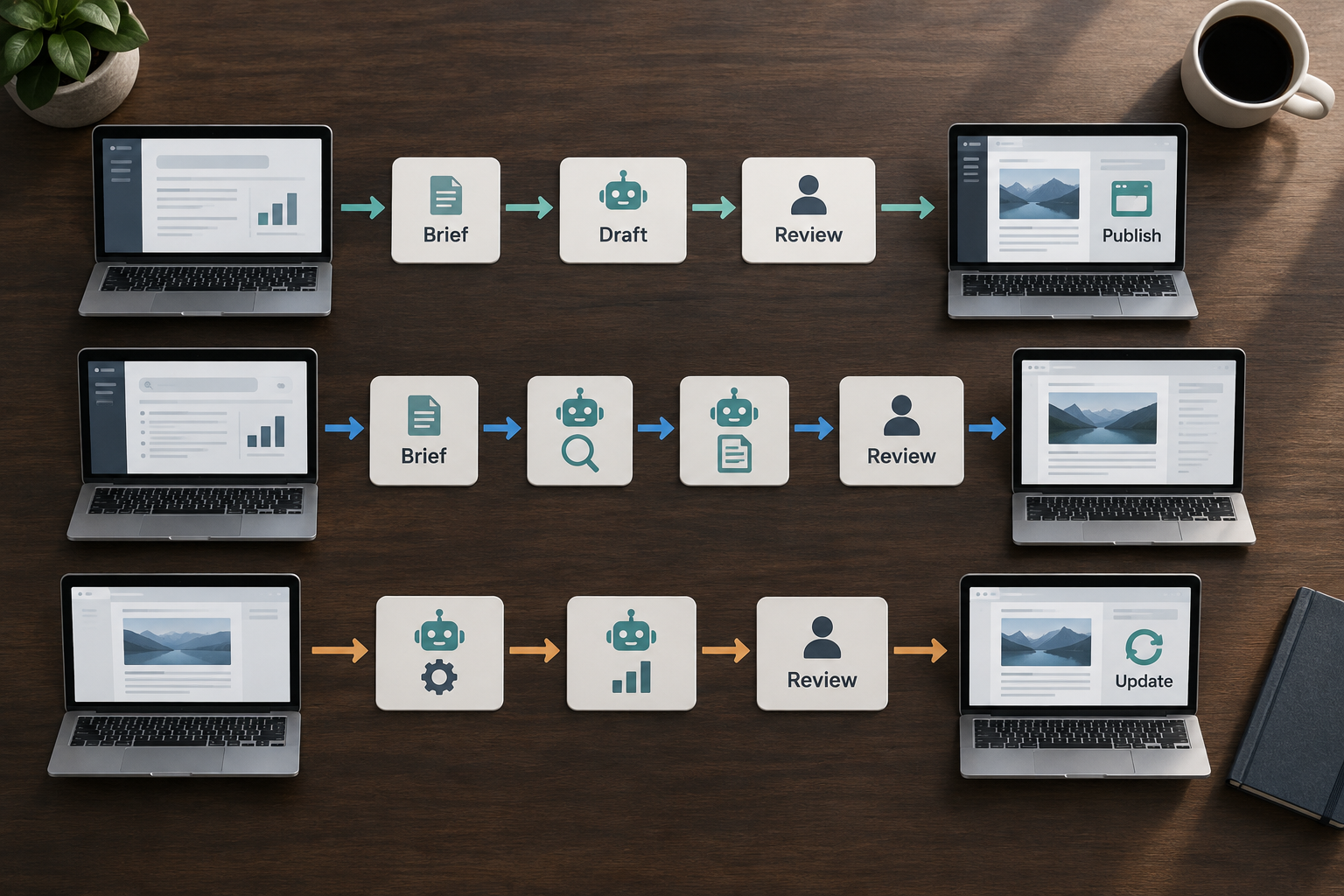
If you publish daily and have no writers, the research-to-publish chain is the real cost. DraftSEO.ai handles that chain: it researches keywords, writes the article with a meta description, FAQ, images and links, and publishes to your connected site on a content calendar. Growth costs $39 per month per site, or $29 per month on annual billing ($348 per year).
The catch is control. Automation gives volume, but you still need to review claims and add your own experience.
When to Choose Which Tool
Use this order to decide:
- You have writers and need quality control: pick an optimizer such as Surfer.
- You already pay for Semrush: try its Writing Assistant first, since your keyword data carries over.
- You are a solo owner who needs steady output: pick an end-to-end writer.
- You publish fewer than four posts a month: a free tool, such as the Yoast SEO WordPress plugin, may be enough.
- You need original research, interviews or legal and medical accuracy: neither type fits. Hire a subject expert.
Whatever you choose, edit every draft and check every number. Search engines and AI answers favor pages with real expertise, and a generic draft has none.
If you want to test the end-to-end route, you can try DraftSEO.ai free on your first site, which includes 3 articles with no credit card.
Frequently Asked Questions
Do content scores actually improve rankings?
Not directly. A score shows how closely your page matches current top results on terms and structure. That helps you fill topic gaps, but links, authority and search intent still decide the ranking.
Can AI SEO writers publish directly to WordPress?
Yes, some can. End-to-end platforms publish with one click, and some optimizers connect to WordPress for editing. Check that images, tables and meta descriptions carry over.
What is the difference between an SEO optimizer and an AI writer?
An optimizer scores and guides a draft you wrote. An AI writer creates the draft. Many products now offer both, but each still leaves different tasks, like fact-checking, to you.
References
[1] SEO Content Creation Tools Comparison: 2026 Guide & Tips
[2] SEO Writing Tools Compared (2026) - The Blog Hero
[3] 10 Best SEO Writing Tools for Content Writing in 2026
[4] Best SEO Content Writing Tools: 12 Tested Picks for 2026
[5] 8 Best AI SEO Content Writing Tools Compared (2026)
[6] 7 Best SEO Content Writing Tools for AI-Powered Blog .
[7] I tested the 6 best SEO AI content writer tools in 2026 .
[8] SEO & AI Search Plans and Pricing
[9] 10 Best SEO Content Optimization Tools in 2026
[10] The 20 best SEO tools in 2026? I personally tested all tools