Jul 23, 2026

What is Long Form Content?
DraftSEO Team
Google's own algorithm documentation has never named a word count as a ranking factor, yet the top three organic results for competitive B2B keywords average well over 1,500 words. That gap between what Google says and what actually ranks is where most content strategies go wrong. Long form content isn't a magic number to hit; it's a format decision that only pays off when the topic actually needs the space.
This matters because writing an 1,800-word article for a query that deserves 600 words wastes a production budget on nothing. Getting the call right, by topic and by search intent, is the actual skill.
What Counts as Long Form Content?
Long form content is any article, guide, or page that runs roughly 1,500 to 3,000+ words and covers a topic with enough depth to answer follow-up questions before the reader has to ask them. Short form content, by contrast, typically sits under 1,000 words and answers one specific question without much elaboration.
The line isn't rigid. Some SEOs draw it at 1,200 words, others at 2,000. What matters more than the exact threshold is what the extra length is doing. A 2,500-word article that walks through five distinct subtopics, each with examples and caveats, is doing real work. A 2,500-word article that restates the same three points in different phrasing is padding with a word count attached.
Word Count Ranges by Content Type
Different formats cluster around different lengths for good reason. A product comparison naturally runs longer than a definition page because it has more variables to cover.
- Quick-answer pages (definitions, "what is X"): 400-800 words
- Standard blog posts (how-to, listicles): 1,000-1,800 words
- Pillar pages and ultimate guides: 2,500-5,000 words
- Comparison and buyer's guide content: 1,800-3,000 words
Where the 1,500-Word Line Actually Comes From
The commonly cited 1,500-word benchmark isn't an arbitrary round number; it comes from repeated observation that competitive, high-intent commercial keywords tend to have longer top-ranking pages than informational, low-competition ones. That's a correlation with competition level, not proof that length itself drives rankings.
Treat 1,500 words as a signal that you're probably dealing with a competitive or complex topic, not as a target to force onto every article regardless of what the query actually needs.
Does Long Form Content Actually Rank Better on Google?
Long form content ranks better for certain query types, specifically ones where searchers want comprehensive coverage, comparisons, or multi-step processes. For simple factual queries, a focused short answer often outranks a padded long one because it matches intent faster.
This is the core nuance that gets lost in "longer is better" advice. Google's ranking systems are built around matching content to search intent, and intent varies enormously by query. A search for "what time zone is Denver in" wants one sentence, not an 1,800-word explainer on time zone history.
Dwell Time and Engagement Signals
Longer content, when it's genuinely useful, tends to produce longer dwell time and lower pogo-sticking back to the search results. Google has talked about using engagement signals as part of a broader quality assessment, alongside things like Core Web Vitals and content relevance. A visitor who reads for four minutes and doesn't bounce back to search is a decent proxy for "this page satisfied the query."
But dwell time cuts both ways. A confusing 2,000-word article can produce long dwell time because the reader is scrolling and searching for the actual answer, frustrated, not because the content is good. Time on page alone doesn't tell you whether the length helped or hurt.
The Backlink Advantage of Longer Content
Long form content earns backlinks more reliably than short form content, mainly because comprehensive guides, original data, and detailed how-tos give other writers something worth citing. A 600-word post rarely gets linked to as a reference; a 3,000-word guide with a comparison table or a step-by-step framework often does.
This is one of the stronger, more defensible arguments for going long on the right topics. If your goal is to build a page that accumulates links over 12-18 months, depth gives other sites a reason to point at you. If your goal is to answer a quick factual query and move on, backlinks were never going to be the point.
Word Count Myths That Waste Production Budget
The biggest misconception in content strategy is that word count itself is a ranking factor, independent of quality or relevance. It isn't, and treating it as one leads directly to padded, filler-heavy articles that rank worse than tighter competitors.
I'd push back hard on any content brief that specifies "2,000 words minimum" for every article regardless of topic. That instruction, on its own, tells a writer nothing about whether the topic supports 2,000 words of genuine substance. It just tells them to hit a number, and writers under that pressure add filler: restated intros, redundant "key takeaways" sections, and generic advice that doesn't move the reader forward.
Three Assumptions Worth Correcting
Here's where word-count thinking typically goes wrong, in order of how often I see each mistake:
- Assuming length alone improves rankings. Google's systems evaluate relevance, depth, and matching to intent — length is a byproduct of covering a topic well, not a cause of ranking well.
- Padding to hit an arbitrary target. Filler sections, repeated points, and inflated intros increase word count without increasing value, and readers notice fast (so does a competent quality rater).
- Believing every topic needs long form treatment. A factual query like "how many ounces in a cup" is fully answered in two sentences; forcing 1,200 words onto it produces a worse user experience, not a better one.
- Ignoring structure in favor of raw length. A 3,000-word wall of unbroken paragraphs performs worse than a well-headered 1,800-word article, because scannability affects whether readers actually consume the content they landed on.
When a Focused 800-Word Answer Wins
Plenty of high-volume keywords are best served by short, direct content, and treating them as long-form candidates is a mistake I'd flag in any content audit. "What is long form content" itself sits in a gray zone — informational, moderately competitive — which is why this piece runs long. But "what is a meta description" or "how to clear cache in Chrome" doesn't need 1,500 words; it needs a clear answer in the first 100 words and maybe a short list of steps after it.
Matching format to intent, rather than defaulting to long form for everything, is the actual differentiator between content strategies that convert budget into rankings and ones that just convert budget into word counts.
Pillar Pages and Topic Clusters: Where Depth Earns Its Keep
Pillar pages are the clearest case where long form content is the right call almost every time. A pillar page covers a broad topic comprehensively and links out to narrower supporting articles, called cluster content, that each target a specific subtopic or long-tail keyword.
This structure works because it mirrors how people actually research complex topics: they start broad, then drill into specifics. A pillar page on "email marketing" might run 3,500-4,000 words, covering strategy, tools, and metrics at a high level, while linking to cluster pages on "email subject line best practices" or "email deliverability" that go deep on one narrow piece.
Building a Cluster Without Duplicating Content
The risk with topic clusters is overlap: writing a pillar page and five cluster pages that all say roughly the same thing in different words. Each piece needs a distinct job. The pillar page orients the reader and links onward; the cluster pages answer one specific question in enough depth that the pillar page doesn't need to repeat it.
A practical check: if you could delete a section from the pillar page and paste it into a cluster article with almost no edits, that section belongs in the cluster article, not the pillar.
Internal Linking Patterns That Actually Move Rankings
Pillar and cluster structures pass authority through internal links, but the direction matters. Cluster pages should link up to the pillar page using the pillar's target keyword as anchor text where it reads naturally, and the pillar page should link down to each cluster page from the section discussing that subtopic. Random cross-linking between cluster pages, without a clear hierarchy, dilutes the structure rather than reinforcing it.
For ecommerce sites, this pattern shows up as a category page acting as the pillar, with individual buying-guide or comparison posts as the cluster content feeding it links and topical relevance.
Content Depth vs. Keyword Coverage: What Actually Matters
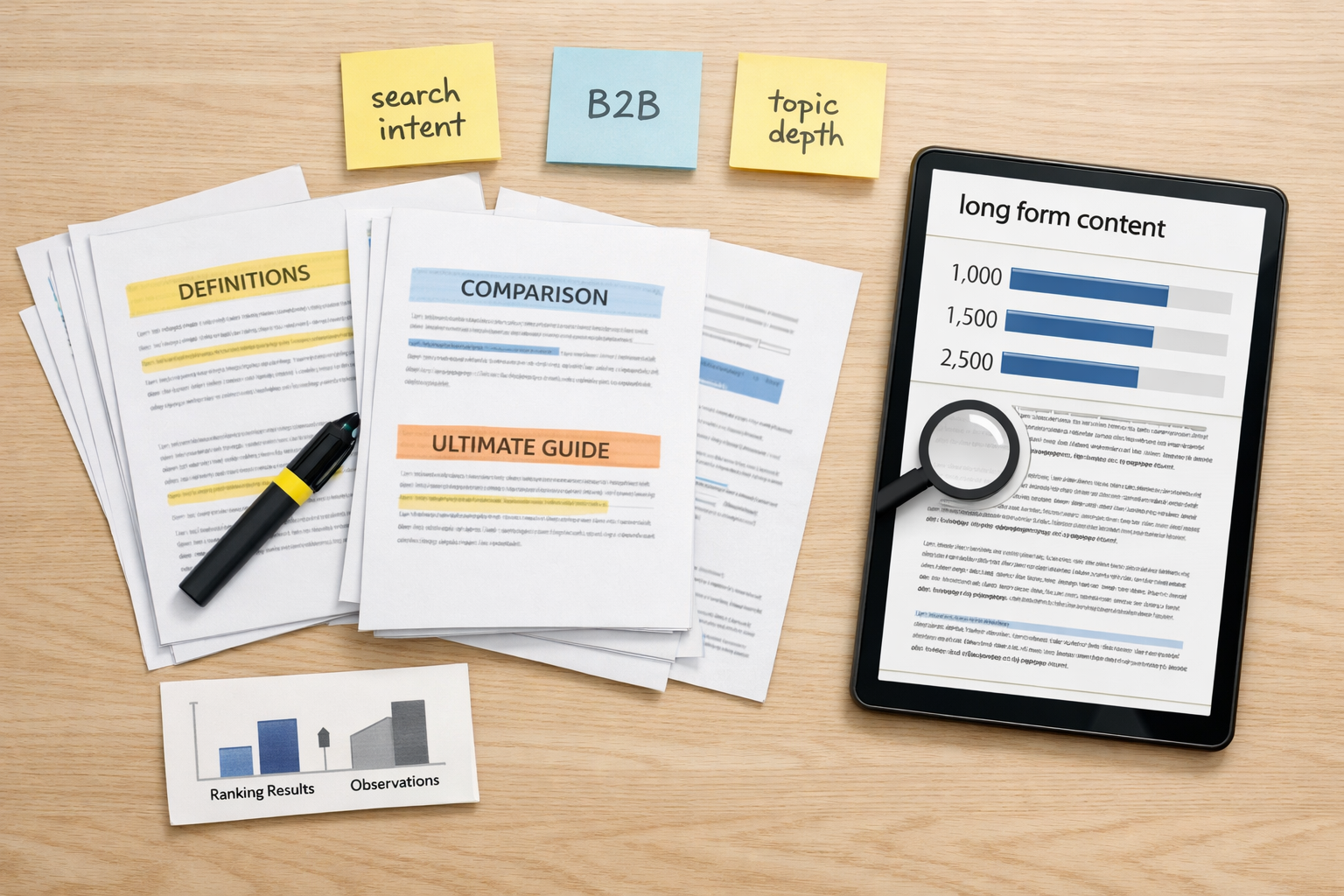
Depth means answering the questions a knowledgeable reader would ask next, without them having to search again. Keyword coverage means including the terms and phrases search engines associate with the topic. The two overlap but aren't the same thing, and confusing them is why some long articles still underperform.
An article can hit every keyword variation an SEO tool suggests and still be shallow, listing terms without explaining relationships between them. Conversely, a genuinely deep article on a topic will naturally pick up most of the relevant keyword variations, because covering a subject thoroughly means using the vocabulary a subject matter expert would use.
Depth Signals Worth Building Into Every Long Article
A few structural choices separate content that reads as deep from content that just reads as long:
- Worked examples or scenarios, not just abstract advice
- Comparisons and tradeoffs, stated explicitly rather than left implied
- Specific numbers, tools, or timeframes, instead of vague qualifiers like "many" or "often"
- Answers to the obvious follow-up question, addressed before the reader has to search again
Structure and Scannability Matter as Much as Length
A long article with no H2/H3 hierarchy, no lists, and no tables performs worse in both user engagement and AI-generated answer citations than a shorter, well-structured one. This matters more now than it did five years ago, because tools like ChatGPT and Google's AI Overviews tend to pull from clearly labeled sections and lists when constructing summarized answers.
Headers that state a real question or claim, rather than a vague label like "More Information," give both readers and AI systems a clear signal about what each section actually contains. This is a structural decision, separate from word count, and it affects whether long form content earns the engagement it needs to justify the extra length.
The Real Time Cost of Producing Long Form Content
A well-researched 2,000-word article, written manually with proper fact-checking, internal linking, and editing, typically takes a competent writer somewhere between 4 and 8 hours depending on topic familiarity and how much original research it requires. That's before formatting for CMS publishing, sourcing images, or running an SEO pass on titles and meta descriptions.
This time cost is the practical reason so many teams either under-invest in long form content or overcorrect by padding shorter pieces to look substantial without the research to back it up. Neither approach works well. A rushed 2,000-word article written in 90 minutes reads exactly like what it is.
Where Production Time Actually Goes
Breaking down that 4-8 hour range: research and outlining typically eats 1-2 hours, drafting takes 2-4 hours depending on the writer's speed and the topic's complexity, and editing plus SEO formatting (headers, internal links, meta tags) adds another 1-2 hours. Multiply that across a monthly content calendar of even 8-10 long form pieces, and you're looking at 40-70 hours of work a month, before any promotion or distribution.
That math is exactly why automated content platforms exist, and why teams increasingly split the workload between manual, high-stakes pages and automated production for the rest of the calendar. Publishing at that pace by hand, month after month, is where most in-house content plans stall out.
Freelance and Agency Cost Benchmarks
For teams outsourcing rather than writing in-house, per-article pricing scales with length and required expertise. Here's a rough breakdown of what long form content commonly costs across common sourcing options.
| Production Method | Typical Cost per 2,000-Word Article | Typical Turnaround |
|---|---|---|
| Freelance generalist writer | $150-$400 | 3-7 days |
| Specialized/technical freelance writer | $400-$900 | 5-10 days |
| Content agency (with editing, SEO) | $500-$1,200 | 1-3 weeks |
| In-house writer (fully loaded cost estimate) | $250-$600 | 2-5 days |
These ranges vary by niche, obviously; a technical SaaS comparison piece costs more than a general lifestyle post because it demands subject matter accuracy. But across sourcing methods, the pattern holds: long form content is expensive relative to short form, which is exactly why misjudging whether a topic even needs the long form treatment wastes real money.
Long Form Content by Industry: Where the Format Fits

Long form content pulls its weight differently depending on the industry and business model behind it. Ecommerce product pages rarely need 2,000 words; ecommerce buying guides almost always benefit from that length. SaaS comparison content and B2B thought leadership tend to reward depth because the buying decisions behind them are slow and research-heavy.
Matching format to industry norms, rather than applying one house style everywhere, is where a lot of content calendars go wrong. A local service business doesn't need the same word counts as a SaaS platform selling a $10,000 annual contract, because the reader's research process is fundamentally different.
Ecommerce: Category Pages Short, Guides Long
Product and category pages should stay lean, usually under 500 words of on-page copy, because shoppers on those pages want to compare options fast, not read prose. Buying guides and "best of" comparison content, on the other hand, regularly runs 2,000-3,500 words because readers at that stage of the funnel are actively weighing tradeoffs and want the depth.
B2B and SaaS: Depth Signals Trust
B2B buyers doing due diligence on a five- or six-figure purchase decision read differently than someone comparing $30 kitchen gadgets. Long form comparison pages, detailed implementation guides, and case-study-style content signal that a vendor understands the problem in depth, which matters more in B2B sales cycles than it does for impulse ecommerce purchases.
Local Service Businesses: Shorter, More Frequent Content Often Wins
A plumber's website doesn't need 2,500-word essays on pipe corrosion; it needs clear, fast-loading service pages and a handful of genuinely useful, moderate-length guides (800-1,200 words) that answer common homeowner questions. Long form content here mostly shows up in a handful of cornerstone guides, not across every page on the site.
Automating Long Form Article Production Without Sacrificing Depth
Automating long form content production is realistic today, provided the system is built to research and structure a topic properly rather than just stretch a short answer with filler. The failure mode with AI-generated long form content has always been repetition dressed up as depth, and that's the exact problem a good production workflow needs to solve before length becomes an asset instead of a liability.
DraftSEO.ai is built around that distinction: it generates up to 30 articles a month for connected sites, structured with the headers, sub-sections, and internal logic that long form content needs to actually earn engagement, rather than just hitting a word count. It integrates with common CMS platforms for direct publishing, which removes the formatting step that eats a chunk of that 4-8 hour manual production window described earlier.
For teams deciding whether automated production fits their workflow, trying it against a real content calendar is more useful than reading specs. There's a free trial with starting credits available through the DraftSEO.ai pricing page, which is a reasonable way to test whether automated long form output holds up against a topic you already know well enough to judge quality on sight.
Frequently Asked Questions
How long should a blog post be for SEO?
There's no universal number; it depends on the query. Simple factual questions are well served by 600-900 words, while competitive or comparison-driven topics often need 1,500-2,500 words to cover the subtopics searchers expect.
Does adding more words to a page improve its Google ranking?
No, not by itself. Google's systems reward relevance and depth, not raw length; padding a page with filler words without adding real value typically has no positive effect and can hurt readability scores that affect engagement.
What's a good balance between short form and long form content on one site?
Most sites do best with a mix: short, fast-loading pages for transactional and quick-answer queries, and long form guides or pillar pages for competitive, research-heavy topics where depth earns backlinks and repeat visits.
How much does it typically cost to produce one long form article?
Freelance rates for a 2,000-word article typically run $150-$900 depending on the writer's specialization, with agencies charging $500-$1,200 when editing and SEO formatting are included. In-house production carries a fully loaded cost usually in the $250-$600 range per article.