Nov 5, 2026

SEO Content Strategy: Plan Topics Around Search Intent
DraftSEO Team
An SEO content strategy starts with search intent, not keyword volume. Group related keywords into clusters, check the live search results to see whether people want to learn, compare, buy or reach a specific site, and give each cluster one page and one format. Then rank the clusters by business value and ranking potential, and keep updating.
That is the whole method. The sections below show how to apply it with a small team that can't publish everything.
The Four Intent Types and the Format Each One Needs
Search intent is the goal behind a query. Most SEOs sort it into four types, a model that grew out of Andrei Broder's 2002 work on informational, navigational and transactional queries.
| Intent | What the searcher wants | Example query | Best format |
|---|---|---|---|
| Informational | To learn something | how to cluster keywords | Guide, tutorial, glossary page |
| Commercial | To compare before buying | best CRM software | Comparison, roundup, review |
| Transactional | To act now | sign up for Notion | Product, pricing or landing page |
| Navigational | To reach a known site | Ahrefs pricing page | Clear brand or product page |
Treat intent as a constraint, not a label
Keyword tools tag queries with intent, but those tags are guesses. Open the live results and read the page-one titles. If nine of ten results are product pages, a blog post will struggle, so pick a page type that matches. Blog posts can still win on some of these queries, but only when they answer what the searcher actually needs.
This check also tells you when to drop a topic. If page one is full of strong brand sites and you sell something different, defer it.
From Keyword List to Prioritized Calendar
Follow these steps in order. Each one narrows the list until only pages you can realistically win remain.
- Pick topic areas your site can credibly cover, based on your products, services and real experience.
- Collect keywords for each area, using Google Keyword Planner, Search Console data and competitor pages.
- Cluster them. Keywords that return the same results belong together. Similar phrasing alone is not enough.
- Check the SERP for each cluster and note the dominant intent, page type and depth.
- Map each cluster to one page. Record the keyword cluster, URL, intent and format in a spreadsheet.
- Score and rank the clusters, as described below.
- Schedule the top-ranked pages on a calendar.
Keyword mapping without cannibalization
Mapping "seo content plan," "seo content planning" and "content plan for seo" to three pages is the most common mapping mistake. The pages compete, and Google may rank none of them well. If the SERPs for those phrases match, they get one page.
Review the map about every three months. Pages change, competitors publish, and results sometimes shift to a different page type. Checking more often usually shows little, because rankings take time to move.
Scoring: business value first
Rate each cluster from 1 to 3 on two factors. Business value asks how directly the topic leads to a lead or sale. A topic that fits your product scores high even with modest traffic. Loosely related topics bring visitors who never convert.
Ranking potential asks whether you can compete. Look at who holds page one and how strong their pages are. Multiply the two scores and write the highest first. This is also where the "80/20 rule" applies in practice: a small share of your pages usually drives most of your results, so aim your effort at those.
Topic Clusters, Internal Links and a Rolling Calendar
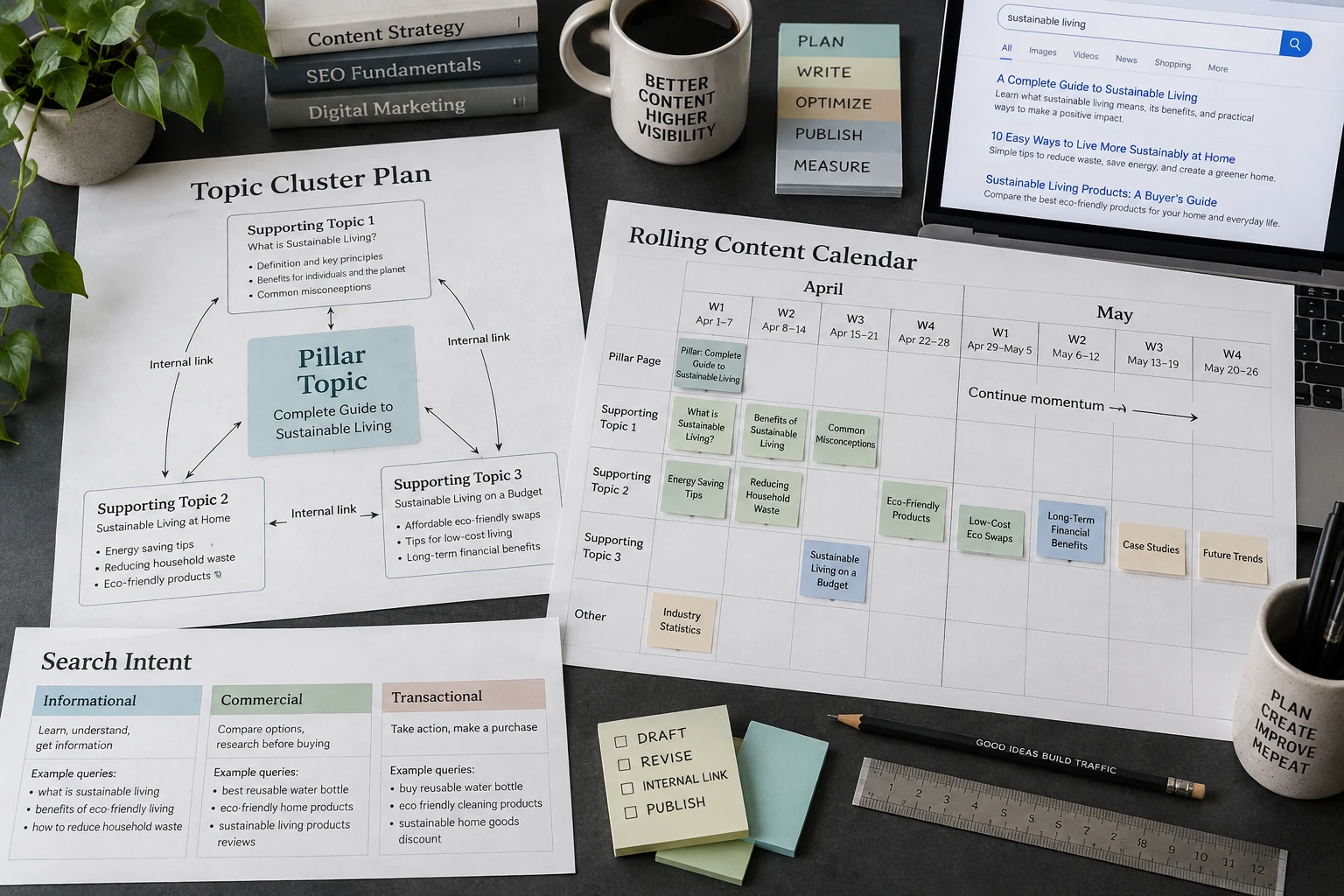
A topic cluster is a pillar page plus supporting pages on subtopics, all linked together. Each page targets its own keyword cluster. The pillar covers the broad topic, and each supporting page answers one narrower question in depth.
Internal links carry the structure. Link every supporting page to the pillar and to its closest siblings, using descriptive anchor text. Without those links, a cluster is only a list of unrelated posts.
For the calendar, quality beats quantity. One well-aimed page a week usually beats five loosely targeted ones, and a small team can sustain it. Publish the pillar and its first supporting pages close together so the links work from day one.
DraftSEO.ai fits this stage. It researches keywords, writes articles with H2/H3 structure, FAQs and internal links, and fills a rolling calendar at about one article a day. You still decide the topics and check the intent, and the calendar carries them out.
Refresh, Measure and Prepare for AI Answers
Publishing is the start. Review each page in Google Search Console after a few months. If it ranks on page two, strengthen it. If it ranks but gets few clicks, rewrite the title. If the SERP has changed to a different page type, restructure it.
AI answers pull from pages that state a direct answer near the top, use clear headings and give specific facts. Put the answer in the first 40-60 words under each heading, add a table where you compare options, and include a short FAQ. These habits help readers as much as they help AI engines.
DraftSEO.ai builds those elements into each article, and you can try it free on your first site to see how a planned cluster looks once it's drafted.
Frequently Asked Questions
What are the four types of search intent in SEO?
The four types are informational (learn), commercial (compare before buying), transactional (ready to act) and navigational (find a specific site). Confirm the type in the live results, because tool labels can be wrong.
How many articles should I publish per month?
There is no fixed number. Publish as many as you can keep well-aimed and refreshed. For many small sites that means four to eight strong pages a month, though a faster pace works if each page has a clear intent and business value.
Is there a free SEO content strategy template?
You can build one in a spreadsheet with these columns: keyword cluster, intent, SERP format, mapped URL, business value (1-3), ranking potential (1-3), priority score and publish date. Review it every three months.
References

[1] SEO Content Strategy: How to Create High-Ranking Content .
[2] SEO Content Strategy: 10 Steps to Plan Content That Ranks
[3] SEO Content Strategy Roadmap
[4] Content Strategy and SEO: How to Align .
[5] How to Create an SEO Content Strategy (Follow the .
[7] Build a Content SEO Strategy and Guide (2026)
[8] Keyword mapping for SEO: Guide + free template