Oct 3, 2026

How Long Does SEO Take to Work?
DraftSEO Team
Google's own Search Advocate, John Mueller, has said it typically takes four months to a year for SEO changes to show measurable results, and that's for a site doing everything right. That number alone explains why so many site owners quit too soon. If you've been publishing content for eight weeks and seeing nothing, you're not failing — you're on schedule.
The honest answer to how long does SEO take is "it depends," but that's not a dodge. It depends on things you can measure before you start: domain age, how competitive your niche is, and whether you publish once a month or once a week. That last one is the variable most people treat as fixed, and it isn't.
Why Four to Twelve Months Is the Realistic Range
Google needs time to find your pages, decide whether to trust them, and figure out where they rank against competitors already indexed for years. That process has three distinct phases, and skipping ahead isn't possible.
Indexing and Crawl Budget
New pages don't appear in search results the moment you publish them. Google has to crawl the page first, which depends on your site's crawl budget — the number of pages Googlebot is willing to visit in a given period. A brand-new domain with no backlink signals might wait days or weeks for a first crawl; an established site with strong internal linking can get indexed within hours. Submitting a sitemap through Google Search Console speeds this up but doesn't eliminate the lag.
Trust-Building and Domain Authority
Even after indexing, a new page sits in what some SEOs call the "sandbox" period — not an official Google policy, but a widely observed pattern where fresh content underperforms for a few months regardless of quality. Domain age and accumulated backlinks are the biggest levers here: a five-year-old site with 200 referring domains will often outrank a six-month-old site with better on-page optimization, simply because Google trusts it more.
Competitive Positioning
Ranking for "best running shoes" takes far longer than ranking for "best trail running shoes for wide feet in Colorado," regardless of how well either page is built. Keyword competition sets a floor on timeline that no amount of extra effort lowers.
What Actually Speeds Things Up (and What Doesn't)
Some factors genuinely shorten the wait; others are myths that waste budget. Knowing the difference keeps you from chasing the wrong fix when rankings feel slow.
- Publish consistently, not sporadically. A site adding 2-4 fresh articles a week sends Google repeated freshness signals, which correlates with faster crawl frequency and quicker indexing of new pages.
- Fix technical SEO issues early. Broken internal links, slow page speed, and missing schema markup don't cause penalties, but they delay the trust-building Google needs to rank you.
- Build a backlink profile gradually. A handful of relevant links from real sites beats fifty low-quality directory links, which can actually slow progress by triggering spam filters.
- Update old content instead of only adding new pages. Refreshing a 2024 article with current data often moves it up faster than publishing something brand new.
- Don't chase every algorithm update. Google runs several core updates a year; reacting to each one with drastic changes resets momentum more than it builds it.
One-time optimization — writing a great page and walking away — stalls because Google rewards sites that show ongoing activity, not a single well-built asset.
Publishing Cadence: The Variable Most Guides Ignore
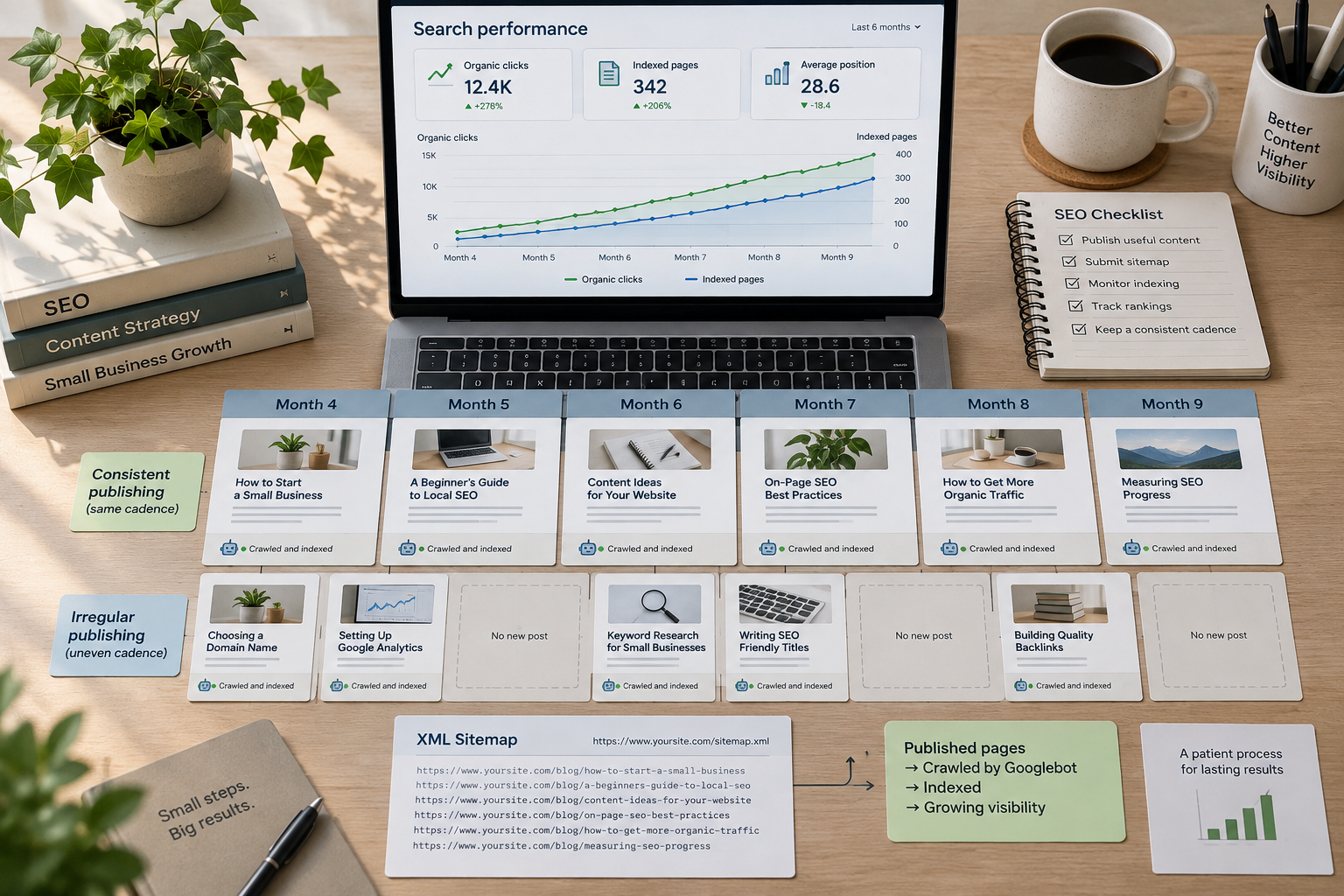
Most timeline estimates treat SEO as something you wait out. In practice, cadence — how often and how reliably you publish — is one of the few variables fully in your control, and it compresses the realistic timeline more than almost anything else.
A site publishing one article every two months looks inactive to Google's crawlers, which space out their visits accordingly. A site publishing weekly gives Google a reason to come back often, which means new pages get indexed faster and ranking signals accumulate sooner. This is less about volume for its own sake and more about consistency signaling an active, maintained site.
Keeping that pace manually is where most content plans fall apart — writers run out of topics, schedules slip, and "weekly" quietly becomes "whenever we get to it." This is the gap DraftSEO.ai is built to close: it generates 30 articles a month for connected sites and integrates with popular CMS platforms, so the publishing schedule stays steady even when the team behind it doesn't have time to write every week.
Setting Realistic Milestones by Month
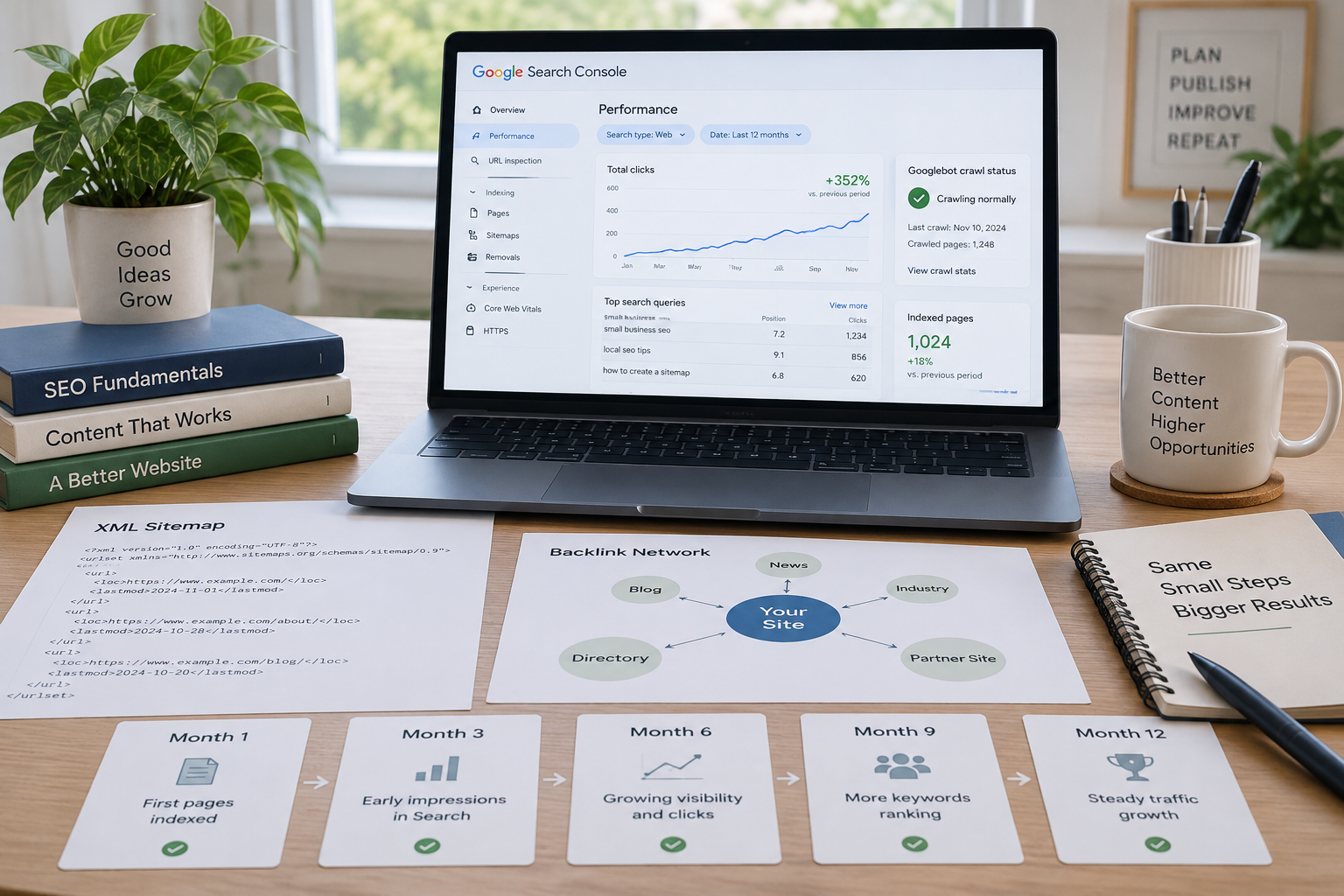
Expecting rankings in week three sets you up to quit right before things start moving. A clearer benchmark helps you judge progress against reality instead of against the first boost.
| Timeframe | What to realistically expect |
|---|---|
| Month 1-2 | Indexing of new pages; little to no ranking movement |
| Month 3-4 | First ranking positions appear, usually page 2-3 for target keywords |
| Month 5-6 | Measurable organic traffic increase; some keywords reach page 1 |
| Month 9-12 | Established rankings for moderately competitive terms; compounding traffic growth |
Niche competitiveness shifts these numbers in either direction. A local service business targeting "plumber in Tulsa" can see page-1 rankings by month 3; an e-commerce store competing for "wireless headphones" might still be building authority at month 12.
If your timeline consistently lags this table despite steady publishing, check technical SEO health first — crawl errors and slow load times are the most common invisible blockers. Testing a free trial with initial credits through the DraftSEO.ai pricing page is a low-cost way to see whether automating the writing and publishing side closes that gap faster than manual effort alone.
Frequently Asked Questions
How long does SEO take to show up in Google rankings?
Most sites see initial ranking movement within 3-4 months and measurable traffic growth by month 5-6, according to patterns Google's own staff have described publicly. Highly competitive niches or brand-new domains can take closer to 12 months before results feel solid.
Why hasn't my SEO worked after 2 months?
Two months is usually too early to judge — Google is still indexing and trust-building during that window, not ranking you poorly. Check that pages are actually indexed in Search Console before assuming the strategy failed.
Does posting more content speed up SEO results?
Yes, within reason: publishing 2-4 quality articles weekly sends stronger freshness signals than sporadic posting, which tends to shorten the realistic timeline. Quality still matters more than raw volume — ten thin pages won't outperform four well-researched ones.