Sep 24, 2026

How Long Should a Blog Be? 2026 SEO Guide
DraftSEO Team
Google's John Mueller has said outright that word count is not a ranking factor. Yet the average page ranking in the top 3 results on Google still tends to run longer than the pages sitting at position 8 or 9. That contradiction is the whole problem with asking how long should a blog be as if it had one number for an answer. The real question is how many subtopics the searcher expects covered, and length is just what happens once you cover them.
For teams publishing at any real volume, this matters more than it sounds. Guessing at a word count for every brief wastes writer hours and produces inconsistent rankings across a site.
Why Word Count Alone Doesn't Predict Rankings
Word count correlates with rankings, but it doesn't cause them. Longer posts tend to rank higher because they tend to cover more subtopics, answer more follow-up questions, and satisfy more search intent variations — not because Google rewards length directly.
The Correlation Trap
Plenty of SEO tools show a chart: average word count of top 10 results versus your draft. Teams read that chart and set a target, like 1,800 words, then write to hit it regardless of topic. That's backwards. A local plumbing FAQ page doesn't need 1,800 words to rank; a comparison guide covering six competing SaaS tools might need 3,000.
What Actually Drives the Correlation
Depth drives rankings. A 2,500-word article that answers eight distinct subtopics beats a 2,500-word article padded with restated intros and filler transitions between three subtopics. Google's helpful content systems are built to catch the second kind. If your paragraph count is inflating but your subtopic count isn't, you're writing filler, not depth — and it shows in bounce rate before it ever shows in rankings.
Match Length to Search Intent, Not a Target Number
The length a post needs depends on what the searcher is trying to do, not on a company-wide word count rule. A transactional query wants a fast answer and a next step. An informational query wants full context. Treating both the same way wastes effort on one and shortchanges the other.
Informational Queries Need Topical Coverage
Someone searching "how long should a blog be" wants a framework, examples, and edge cases — that's why this article runs longer than a typical FAQ page. Informational guides in competitive niches commonly run 1,500 to 2,500 words once every genuine subtopic is covered, not because that number is magic but because that's how much space full coverage takes.
Transactional and Local Pages Need Speed, Not Bulk
Ecommerce category pages and local service pages convert on clarity, not word count. A product page loaded with 1,200 words of generic copy above the "Add to Cart" button usually hurts conversion. Local landing pages for a single service in a single city often perform fine at 600 to 900 words plus a strong FAQ block, because the searcher already knows what they want.
Run a Competitor Content Gap Before You Set Any Length
Before writing a brief, check what the top 10 ranking pages actually cover — not how long they are. Pull the H2s and H3s from each, list every subtopic that appears in at least three of them, and treat that list as your minimum coverage requirement. Length follows from there.
This process works the same whether you do it by hand or automate it. Manually, it takes roughly 30-45 minutes per keyword: opening ten tabs, skimming headings, and building a shared outline. At scale — say 30 or more articles a month — that time adds up fast, which is why automating competitor length and topic research, the way DraftSEO.ai handles it when generating monthly articles for a connected site, keeps briefs consistent without a writer manually re-running the same audit every time.
Here's a repeatable sequence for sizing any post:
- Pull the top 10 organic results for the target keyword.
- Extract every H2/H3 subtopic across those results.
- Flag subtopics appearing in three or more competitors as required coverage.
- Draft an outline covering every required subtopic plus one differentiator.
- Let word count fall out of the outline — don't set it first.
- Compare the finished draft's depth, not just length, against the median competitor.
Length Benchmarks by Content Type
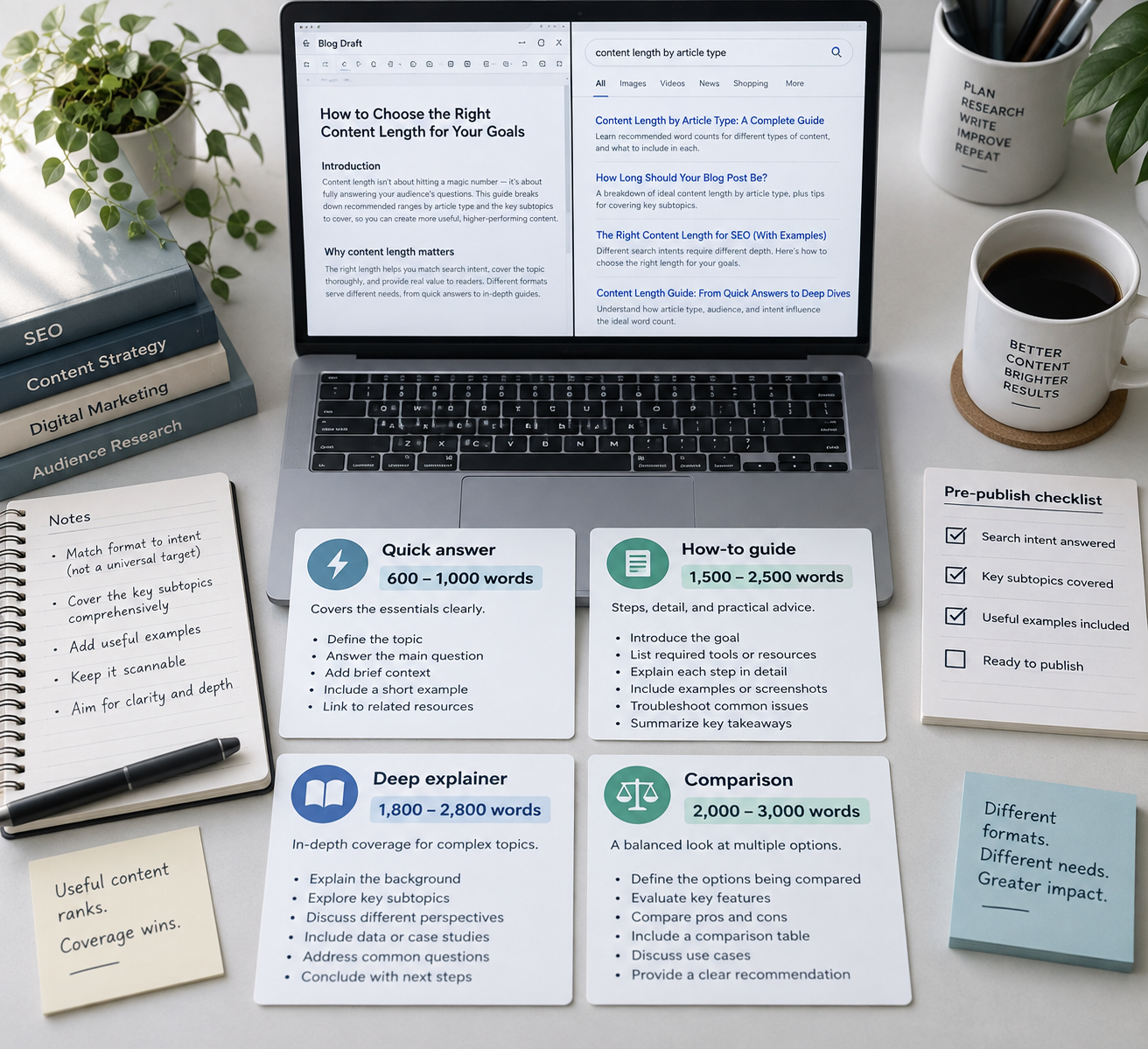
Different content types carry different natural lengths because they carry different amounts of required subtopic coverage. Treating a listicle brief the same as a comparison guide brief is one of the most common scaling mistakes agencies make.
| Content Type | Typical Word Range | Why |
|---|---|---|
| Listicle | 1,200-2,000 | Bounded by item count; each entry needs 100-200 words |
| How-to guide | 1,500-2,800 | Needs sequential steps plus troubleshooting and prerequisites |
| Comparison/vs. page | 2,000-3,500 | Requires full feature parity across every option compared |
| Local service page | 600-1,000 | Intent is fast, near-decision; FAQ block adds most of the value |
| Ecommerce product page | 150-500 | Conversion copy, not topical depth, is the job |
Thin content penalties don't target short pages. They target pages that claim expertise without demonstrating it — no author signal, no specifics, no evidence the writer actually knows the subject. A 400-word product page with real specs and honest limitations clears E-E-A-T review far more easily than a 2,000-word page stuffed with generic adjectives.
Publishing Frequency vs. Post Length: The Real Tradeoff
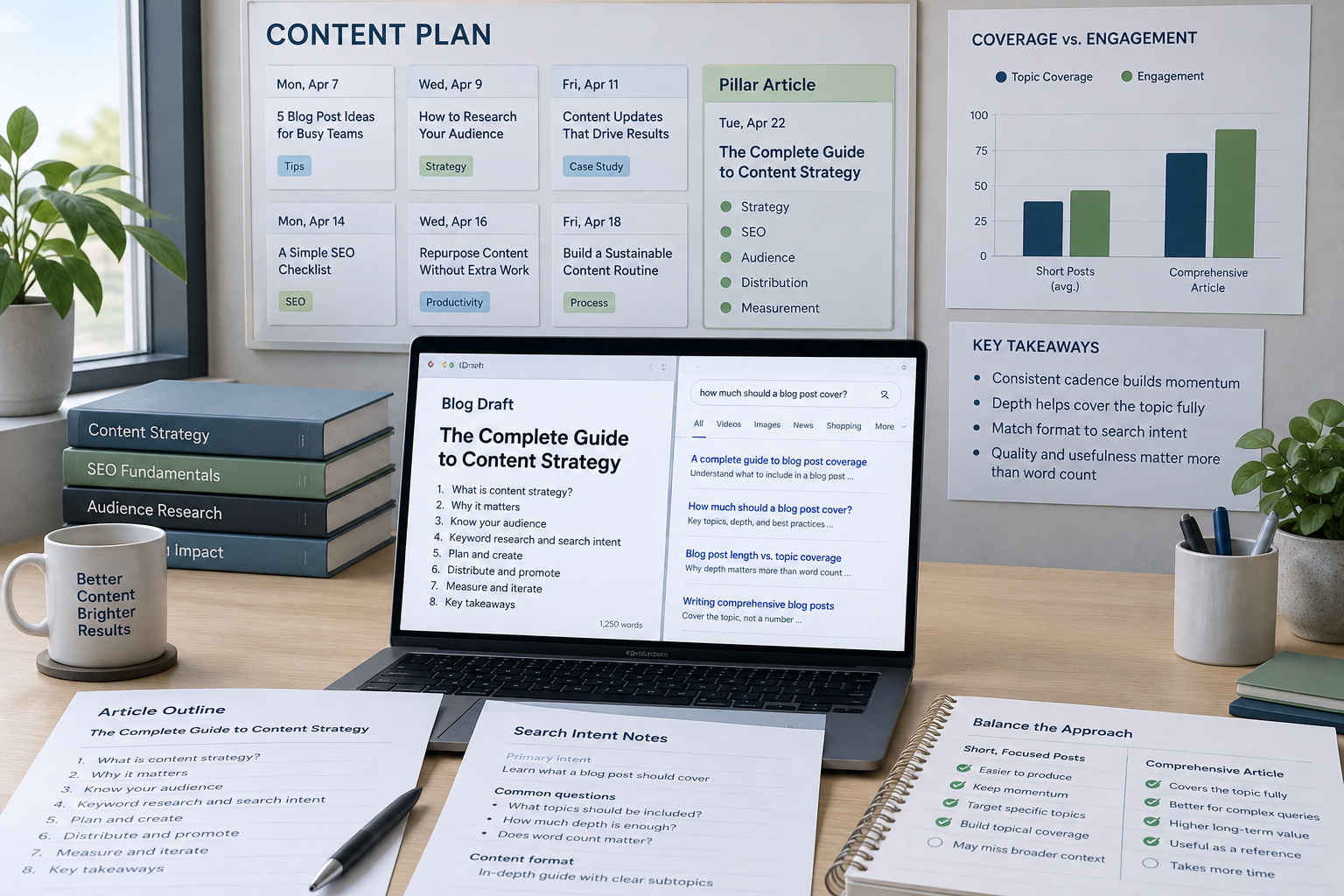
Publishing more often with shorter, well-scoped posts usually beats publishing fewer, longer posts if your team's bandwidth is fixed. This is the tradeoff most content calendars get wrong: they assume longer always means better, so cadence drops to protect length.
In practice, a site that ships 20 tightly scoped 1,200-word posts a month, each fully covering its SERP's subtopic set, tends to build topical authority faster than a site that ships 5 posts at 4,000 words each. Coverage across the whole content cluster matters as much as depth on any single page.
That's the tradeoff DraftSEO.ai is built around: it generates 30 articles a month for a connected site, sized to what each keyword's SERP actually demands rather than a fixed template, and it publishes through the CMS integrations most WordPress and ecommerce teams already use. If you want to see how a right-sized brief looks against your own niche before committing, the free trial with starter credits on the DraftSEO.ai pricing page is enough to test one article end to end.
Frequently Asked Questions
Is there a minimum word count Google requires for a blog post to rank?
No. Google has no minimum word count. Thin, low-value pages get filtered by helpful content systems regardless of length, and short pages with full topical coverage rank fine — plenty of local pages under 900 words hold top-3 positions.
Should AI-generated blog posts be longer to compensate for lower perceived quality?
No — padding an AI draft to hit a higher word count makes quality worse, not better. Size AI content to the same SERP subtopic audit you'd use for human-written content, then let the outline set the length.
How long should a blog be if I'm publishing 30+ posts a month?
Size each post individually to its SERP's subtopic coverage rather than using one company-wide target; most sites at that volume land between 900 and 2,500 words per post depending on content type and intent.