Aug 16, 2026

Article Generator for SEO Blog Posts on Autopilot
DraftSEO Team
Roughly 90% of websites get zero organic traffic from Google, according to figures Ahrefs has published from its own index of billions of pages. Most of that failure traces back to one thing: nobody kept publishing long enough for the site to build topical authority. An article generator gets pitched as the fix — write faster, publish more, rank sooner. That's only true if the tool handles the parts that actually move rankings, not just the sentences in between.
The honest answer for site owners evaluating this category: article generators work when they combine keyword targeting, correct on-page structure, and a publishing schedule you don't have to babysit. They fail when treated as a replacement for a content plan instead of a way to execute one.
What an Article Generator Actually Automates
An article generator is software that produces full blog posts from a topic or keyword input, using a language model trained to write in a given structure and tone. The word "generator" undersells what a decent one does — the writing itself is the easy 30%.
Research and Structure, Not Just Sentences
The harder work is upstream: pulling a keyword, checking what's already ranking for it, and building a content brief that maps headings to search intent before a single sentence gets drafted. Tools that skip this step produce generic prose that reads fine but never earns a ranking, because it never answers what the searcher actually typed.
Where the Automation Stops
No generator, including ours, tracks whether an article's rank position moves after publishing, audits backlinks, or reports traffic trends. Those are separate disciplines — rank tracking and analytics — and conflating them with content generation is where a lot of buyers get disappointed. Writing and publishing get automated. Measurement doesn't, unless you pair the tool with Google Search Console or a rank tracker you already run.
The Real Bottleneck Is Cadence, Not Word Count
Most sites that try content marketing quit within about three months. Not because the writing was bad — because a team member got busy, an agency contract ended, or a freelancer went dark, and the calendar went blank. Google's algorithm rewards sustained topical coverage over time, so a stalled blog loses whatever momentum it built.
This is the part buyers underestimate. Volume was never the bottleneck — a solo founder or an in-house marketer can usually hand-write two or three decent posts a month. What breaks is consistency: the fourth month, the ninth month, the point where content becomes the first thing cut when budgets tighten.
An article generator that runs on autopilot solves the reliability problem, not the creativity problem. DraftSEO.ai, for example, is built around producing 30 articles a month for a connected site and pushing them out on a fixed schedule, so cadence doesn't depend on anyone remembering to log in. That's a scheduling and infrastructure claim, not a claim about writing genius — and it's the more defensible one.
Publishing Without a Bottleneck: CMS Integration and Review
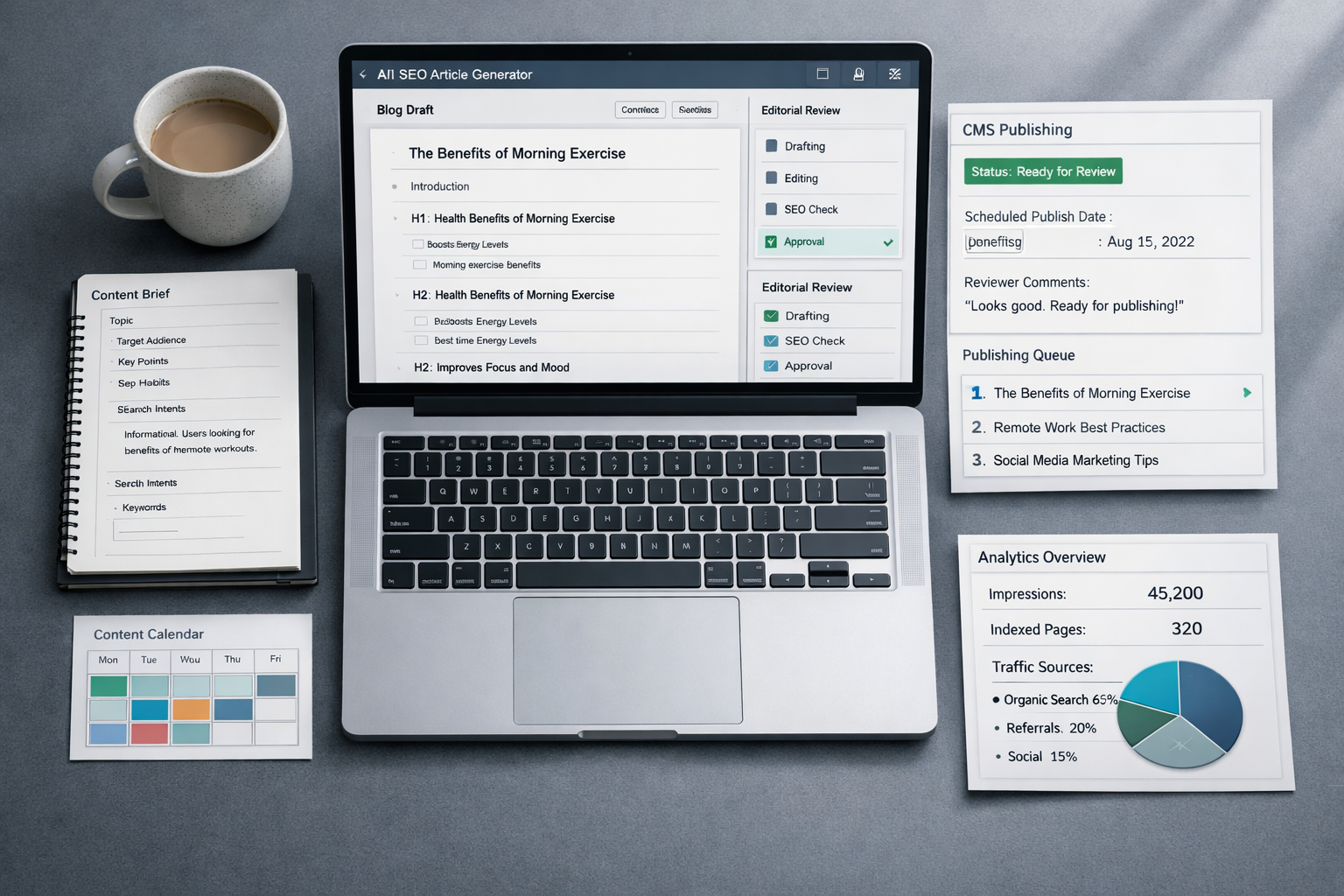
Generating a draft is not the same as getting it live. A generator that dumps text into a spreadsheet still requires someone to format, upload, and schedule it in WordPress or Shopify — and that manual step is exactly where the three-month abandonment pattern starts again.
Automated Publishing to CMS
The fix is direct integration. DraftSEO.ai connects to popular CMS platforms so finished articles publish straight to your site on schedule, with formatting, headings, and images intact, instead of sitting in a queue waiting on someone to copy and paste. For a WordPress site owner running five client blogs through an agency, that difference is the gap between a system and a chore.
Why Zero-Review Publishing Is a Mistake
Publishing automatically does not mean publishing unreviewed. Google's quality guidance (the E-E-A-T framework — experience, expertise, authoritativeness, trust) rewards content that reads as written by someone who knows the subject, and a pure autopilot workflow with no human check can quietly drift into generic filler or factual errors nobody catches until a customer flags it.
A workable review workflow looks like this in practice:
- Generate the draft from a keyword and brief.
- Skim for factual accuracy, especially numbers, prices, and named entities.
- Run an originality check to confirm nothing duplicates existing content on the site or elsewhere.
- Confirm internal links point to real, relevant pages rather than generic anchors.
- Approve for the scheduled publish slot, or hold it back one cycle.
That review step takes minutes per article, not hours, but skipping it entirely is how AI content earns its reputation problem.
SEO Optimization Isn't Automatic Just Because AI Wrote It

Text generated by an AI model is not automatically optimized for search. Optimization is a separate layer — keyword placement, header structure, internal linking, meta descriptions — that has to be built into the generation process, not assumed as a side effect of fluent writing.
The Structural Checklist Behind Every Ranking Post
A properly structured article targets one primary keyword and a handful of related terms pulled from actual search data, places them in the title, H1, and early paragraphs, and organizes H2/H3 headings around the sub-questions a searcher has. Internal links to relevant existing pages on the site also matter more than most non-technical marketers assume — they're one of the few ranking signals a site owner fully controls.
Bulk Generation Without Losing Relevance
Batch-generating 20 or 30 articles at once is efficient, but only if each targets a distinct keyword tied to genuine search intent. Publishing 30 articles that all compete for the same three terms doesn't multiply traffic — it just splits it. More posts helps only when each one covers new ground a reader is actually searching for.
| Approach | Time to publish (per article) | Cadence risk | SEO structure included |
|---|---|---|---|
| Manual writing, in-house | 3-6 hours | High (drops off after busy weeks) | Depends on writer's skill |
| Freelance writer | 2-4 days turnaround | Medium (depends on contract renewal) | Varies by brief quality |
| Article generator, unmanaged | Minutes | Low, but quality risk if unreviewed | Only if the tool builds it in |
| Article generator, reviewed workflow | Same day with a short review pass | Low | Built into keyword and outline step |
If you're deciding whether to try one of these platforms, doing it without commitment is the lower-risk path. DraftSEO.ai offers a free trial with starting credits, so you can generate and publish a handful of articles through the pricing page at https://draftseo.ai/pricing before deciding whether the cadence and quality hold up for your site.
Frequently Asked Questions
Will Google penalize AI-generated blog posts?
No, not for being AI-written specifically. Google's public guidance focuses on quality and usefulness, not the tool used to produce it — penalties come from thin, duplicate, or misleading content, which an unreviewed batch job can easily produce.
How many articles per month actually move rankings?
There's no fixed number; it depends on your site's existing authority and competition level. A steady 10-30 well-targeted articles a month, each covering a distinct keyword and intent, outperforms an irregular schedule of sporadic bursts.
Can an article generator replace an SEO strategist?
No. It executes a content plan faster than manual writing, but someone still needs to pick keywords, define site structure, and prioritize which topics matter before generation starts.