Sep 20, 2026

The ROI of SEO: How to Measure SEO ROI (with Formulas)
DraftSEO Team
Marketing budgets get cut fast when nobody can prove where the money went. A 2023 Gartner survey found CMOs planned to spend a smaller share of revenue on marketing than the year before, and SEO is usually first on the chopping block because its payoff isn't obvious month to month. Tying seo and roi together with real numbers is the only way to defend the budget line, and it starts with treating organic traffic as a financial asset, not a vanity metric.
Most teams can quote traffic growth. Few can quote what that traffic is actually worth in dollars, or what it cost to get there.
The SEO ROI Formula and Why Traffic Growth Isn't ROI
SEO ROI equals (value generated from organic traffic minus cost of SEO) divided by cost of SEO, multiplied by 100. It's a percentage, not a traffic count, and confusing the two is the single biggest measurement mistake teams make.
A site that doubles organic sessions from 10,000 to 20,000 a month hasn't proven anything financially. If none of those extra sessions convert into leads or sales, the traffic growth is a cost center, not a return. ROI only exists once traffic gets connected to revenue or lead value.
Turning Traffic Into a Dollar Value
To get value generated, multiply organic sessions by conversion rate, then by average goal value (average order value for ecommerce, or average lead value times close rate for service businesses). A site pulling 20,000 organic sessions at a 2% conversion rate and a $150 average order value generates $60,000 in attributed monthly value.
Where the Cost Side Usually Breaks
Cost of SEO needs to include tool subscriptions (Ahrefs or Semrush, typically $99-$399 a month), any agency retainer, and — the part almost everyone underestimates — writer and editor hours. If a $60,000 result cost $40,000 to produce, ROI is 50%, not the 200%+ figure people assume when they only count the SEO tool bill.
Cost of SEO: Where Agencies and In-House Teams Actually Bleed Money
The real cost of SEO is rarely the software. It's labor, and specifically content production labor, that quietly eats the margin between reported traffic wins and actual profit.
A single 1,500-word optimized article, done properly, involves keyword research, an outline, a draft, editing, and on-page formatting. At a blended rate of $50-$75 an hour across those tasks, that's commonly 4-8 hours of work per article, or roughly $200-$600 in labor alone before a single dollar of tool spend gets added.
The Content Cost Table Nobody Builds
Here's what a monthly content program of 10 articles typically costs when every line is counted, not just the obvious ones.
| Cost Component | Typical Monthly Range |
|---|---|
| SEO tool subscription | $99 - $399 |
| Writer hours (10 articles) | $2,000 - $6,000 |
| Editing and QA | $500 - $1,000 |
| Publishing/CMS management | $150 - $400 |
| Total | $2,749 - $7,799 |
Why Automating Content Cuts the Denominator, Not the Numerator
The ROI formula has two sides, and most SEO advice only touches the traffic side. Cutting labor cost per article, without cutting output or quality, raises ROI directly because the denominator shrinks while the value generated stays the same.
This is the actual lever worth pulling if seo and roi math looks weak. Platforms that automate research, drafting, and publishing — including tools like DraftSEO.ai, which generates 30 articles a month per connected site — change the cost side of the equation instead of asking traffic to grow faster. Teams evaluating that trade-off can compare current per-article labor spend against a flat monthly plan on the DraftSEO.ai pricing page before committing.
Attribution, Timeline, and LTV: The Three Numbers That Distort ROI

Three inputs wreck SEO ROI calculations more than any other mistake: using last-click attribution only, expecting returns in weeks, and ignoring customer lifetime value.
Last-click attribution credits whatever channel closed the sale, usually a branded search or a direct visit, even when organic content brought the customer in three weeks earlier. Google Analytics 4's default reporting still leans this way unless you build a comparison view. Switching to a data-driven or position-based model in GA4, or cross-referencing Search Console's query data with the assisted-conversion paths, recovers credit SEO earns but never gets counted for.
Timeline expectations are the second distortion. SEO ROI on a time-to-ROI basis realistically runs 6-12 months for a new content program, sometimes longer in competitive B2B or ecommerce verticals. Judging a campaign at 60 days and calling it a failure is a measurement error, not a strategy failure.
Why LTV Changes the Whole Calculation
Average order value understates SEO's return for any business with repeat customers. If a $150 first purchase leads to $450 in lifetime spend across 12 months, the true value-generated figure in the ROI formula should use $450, not $150. This single swap can turn a mediocre-looking 40% ROI into something closer to 300%.
SEO ROI vs. PPC ROI: Different Curves, Different Math
PPC ROI is nearly instant and stops the moment spend stops. SEO ROI compounds: an article ranking on page one in month 8 can still be generating leads in month 24 with no added spend. Comparing the two on a single-month basis always makes PPC look better and SEO look worse, which is the wrong comparison to run.
A Practical Sequence for Calculating and Reporting SEO ROI
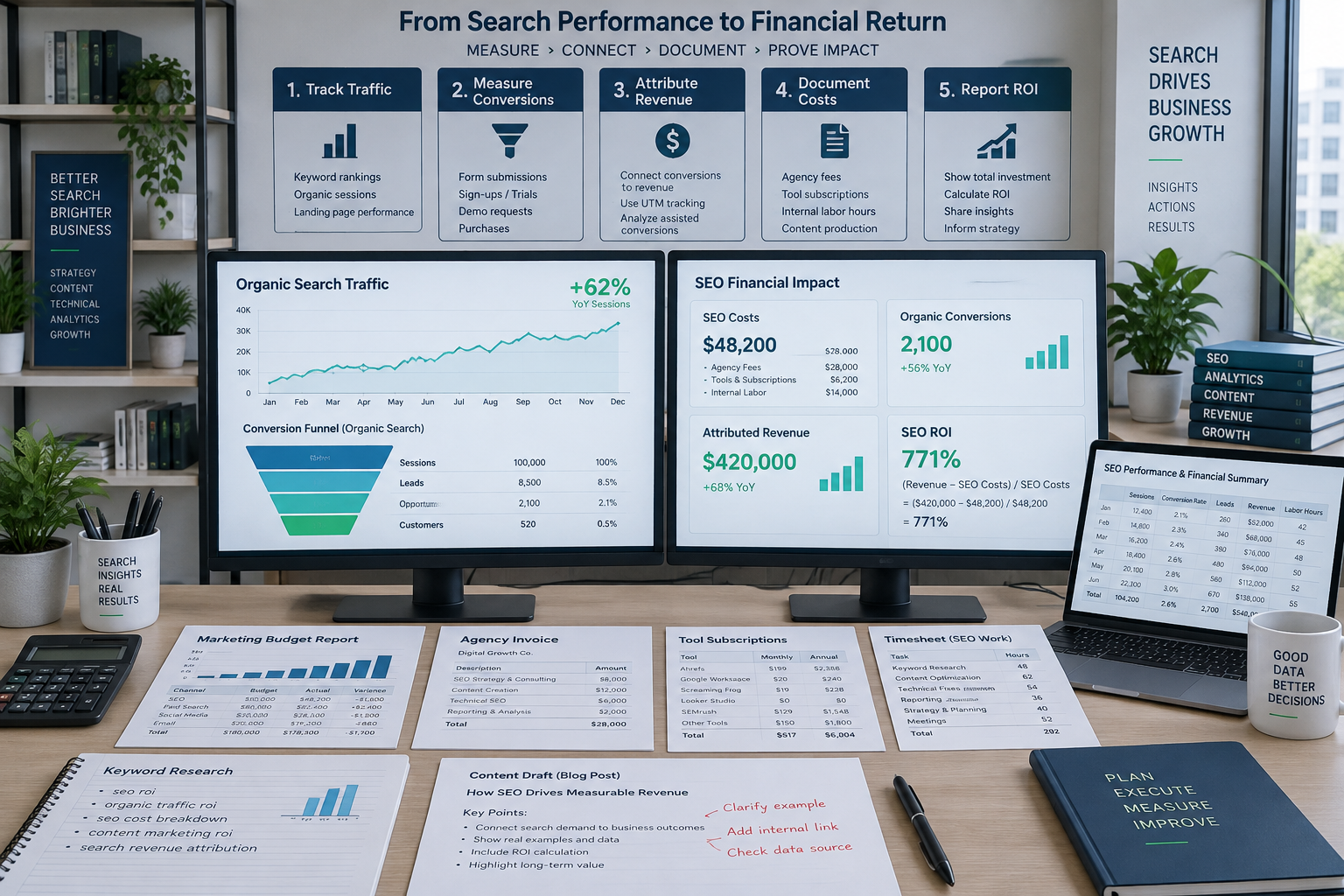
Reporting ROI credibly to a client or a CFO means following the same sequence every time, so the numbers are defensible when questioned.
- Pull organic sessions and goal completions from Google Analytics and Search Console for the reporting period.
- Calculate value generated: sessions × conversion rate × average order value (or lead value × close rate).
- Swap in customer lifetime value where repeat purchase data exists.
- Total the true cost of SEO: tools, labor hours at loaded rate, agency fees, and content production.
- Apply the ROI formula: (value − cost) ÷ cost × 100.
- Compare the result against the 6-12 month baseline, not a 30-day snapshot.
- Re-run the calculation monthly to track the compounding curve, not a single data point.
Skipping step 3 is the most common shortcut, and it's the one that most understates SEO's actual return.
Once the formula is running cleanly, the fastest way to improve the ratio is scaling output without scaling the labor bill. Teams testing that approach can start with a free trial that includes initial credits on the DraftSEO.ai pricing page to see how the cost side of the ROI equation shifts before committing to a monthly plan.
Frequently Asked Questions
How long does it take to see positive ROI from SEO?
Most campaigns take 6-12 months to show clear positive ROI, with competitive B2B or ecommerce niches sometimes running closer to 12-18 months. Judging results before month 6 usually produces a false negative.
What's a realistic SEO ROI percentage to expect?
There's no universal benchmark, but many well-run programs land between 100% and 300% ROI once labor costs and lifetime value are counted accurately, rather than the inflated figures produced when only tool subscriptions are counted as cost.
Does SEO ROI outperform PPC ROI long-term?
Usually yes, because SEO traffic continues after you stop paying for content, while PPC traffic stops the moment ad spend stops. PPC still wins on speed for anyone needing conversions within days rather than months.