Sep 29, 2026

ROI and SEO: Measuring Organic Growth in 2026
DraftSEO Team
Google's own data shows AI Overviews now appear on more than half of informational searches in the US, and a meaningful chunk of those users never click through at all. That single shift is why so many ROI and SEO conversations stall in 2026: the traffic you can count is shrinking, even as the search itself keeps doing commercial work. If you're building a case for budget, you need a model that accounts for value earned before a click, not just after one.
That means rethinking what "measuring ROI" even asks of your reporting stack, and it means admitting that last-click revenue was never the full picture to begin with.
Why Last-Click Attribution Undercounts Organic Search
Last-click models assign 100% of conversion credit to whatever channel closed the sale. If someone reads your blog post in March, sees a paid ad in April, and buys after a direct visit in May, organic gets nothing. That's not a rounding error — it's a systemic undercount of organic's actual contribution.
Assisted Conversions Tell a Different Story
GA4's path reports and assisted conversion data (available through Explorations) show how often organic search appears earlier in a multi-touch journey without landing the final click. In most B2B and considered-purchase B2C sites, organic assists on 20-40% more conversions than it directly closes. If you're only reporting last-click organic revenue to stakeholders, you're likely handing them a number that's meaningfully too low.
Data-Driven Attribution as the Practical Fix
GA4's default model since 2023 has been data-driven attribution (DDA), which uses machine learning to distribute credit across touchpoints based on actual conversion patterns on your property. It's not perfect, but it's a real improvement over last-click, and it's already built into standard GA4 reporting — so there's no excuse for a mature program to still be quoting last-click figures in a board deck.
The Zero-Click Problem: Measuring Value You Can't See in Analytics
A growing share of organic value now happens before anyone lands on your site. AI Overviews, featured snippets, and chat-based answers (including ChatGPT citing your content) can build brand awareness, answer a question, and influence a later branded search — all without a single session in GA4.
You can't fully attribute this in a standard analytics tool, but you can approximate it. Track branded search volume over time in Google Search Console; a rising trend after you start ranking in AI Overviews for a topic is a reasonable proxy for pre-click influence. Some teams also run brand-lift-style surveys asking new customers "how did you hear about us," which still catches organic sources analytics misses entirely.
The honest position here is that zero-click ROI is directional, not precise. Treat it as a supporting signal alongside hard conversion data, not a replacement for it.
Building an ROI Formula That Actually Reflects Cost
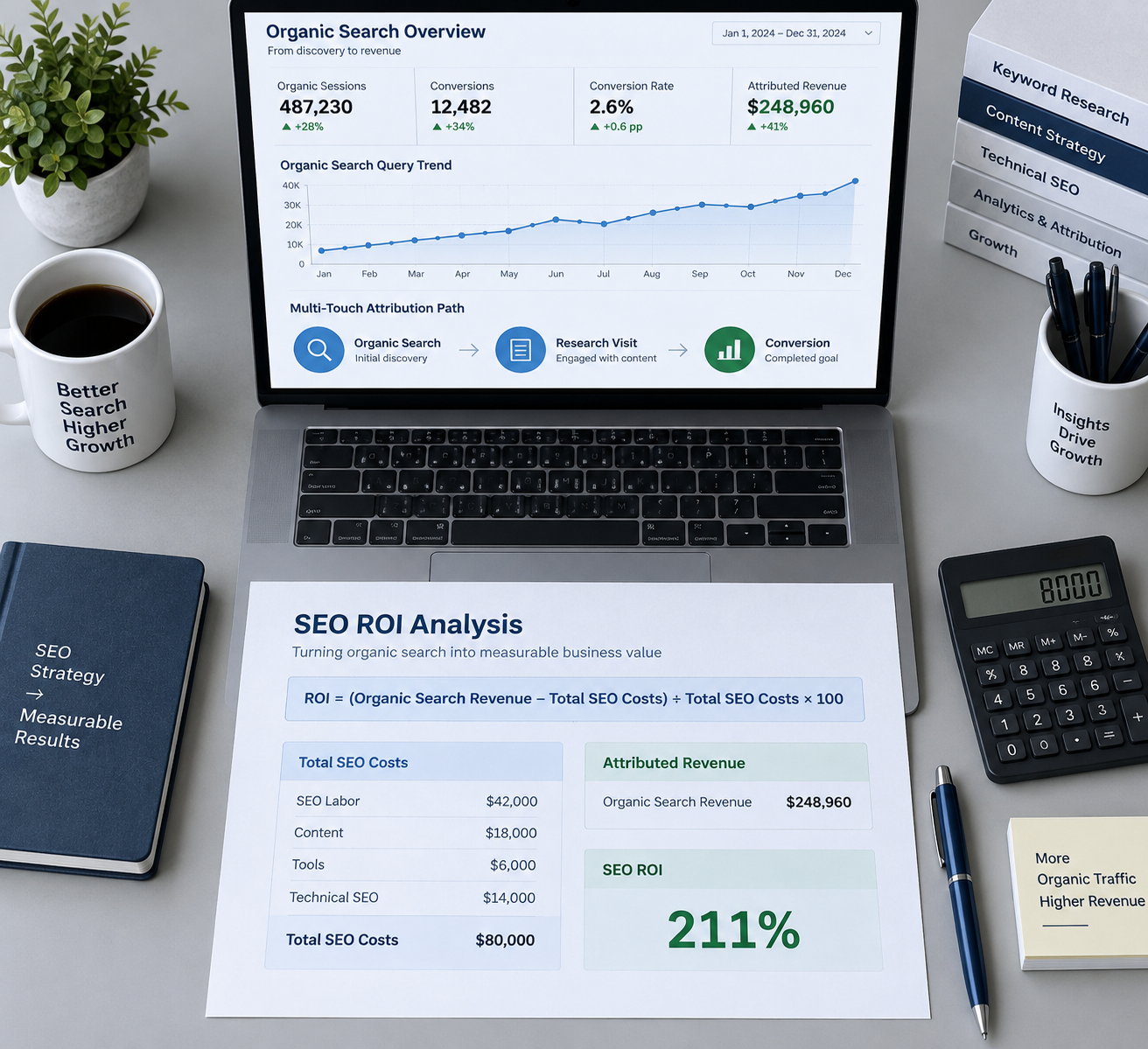
The most common mistake in SEO reporting isn't the attribution model — it's leaving costs off the ledger entirely. Treating traffic or rankings as ROI, instead of revenue, inflates results and erodes trust the first time a CFO asks for the math.
A workable formula looks like this:
ROI = (Organic Revenue − Total SEO Cost) / Total SEO Cost × 100
Total SEO Cost needs to include everything, not just headline agency fees:
- Content production (writers, editors, freelancers, or a content platform's monthly cost)
- SEO tooling (rank trackers, technical audit tools, keyword research platforms)
- Internal staff time (in-house SEO, dev hours for technical fixes)
- Any paid promotion supporting content distribution
- CMS or hosting overhead directly tied to content publishing
| Cost Category | Typical Monthly Range (US, mid-size site) |
|---|---|
| Content production | $2,000 – $8,000 |
| SEO tooling | $200 – $1,500 |
| Technical/dev support | $500 – $3,000 |
| Distribution/promotion | $0 – $2,000 |
One place to cut this ledger down without cutting output is content production cost itself. Teams that automate the drafting stage — using a platform like DraftSEO.ai's pricing plans to generate a set volume of SEO-structured articles monthly — often move that biggest line item from a variable freelancer spend to a fixed, predictable subscription cost, which makes the ROI formula easier to defend quarter over quarter.
Time-to-ROI: Why 4-6 Months Is the Realistic Floor
Expecting SEO ROI in six weeks is the second most common reporting failure, right behind ignoring costs. Google needs time to crawl, index, and trust new content, and rankings for competitive terms typically take 3-6 months to stabilize even when the content is solid.
Add in the fact that 2026's SERP volatility (Google rolled out several core updates this year, and AI Overview placement keeps shifting) means rankings can swing before they settle. A realistic model expects break-even somewhere between month 4 and month 9, depending on competition level and domain authority. Reporting weekly "ROI" numbers during that window sets up a program to look like a failure when it's actually on track.
Scaling Output Without Losing Measurement Discipline

Once your formula works, the next constraint is usually production volume, not strategy. Publishing consistently — enough content to compound organic visibility across a wider set of keywords — is what turns a break-even quarter into a genuinely profitable one, and it's the stage where a lot of internal teams hit a bottleneck.
If your team wants to test whether higher content velocity moves the ROI needle without committing to a bigger contract, DraftSEO.ai offers a free trial with starting credits, letting you run a batch of articles through your own tracking setup before deciding on a paid plan.
Frequently Asked Questions
How do you calculate ROI for SEO?
Subtract total SEO cost (content, tools, staff time, promotion) from organic revenue, divide by total cost, and multiply by 100. The result is a percentage; a positive number above your target margin signals a profitable channel, not just growing traffic.
How long does it take to see ROI from SEO?
Most sites see measurable ROI between 4 and 9 months, depending on competition and existing domain authority. Expecting returns inside 6-8 weeks is the most common reason stakeholders lose confidence in a program that's actually performing normally.
Does AI Overview visibility count toward SEO ROI?
Not directly in most analytics tools, since many AI Overview interactions generate no click. Track branded search growth in Search Console as a proxy signal, and treat it as supporting evidence alongside hard conversion data, not a standalone ROI metric.