Aug 25, 2026

Sentence Generator Free for Blog Ideas in 2026
DraftSEO Team
Google's algorithm updates in 2024 and 2025 pushed thin, AI-spun content further down the results page, yet the demand for fresh blog topics hasn't slowed at all. A sentence generator free of cost solves a narrow problem: it breaks writer's block by spitting out a line you can react to, argue with, or rewrite. That's genuinely useful. The catch is what happens next, because a sentence isn't an article, and treating it like one is how content teams waste a Tuesday afternoon.
For SEO teams and agencies managing dozens of client sites, the real question isn't whether these tools work. It's where they belong in a workflow that has to produce ranking pages, not just interesting first lines.
What a Free Sentence Generator Actually Does
A sentence generator free tool takes a seed word, topic, or keyword and produces one or more grammatically complete sentences using pattern templates or a lightweight language model. It's not writing an article — it's producing a single spark, usually in under a second, with zero cost and no login required in most cases.
Tools in this category range from simple template-based generators (fill-in-the-blank sentence structures pulled from a database) to lightweight AI writing assistants that use a small language model to generate more natural phrasing. The template kind is faster but repetitive after a few tries. The AI-based kind reads more naturally but can drift off-topic if the seed keyword is vague.
Either way, the output is raw material. It has no SEO structure, no header hierarchy, no internal linking, and often no factual grounding at all. Feeding a generated sentence directly into a blog post without editing is how brand voice gets diluted and how factual errors slip past review — the tool doesn't know your product, your audience, or your last three blog posts.
Where the Free Tier Usually Stops
Most free sentence generators cap you at short single-line outputs, sometimes with a daily limit around 10 to 20 generations before they nudge you toward a paid tier. That's fine for topic brainstorming. It's not designed to produce a 1,500-word article, and no free sentence tool on the market claims otherwise in its actual feature list.
Free vs. Paid Sentence and Content Generators: What Changes
The jump from free sentence generator to paid content generator is about scope, not just polish. Free tools give you isolated sentences or short snippets. Paid tools — especially ones built specifically for blogging — handle keyword research, outline structure, full drafts, and often publishing.
| Feature | Free Sentence Generator | Paid AI Content Platform |
|---|---|---|
| Output length | 1 sentence to a short paragraph | Full articles, 800–2,500+ words |
| SEO structure (headers, meta) | None | Built in |
| Keyword targeting | Manual, one seed word | Keyword research often included |
| Publishing | Copy/paste only | Direct CMS integration in most tools |
| Typical cost | $0 | Monthly subscription |
The mistake I see most often is expecting a free sentence generator to close that entire gap on its own. It won't, and no amount of clever prompting changes that — the architecture behind a one-line generator simply isn't built to hold a keyword strategy, a content brief, and a publishing schedule at once.
Turning One Sentence Into a Full Blog Idea Pipeline

The actual bottleneck in content production isn't generating a spark line. It's what happens in the hours after that spark — researching the angle, structuring the outline, writing 1,000+ words that satisfy search intent, and getting it published without someone manually formatting it in WordPress at 11 p.m.
A workable sequence looks like this:
- Generate 10-15 candidate sentences from a free sentence generator using your target keyword as the seed.
- Scan for the two or three that suggest a genuine angle rather than a generic restatement of the keyword.
- Run each surviving idea through a quick search-intent check — does it match what someone typing that phrase into Google actually wants?
- Turn the strongest angle into a working title and a rough section outline.
- Hand that outline to a full article-writing process, whether that's a writer, an editor, or an automated content platform.
- Publish and monitor how the piece performs before repeating the cycle.
This is where scaling sentence ideas into full articles becomes the real work. A content team generating five blog ideas a week from a free tool still needs someone — or something — to turn those five sparks into five publish-ready, SEO-structured articles, and that's usually where the process bogs down for small teams and solo site owners alike.
Common Ideation Mistakes to Avoid
Publishing generated sentences verbatim is the fastest way to end up with a site full of interchangeable, voiceless pages. Search engines and human readers both notice. Another frequent error is confusing a random sentence generator with an AI content generator built for blogging — they solve different problems, and swapping one for the other creates a gap in the middle of your workflow that nobody planned for.
Scaling Blog Ideation Without Burning Out Your Team
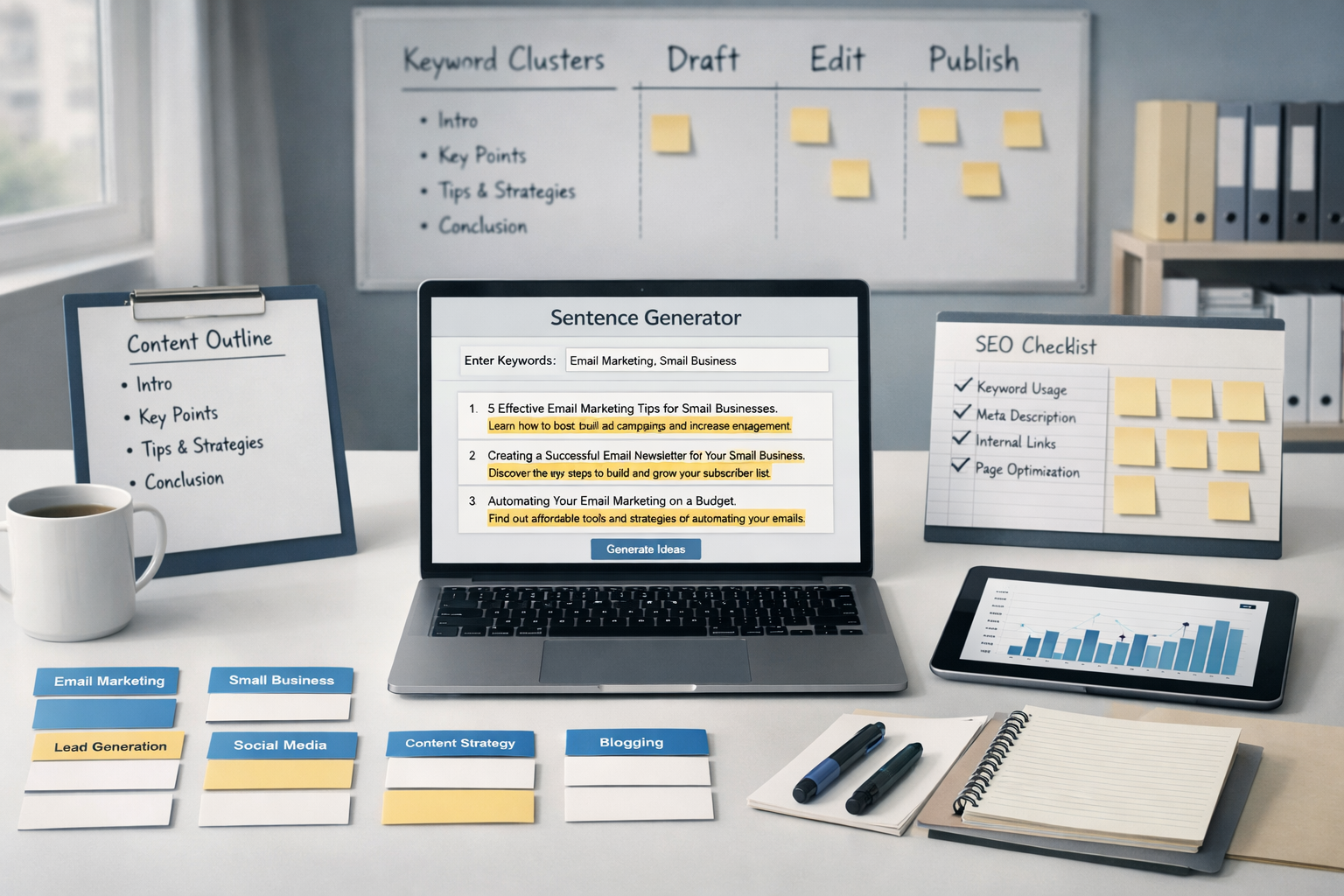
Manually running seed keywords through a free generator, filtering results, and briefing writers works fine at a volume of two or three posts a month. It falls apart past that. Agencies managing ten or more client sites need a pipeline that goes from keyword to published article without a human touching every step.
This is the gap DraftSEO.ai is built to close. The platform takes a niche or topic input and generates full SEO-structured articles automatically, producing 30 articles per month for each connected site and publishing them directly through CMS integrations rather than leaving drafts sitting in a queue. It skips the manual hand-off between "here's an idea" and "here's a live page" that trips up teams relying only on brainstorming tools.
For a content creator or agency, the practical shift is going from ideation-as-a-task to ideation-as-an-input. The sentence generator, or any brainstorming step, still has a place — it's a fast, free way to test angles before committing resources. What changes is not treating that spark as the finish line.
If you're testing whether automated blog content generation fits your workflow, DraftSEO.ai offers a free trial with starter credits, and current plans are listed on the DraftSEO.ai pricing page if you want to see what a full monthly output looks like before committing.
Frequently Asked Questions
Can a free sentence generator write an entire blog post for me?
No. It produces isolated sentences or short snippets, not a structured article with headers, SEO formatting, or search-intent alignment — you still need a separate writing or automation step to get to a publish-ready page.
Are AI sentence generators different from AI content generators?
Yes. A sentence generator focuses on single-line output for brainstorming, while an AI content generator handles full drafts, outlines, and often keyword targeting and publishing — they're built for different stages of the same workflow.
How do I know if a generated sentence is worth turning into a full article?
Check it against real search intent first. If the sentence suggests an angle someone would actually type into Google, and it's not just the keyword restated, it's worth outlining into a full piece.