Sep 5, 2026

Sentence AI Generator for SEO-Ready Copy
DraftSEO Team
Google's own guidance on helpful content, updated repeatedly since the September 2023 "helpful content update," makes one thing clear: content produced entirely by automation with no human review gets flagged as low-value. That matters if you're evaluating a sentence ai generator for production work. These tools write fluent, grammatically correct sentences fast, but fluency and search visibility are not the same thing.
For SEO teams, the real question isn't whether the sentence sounds natural. It's whether that sentence fits inside a workflow built for ranking, and that means treating the generator as one gear in a bigger machine rather than the whole engine.
What a Sentence AI Generator Actually Does
A sentence ai generator uses a large language model trained on huge text corpora to predict the next most likely word in a sequence, producing sentences that read as if a person wrote them. It doesn't "know" facts the way a person does. It's pattern-matching probability, which explains both its strengths and its failure points.
Natural Language Generation vs. Sentence Rewriting
Natural language generation (NLG) builds a sentence from scratch based on a prompt or data input. Sentence rewriting tools take an existing sentence and produce variations, changing structure, tone, or word choice while keeping the meaning intact. Tools like Grammarly's rewrite feature or QuillBot lean toward the second category; general-purpose models like GPT-4 or Claude can do both depending on the prompt.
Where the Line Sits Between Useful and Risky
The output is useful for varying sentence structure, tightening a clunky paragraph, or generating a first-pass draft sentence around a target keyword. It gets risky the moment you trust it for facts, statistics, or specific claims it wasn't given. These models generate plausible-sounding numbers and citations that don't exist — a known failure mode sometimes called hallucination. Every specific claim needs a human check against a real source before it goes live.
Sentence-Level Tools Can't Carry Full SEO Structure
A sentence ai generator writes sentences. It doesn't build page architecture, internal links, or heading hierarchy, and that gap is where most misuse happens. Treating a sentence tool as a page-builder is the single most common mistake teams make with this category of software.
Ranking pages need H1/H2 structure that matches search intent, internal links distributed with anchor text variety, schema markup where relevant, and a logical flow from problem to answer. None of that lives inside a sentence-level tool, no matter how good the individual output reads. You can generate 50 well-written sentences and still end up with a page that has no clear topical hierarchy and no path for Google to understand what the page is actually about.
This is also where keyword stuffing creeps back in. Ask a sentence generator to include a keyword phrase five different ways in five sentences, paste them into one paragraph, and you get repetitive, robotic-sounding copy that trips both readability checks and Google's spam signals. The fix isn't avoiding the keyword — it's controlling where and how often it appears across a properly structured page, something a sentence tool has no visibility into.
Building It Into a Real Content Pipeline
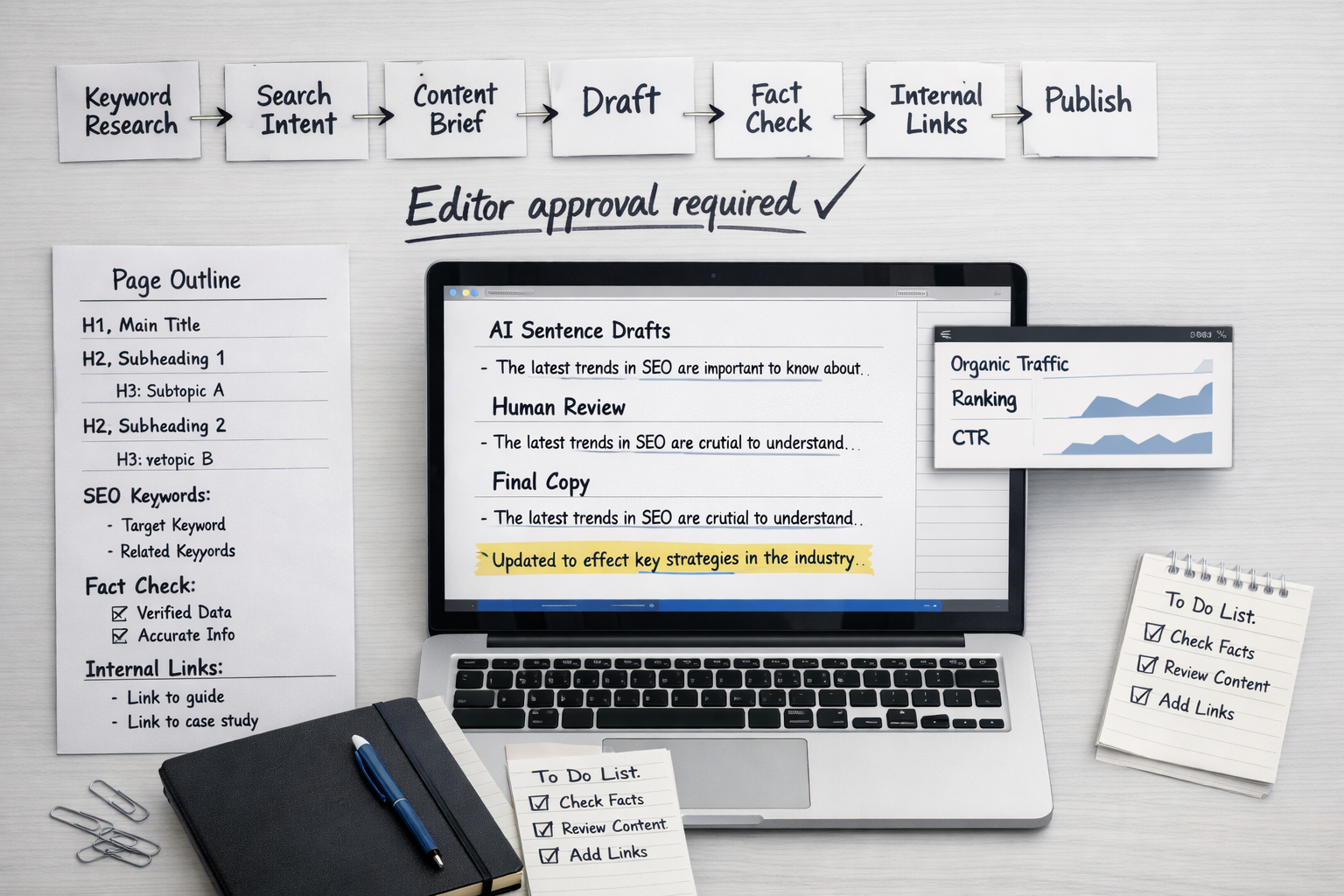
The teams getting value from AI sentence tools use them mid-process, not as the starting or ending point. A workable pipeline looks something like this:
- Keyword and search-intent research to confirm what the page needs to answer.
- Outline and heading structure built around that intent, not around the tool's output.
- Draft generation at the paragraph or article level, with sentence tools used only to punch up specific rough spots.
- Readability pass — checking sentence length variety, passive voice, and reading grade level (tools like Hemingway Editor or the Yoast readability score work here).
- Originality and plagiarism check against tools like Copyscape or Originality.ai.
- Fact-check pass on every number, name, date, or statistic the AI introduced.
- Human edit for tone, brand voice, and internal linking before publishing.
Skipping steps 5 through 7 is how AI-assisted content ends up thin, duplicate-flagged, or just wrong. A sentence generator can absolutely speed up step 3. It has no role in steps 1, 2, or 4 through 7 without human direction.
Where This Fits for Marketers and Agencies at Scale

An agency managing content for a dozen ecommerce clients doesn't need faster sentences — it needs faster pages, published on a schedule, without a writer burning out rewriting product descriptions from scratch every week. That's a different problem than the one a sentence generator solves.
Matching the Tool to the Job
| Task | Sentence-level tool | Full-pipeline platform |
|---|---|---|
| Rewrite one awkward sentence | Good fit | Overkill |
| Vary sentence structure across a paragraph | Good fit | Overkill |
| Research keywords and build article structure | Not built for this | Good fit |
| Publish 20-30 articles per month across a CMS | Not built for this | Good fit |
| Maintain consistent internal linking at scale | Not built for this | Good fit |
Where Full Automation Earns Its Keep
This is the gap a platform like DraftSEO.ai is built to close: it handles research, structure, drafting, and CMS publishing as one connected process instead of stitching together five separate tools by hand. It generates 30 articles a month for a connected site and integrates with popular CMS platforms for publishing, which matters more for agencies juggling multiple client sites than for someone polishing a single landing page sentence. Sentence-level tools still have a place for spot edits, but they were never meant to run the whole pipeline.
If you're weighing whether full automation fits your workload, DraftSEO.ai offers a free trial with starter credits through its pricing page, which is a reasonable way to see whether the output holds up against your own editing standards before committing budget.
Frequently Asked Questions
Can a sentence AI generator write content that's fully ready to publish?
No. It can produce clean, grammatically sound sentences, but it can't verify facts, build page structure, or guarantee brand tone. Every AI-generated sentence needs a human fact-check and edit pass before it goes live on a ranking page.
Will using AI sentence tools get a page penalized by Google?
Not automatically. Google's guidance targets low-quality, unedited mass content, not AI use itself. Thin, repetitive, or unverified AI copy is the actual risk factor, not the tool used to draft it.
How is a sentence generator different from a full AI content platform?
A sentence generator works on one sentence or paragraph at a time. A full platform like DraftSEO.ai handles keyword research, structure, and CMS publishing for entire articles, producing around 30 posts per month per connected site instead of isolated lines of text.