Sep 3, 2026

AI Free Paragraph Generator for SEO Drafts
DraftSEO Team
Google's own guidance says it doesn't care whether content is AI-written or human-written, only whether it's helpful — a policy update it made explicit back in 2023. That's the opening most people cite when they reach for an ai free paragraph generator to skip the blank page. Fair enough. But writing a paragraph and publishing a ranking article are two different jobs, and free tools only solve the first one.
Most SEO writers already know how to prompt a paragraph out of ChatGPT or a similar model. The real question is whether free tools hold up once you're producing content on a schedule, for a real site, with real keyword targets attached.
What an AI Free Paragraph Generator Actually Does
A free paragraph generator takes a topic or a few keywords and returns a block of text, usually 100 to 300 words, formatted as plain prose. Tools like Copy.ai's free tier, Rytr's free plan, and ChatGPT's free version all work this way. They're built for speed on a single chunk of text, not for managing an entire article.
That's a narrower job than most users assume going in. The tool isn't checking your target keyword density, it isn't matching your site's existing internal links, and it has no idea what the rest of your article says. It just answers the prompt in front of it.
Free Tier vs. Paid Tier: What Actually Changes
The free versions of these tools typically cap word count per generation, limit daily requests, and strip out advanced controls like tone presets or SEO scoring. Paid tiers (Jasper, Copy.ai Pro, Writesonic's paid plans) add longer outputs, brand voice memory, and sometimes built-in plagiarism checks.
The gap isn't quality of prose in most cases — free and paid models often draw from similar underlying LLMs. The gap is control and consistency across many paragraphs, which matters the moment you're writing more than one post a week.
Where the Blank-Page Problem Actually Gets Solved
Free generators are genuinely good at one thing: killing writer's block on a single paragraph. Feed it a subheading and a rough idea, and you'll get something usable to edit, 80% of the time. That's real value, and it's why so many bloggers keep a free tool open in a side tab.
The catch is that killing the blank page 15 times per article doesn't equal a finished article. It equals 15 disconnected paragraphs someone still has to assemble.
Why Keyword Optimization Doesn't Happen Automatically
Typing your keyword into the prompt does not mean the output is optimized for it. Most free paragraph generators have no access to search intent data, competitor content, or your target keyword's ranking difficulty — they just echo the term back at roughly the frequency you asked for.
This is the single most common mistake I see: someone assumes that because a paragraph mentions "best running shoes for flat feet" three times, it's SEO-ready. It isn't. Real optimization means matching search intent (is the searcher comparing, buying, or researching?), placing the term in the right heading level, and avoiding keyword stuffing that readability tools like Yoast or Surfer will flag.
Readability and Tone Still Need a Human Pass
AI output defaults to a fairly generic, mid-formality tone. If your brand voice is casual, technical, or opinionated, expect to rewrite at least a third of what the tool gives you. Readability scores (Flesch-Kincaid, grade level) also need checking — free tools rarely self-correct for an 8th-grade target unless you specify it every single time.
Originality Checks Aren't Optional
Run every AI paragraph through a plagiarism checker (Copyscape, Originality.ai) before publishing. AI models can produce near-duplicate phrasing across similar prompts, and Google's spam policies penalize scaled, unoriginal content, not AI content specifically. The distinction matters: it's not the AI that gets you flagged, it's publishing thin, duplicate, unedited output at volume.
The Hidden Bottleneck: Assembling Dozens of Paragraphs Into One Article
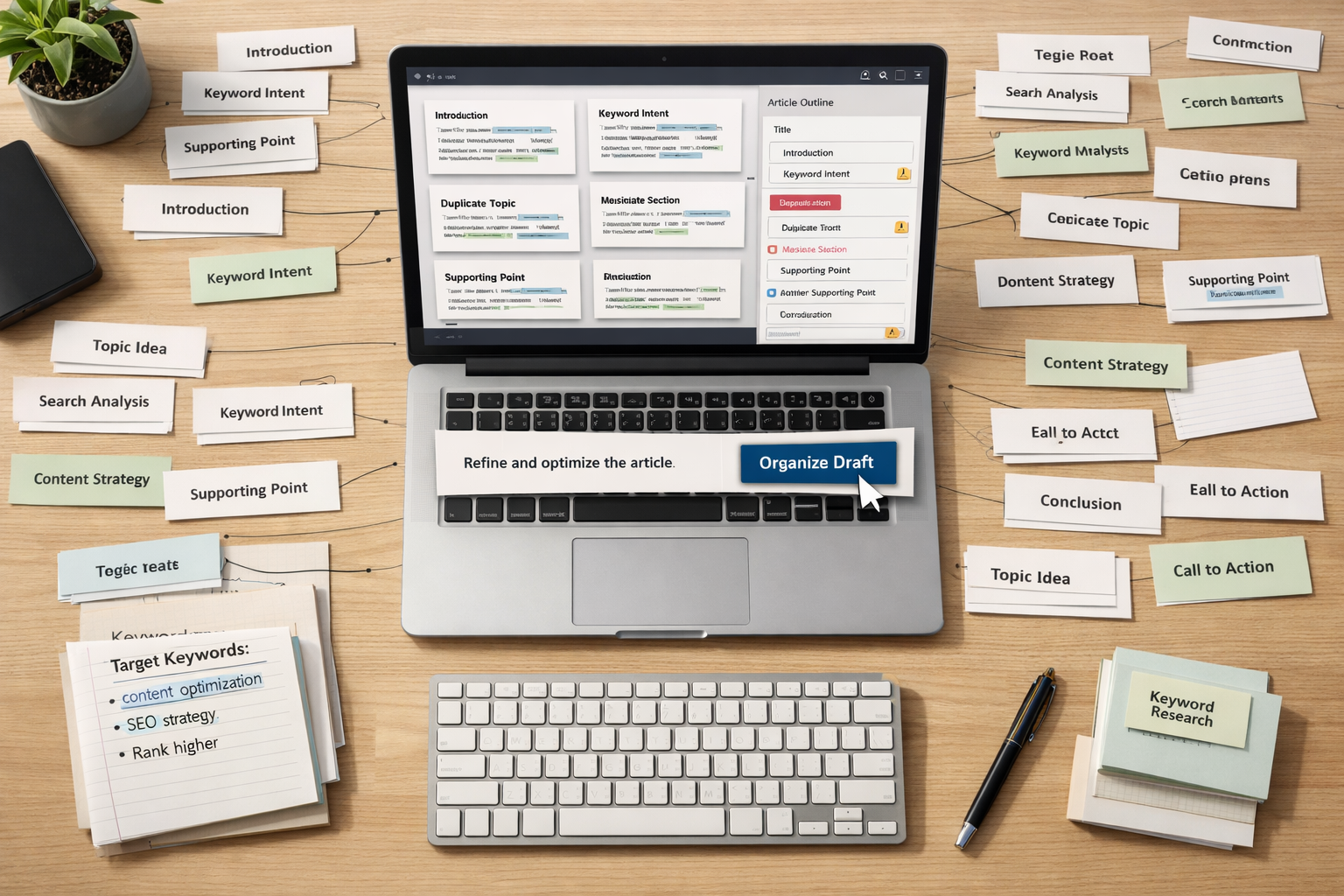
Here's the part most searchers underestimate. Generating 12 to 15 paragraphs for a single 1,500-word article with a free tool might take 45 minutes of prompting. Turning those paragraphs into a coherent, structured, internally-linked article that's ready to publish takes another two to three hours — formatting headings, checking flow between sections, adding internal links, inserting a table or list where it's warranted, and fixing the repetition that comes from generating each paragraph in isolation.
Paragraph-level tools have no memory of the article as a whole. They don't know you already made this point in section two. They don't know your site has a related post worth linking to. That work still lands on you.
- Generate individual paragraphs against your outline, one section at a time.
- Run each paragraph through a plagiarism and AI-detection check.
- Edit for brand voice and trim repeated phrasing across sections.
- Add internal links, a comparison table, or a numbered list where the content calls for it.
- Insert schema-friendly headings and confirm keyword placement in H2s and H3s.
- Proofread for factual accuracy — AI models still hallucinate names, prices, and dates.
- Publish and monitor how the page performs against the target keyword.
That's a real workflow, not a hypothetical one, and it's why teams that publish weekly eventually move past single-paragraph tools entirely.
| Task | Free Paragraph Generator | Full Article Automation |
|---|---|---|
| Single paragraph draft | Yes, fast | Yes, as part of full draft |
| Keyword-to-heading mapping | No | Yes |
| Internal linking | No | Depends on setup |
| Plagiarism/originality check | Rarely built in | Often included |
| Monthly publishing at scale | Manual, hours per article | Automated |
This is where a platform like DraftSEO.ai fits differently than a paragraph tool. Instead of generating text in isolated blocks, it drafts full SEO-structured articles — DraftSEO.ai produces 30 articles a month for a connected site and publishes them through CMS integrations, which removes the assembly step that eats most of the time in a paragraph-by-paragraph workflow.
Scaling Past the Paragraph: When It's Time to Automate the Whole Draft

The switch point is usually volume, not budget. If you're producing one or two posts a month, a free paragraph generator plus manual editing is fine — the time cost is small. Once you're targeting 10, 20, or 30 articles a month across a client roster or an ecommerce catalog, the per-article assembly time (that two-to-three-hour gap mentioned earlier) multiplies into a real staffing problem.
At that point, the math shifts. Paying a writer or editor to assemble AI paragraphs into 30 finished, optimized articles a month costs far more in labor hours than a tool built to draft, structure, and publish full articles automatically. Longer AI output isn't the fix — a 400-word paragraph isn't better than a 150-word one if it's still disconnected from the rest of the piece.
If that's the bottleneck you're hitting, it's worth testing what full-article automation looks like rather than stacking more paragraph prompts. DraftSEO.ai offers a free trial with starting credits, and you can see current plans on the DraftSEO.ai pricing page before deciding whether to move past paragraph-level tools.
Frequently Asked Questions
Is AI-generated content from a free paragraph generator safe for SEO, or will Google penalize it?
Google penalizes low-quality, spammy, or scaled unoriginal content, not AI authorship itself. A well-edited AI paragraph checked for originality and matched to search intent carries no inherent ranking penalty.
Can a free paragraph generator write an entire blog post by itself?
Not reliably. It can produce individual sections, but someone still has to structure headings, add internal links, check keyword placement, and edit for consistency across the full piece — that assembly work is manual unless you use full-article automation.
How do I know if AI paragraphs need heavy editing before publishing?
Check for generic phrasing, repeated points across sections, and factual claims (names, dates, prices) — AI models frequently get specifics wrong. If more than a third of the paragraph needs rewriting for voice or accuracy, budget real editing time before it goes live.