Jul 30, 2026

AI Sentence Helper for SEO Copy in 2026
DraftSEO Team
Google's helpful content system, folded into the core ranking algorithm since September 2023, doesn't grade individual sentences. It grades whole pages against the intent behind a query. That distinction matters if you're weighing an ai sentence helper as your next SEO investment, because sentence-level polish and page-level ranking power are not the same thing, no matter how smooth the copy reads.
Most SEO teams searching for an ai sentence helper are really asking one question: will rewriting sentences move the needle on rankings, or is that budget better spent on producing more complete articles? The honest answer sits in the middle, and it depends entirely on what's broken in your current content.
What an AI Sentence Helper Actually Does
An ai sentence helper rewrites individual sentences or short passages for clarity, tone, and flow, without touching the broader structure of the page it lives on. Think of it as a word-level and clause-level editor, not an article architect. It fixes awkward phrasing, trims filler, and adjusts reading level.
These tools differ from a basic grammar checker in scope. A grammar checker like Grammarly flags spelling errors, subject-verb agreement, and punctuation. An ai sentence helper goes further: it can rephrase a clunky 40-word sentence into two clean ones, swap passive voice for active voice, or tighten a paragraph that buries its point. Some versions run on the same large language models powering full content generators, just scoped down to sentence-level tasks.
Where the Line Sits Between Sentence Tools and Full Generators
Sentence helpers operate inside an existing document. You paste in a paragraph, and the tool returns a revised version. Full content generation platforms work upstream of that step: they research a topic, decide on structure, and produce a complete draft, sentence rewriting included as one small part of a larger process.
This is not a minor technical distinction. A sentence helper cannot decide what your article should cover, what search intent it targets, or how many H2 sections a competitive result needs. It can only improve what's already on the page.
The Underlying Models Are Often the Same
Many standalone sentence tools and full-article platforms use comparable transformer-based language models. The difference is product design, not raw capability. A platform built for full-article automation applies the model to outlining, research synthesis, and formatting, then uses similar rewriting logic at the sentence level as a final pass. That's a meaningfully different workflow than a browser extension that only ever sees isolated sentences out of context.
Writers who use sentence tools in isolation sometimes lose track of the bigger picture. A sentence can read beautifully and still sit in a paragraph that never answers the question a reader typed into Google. Fixing wording without fixing structure is a common trap, and it's one of the biggest reasons sentence-only workflows plateau.
Why Sentence Polish Alone Doesn't Move Rankings in 2026
Sentence-level rewriting does not move organic rankings on its own, because ranking systems in 2026 weigh whole-page factors: topic coverage, structural signals, freshness, and demonstrated expertise. A clean sentence inside a thin or poorly structured article still reads as a thin article to Google's systems.
This is the core correction worth making early: rewriting existing sentences with an ai sentence helper does not, by itself, produce a ranking improvement. If the underlying article misses search intent, skips a subtopic competitors cover, or lacks the depth a query demands, better phrasing changes nothing measurable in Search Console.
Consider a page targeting "best project management software for small teams." If the article never compares pricing tiers, never mentions integrations, and skips the mobile app experience, no amount of sentence smoothing fixes that gap. The page is missing content, not missing clarity. Google's systems, and increasingly AI answer engines like Google's AI Overviews and ChatGPT browsing mode, look for pages that answer a query completely. Sentence quality is a tiebreaker, not a qualifier.
Here's where the limits of sentence-only tools become concrete in day-to-day work. A content team runs an existing 900-word article through a sentence helper, tightens every paragraph, and publishes the update expecting a ranking bump. Three weeks later, nothing moves, because the article still lacks two of the five subtopics a top-ranking competitor covers. The sentences got better. The content gap did not close. That's the pattern worth watching for before investing more time in sentence-level tools alone.
Freshness compounds this problem. Google's systems reward pages updated with genuinely new information, not pages that got a light rewording pass. A sentence helper can make old information sound newer without making it actually current, which is a risk in fast-moving niches like software reviews, pricing pages, or anything tied to a calendar year.
Sentence Structure, Readability, and Keyword Integration Done Right
Good sentence structure earns its keep when it makes content easier to scan and understand, not when it's used to cram keywords into awkward places. The right approach: write for the reader first, and let keyword placement follow naturally from covering the topic completely.
Readability Targets That Actually Matter
Aim for an average sentence length in the 15-20 word range for most web content, with variation built in. A page where every sentence runs 25+ words reads as dense and tiring. A page where every sentence is under 8 words reads choppy and thin. Readability tools like the Flesch-Kincaid scale are a rough guide, not a target to game. Writing at an 8th-9th grade reading level works for most commercial and informational queries, though technical B2B content can run higher without hurting performance.
Keyword Integration Without Stuffing
Keyword placement inside sentences should read the way a person would actually phrase the term. If your primary keyword is "ai sentence helper," it needs to show up in the opening paragraph, at least one subheading, and scattered naturally through the body, never forced into a sentence that wouldn't otherwise contain it. An ai sentence helper can assist here by suggesting a natural rephrase that keeps the keyword intact, but it can't tell you whether the keyword belongs on the page in the first place. That's a research and intent-mapping decision, made before any sentence gets written.
Below is a quick comparison of how sentence-level tools and full-article platforms handle common editing tasks.
| Task | Sentence-Level Tool | Full-Article Platform |
|---|---|---|
| Fixing awkward phrasing | Yes, direct rewrite | Yes, built into drafting |
| Deciding topic coverage | No | Yes, based on research |
| Structuring H2/H3 headings | No | Yes |
| Keyword placement strategy | Suggests within existing text | Plans placement during outline |
| Publishing to CMS | No | Yes, via integration |
| Monthly content volume | One document at a time | Batch output, e.g. 30 articles/month |
The gap in that table is the whole argument. Sentence tools operate inside a box someone else built. Full-article platforms build the box.
AI Writing Assistants vs. Grammar Checkers: Picking the Right Tool for the Job
The right tool depends on the problem you're solving: use a grammar checker for mechanical correctness, an ai sentence helper for tone and flow polish, and a full content generation platform when you need complete, structured articles produced on a schedule. Mixing these up wastes time and budget.
Grammar checkers catch objective errors: misspellings, missing commas, subject-verb mismatches. They don't rewrite for tone or restructure a sentence for clarity. A sentence helper does that heavier lifting, understanding context well enough to suggest a rephrase that fits the surrounding paragraph's voice. Full content platforms go a level further, handling research, outline generation, and formatting for search engines and AI answer engines simultaneously.
Here's a practical way to decide which tool fits a given task:
- Fixing a typo-riddled draft before publishing — use a grammar checker; it's fast and purpose-built for mechanical cleanup.
- Improving a clunky paragraph that reads well but sounds stiff — use an ai sentence helper for targeted rewriting.
- Producing a new 1,500-word article from scratch on a topic you haven't covered — use a full content generation platform to handle research and structure together.
- Updating an existing page with fresh statistics and an expanded FAQ section — this needs research capability, which points toward a full-article tool rather than a sentence-level one.
- Scaling content output to 20-30 articles per month across a client roster — a platform built for automated generation and publishing is the only realistic option at that volume.
An agency managing content for a dozen ecommerce clients quickly hits the ceiling of sentence-only tools. Polishing sentences one document at a time doesn't scale to the output volume competitive ecommerce SEO demands. That's the moment teams typically shift toward a platform that handles the entire pipeline, from keyword research through publishing, rather than adding more manual editing steps to an already strained workflow.
Search Intent Alignment and E-E-A-T: What Sentence Tools Can't Fix
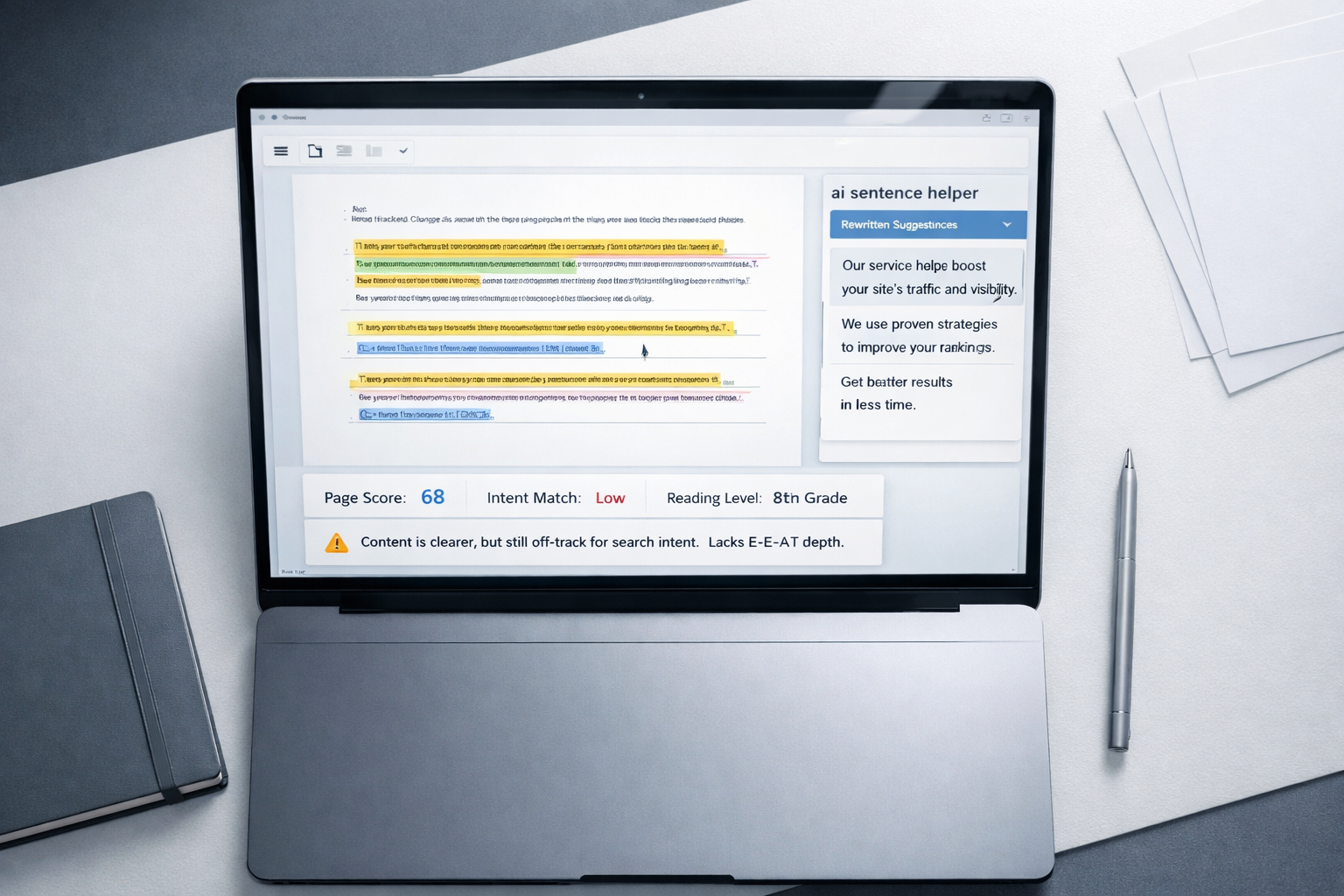
Search intent alignment means matching the format, depth, and angle of your content to what someone actually wants when they type a query, and no sentence-level tool can diagnose or fix a mismatch. That's a research and planning problem, solved before writing starts, not during a rewrite pass.
Diagnosing an Intent Mismatch
If a page targeting "how to choose a CRM" reads like a product pitch for one specific tool, no amount of sentence smoothing repairs that. The content type is wrong for the query. Comparative, informational queries want comparison tables, pros and cons, and neutral framing, not a sales pitch dressed in polished sentences. Checking the top five ranking pages for a target query before writing is the fastest way to catch this before it becomes a rewrite problem later.
E-E-A-T Signals Live at the Article Level
E-E-A-T stands for Experience, Expertise, Authoritativeness, and Trustworthiness, a framework from Google's Search Quality Rater Guidelines. These signals show up through things like author bylines, cited sources, original data, and demonstrated first-hand knowledge, none of which a sentence rewriter can add. A sentence tool can make a claim read more confidently. It cannot make that claim more accurate, more sourced, or more credible.
This is where teams sometimes get the causality backwards. AI-assisted writing itself is not a trust problem for Google, and there's no evidence search engines penalize content simply because AI helped write it. The actual risk is low-quality output: thin content, factual errors, or text so generic it adds nothing a reader couldn't get from ten other pages. A well-researched article written with AI assistance and reviewed by a knowledgeable editor carries the same ranking potential as one written entirely by hand. The tool isn't the variable. The quality bar is.
Detection tools that claim to flag "AI-generated content" also deserve skepticism. Their accuracy is inconsistent, and Google has stated repeatedly that its systems focus on content quality and helpfulness, not on the production method. Treating AI detection scores as a ranking signal is a wasted worry; treating thin, unhelpful content as acceptable because a human typed it is the actual mistake.
Building an Editing Workflow That Uses Sentence Tools Correctly
The right workflow treats sentence-level polishing as the last step in content production, applied after structure, research, and intent alignment are already locked in. Reversing that order, polishing sentences before the article's bones are set, wastes editing time on text that might get cut or rewritten anyway.
A Practical Sequence for Content Teams
Start with keyword and intent research, confirming what format and depth the query demands. Move to an outline that covers every subtopic a competitive result addresses. Draft the full article, then run a structural review checking for gaps, then apply sentence-level polishing as a final pass. Editing sentences before the outline exists is backwards, and it's a habit worth breaking if your team still does it.
Teams running high content volume, ecommerce sites publishing category descriptions across hundreds of products, or agencies managing multiple client blogs, hit a wall when every step in that sequence is manual. Research alone can eat an hour per article. Add outlining, drafting, and a separate sentence-polishing pass, and a single piece can consume half a day of staff time before it ever gets near a CMS.
Where Automation Changes the Math
This is exactly the workflow DraftSEO.ai is built around: automated research, structuring, and drafting, with sentence-level refinement built into the output rather than treated as a bolt-on step handled separately. The platform generates 30 articles monthly for connected sites and integrates directly with popular CMS platforms for publishing, so the sequence above happens without a human manually stitching together five different tools. For a team that's been running sentence helpers on hand-built outlines, that's a meaningful shift in where editing time actually goes: less time smoothing individual paragraphs, more time reviewing whether the finished article covers the topic completely.
The tradeoff is worth naming honestly. Automated drafting still benefits from a human pass checking facts, tone fit for the brand, and any niche-specific nuance a general model might miss. Nobody should publish a fully automated draft unread, regardless of which platform produced it.
Avoiding the Most Common Sentence-Level AI Mistakes
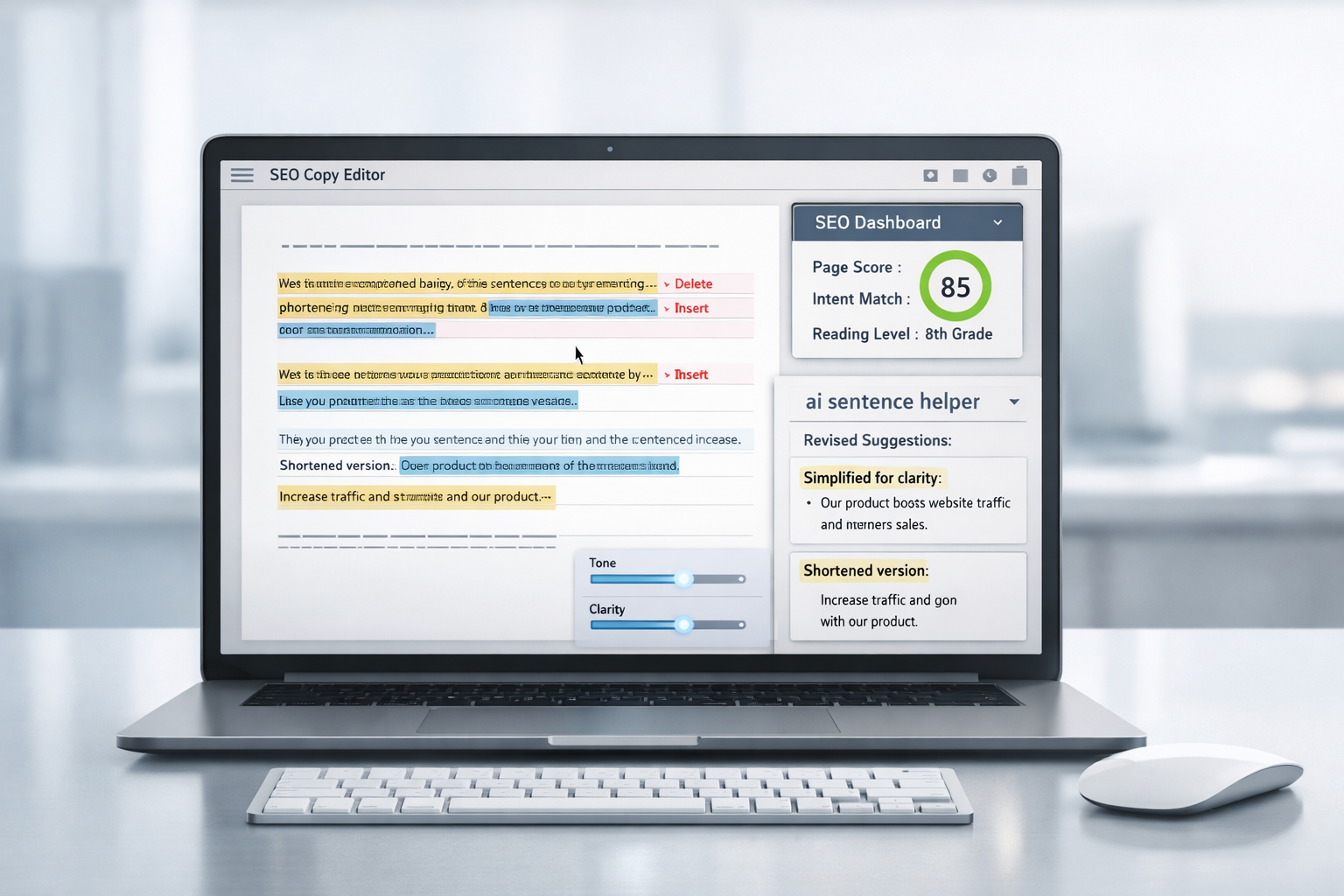
The most damaging mistake teams make with sentence tools is running the same paragraph through the same rewriter repeatedly, chasing a "better" version until the text loses its original voice and starts sounding like every other AI-polished page on the web. This is a real, observable pattern, not a hypothetical risk.
Over-paraphrasing has a compounding effect across a niche. If ten competing sites all run their product descriptions through similar AI rewriting tools with similar prompts, the output converges toward similar phrasing, similar sentence rhythms, similar transitional phrases. Readers notice a sameness even when they can't articulate why. Search engines, trained on enormous volumes of text, are well-positioned to notice patterns like this too, even without an explicit "AI content" penalty.
A second common mistake is assuming every AI rewrite automatically improves SEO performance. It doesn't. A rewrite that removes your target keyword in favor of a synonym, however elegant, can quietly undermine keyword targeting that took real research to establish. Always check that a sentence rewrite preserves the specific terms your keyword research identified, rather than trusting the tool's judgment on synonym swaps.
A third mistake: treating tone optimization as cosmetic rather than strategic. Tone should match the query type. A comparison article for software buyers reads differently than a how-to guide for beginners, and a sentence helper set to one default tone across every page flattens that distinction. Adjusting tone settings per content type, rather than running everything through a single default, preserves the fit between content and reader expectation.
The fourth mistake is the most costly: believing that consistent, careful sentence-level editing substitutes for the harder work of full-article production at scale. It doesn't. A perfectly worded 600-word page still loses to a well-structured 1,800-word competitor covering five more subtopics. If your content calendar depends on publishing regularly enough to build organic traffic, and you're still hand-editing every sentence of every draft, the bottleneck isn't your wording. It's your production capacity. Teams that reach this point usually look at automated SEO article generation platforms next, and DraftSEO.ai offers a free trial with initial credits at https://draftseo.ai/pricing for anyone who wants to test the output against their current sentence-by-sentence process before committing budget either way.
Frequently Asked Questions
Does using an AI sentence helper hurt SEO rankings?
No, using an ai sentence helper does not directly hurt rankings. The risk comes from over-paraphrasing until content sounds generic or duplicated across competitors, or from polishing sentences on an article that's structurally thin and missing search intent coverage.
Can I rank an article using only sentence-level AI editing?
Not reliably. Rankings depend on whole-page factors like topic coverage, structure, and freshness. A sentence helper improves wording but can't add missing subtopics, fix intent mismatches, or build the internal structure competitive queries need.
How is an AI sentence helper different from tools like Grammarly?
Grammarly focuses on grammar, spelling, and mechanical correctness. An ai sentence helper goes further, rewriting for tone, flow, and clarity, sometimes restructuring a whole sentence rather than just correcting an error within it.
Should agencies replace sentence tools with full content automation?
For scaling output, yes, generally. Sentence tools still have a role for final polish on individual pieces, but agencies producing dozens of articles monthly usually need research, outlining, and drafting handled together, which is what platforms like DraftSEO.ai are built to do.