Aug 20, 2026

Clearscope Alternative: DraftSEO.ai vs Clearscope
DraftSEO Team
Clearscope's Essentials plan starts at $189 a month for a single user and 20 content reports, and costs climb fast once you add seats or need more reports. That price buys you a scoring engine, not a written article. If you're comparing a clearscope alternative because your team is stretched thin writing to hit those scores, the math on your current workflow deserves a second look.
Most teams don't leave Clearscope because the scoring is bad. They leave because scoring isn't the bottleneck. Writing is.
Why Teams Look for a Clearscope Alternative in the First Place
The main reason teams shop for a Clearscope alternative is that grading tools tell you what to fix, but someone still has to write the fix. That gap between diagnosis and finished content is where most SEO budgets quietly disappear.
Clearscope generates a content grade and a term list based on top-ranking pages for a keyword. It's genuinely useful for identifying gaps in an existing draft. But the tool assumes you already have a writer, a content calendar, and hours free each week to revise drafts against a shifting term list. For an agency managing 15 client sites or an ecommerce team publishing category pages weekly, that assumption breaks down fast.
This is where the market has split into two camps, and it's worth being clear about which camp you're actually shopping in.
Graders vs. Generators
Tools like Surfer SEO, MarketMuse, and Frase mostly compete with Clearscope on the same turf: they analyze competitor content and score your draft against it. Switching between them saves some money but doesn't remove the writing bottleneck — you still need a human (or a separate AI tool) to produce the draft before any of them can grade it.
A smaller group of platforms, including DraftSEO.ai, skips the grading-then-writing sequence entirely. Instead of handing you a checklist, the platform researches the topic, writes the full article, and publishes it directly to your site. The distinction matters: one category tells you what good content looks like, the other one produces it.
Feature and Pricing Comparison
Pricing across this category varies by report volume, seats, and whether publishing is included at all. Here's how the core mechanics stack up.
| Feature | Clearscope | Typical Grading Alternatives | DraftSEO.ai |
|---|---|---|---|
| Core function | Content grading/scoring | Content grading/scoring | Full article generation + publishing |
| Writing required from you | Yes, full draft | Yes, full draft | No, drafts are generated |
| CMS publishing | Not included | Rarely included | Included, integrates with popular CMS platforms |
| Monthly output | Report-based, no article cap on writing | Report-based | 30 articles/month for connected sites |
| Starting price | ~$189/month | Varies, often $59–$149/month | See current plans |
The pricing gap looks small on a spreadsheet until you factor in labor. A content report might cost $10, but if a writer spends four hours per article revising against it, that's the real cost per piece. Automated publishing changes that equation because the writing hours disappear from the budget entirely, not just the software line item.
You can see the current plan breakdown and included article volume on the DraftSEO.ai pricing page, which lays out what's included at each tier before you commit to anything.
Scoring Accuracy Isn't the Whole Story
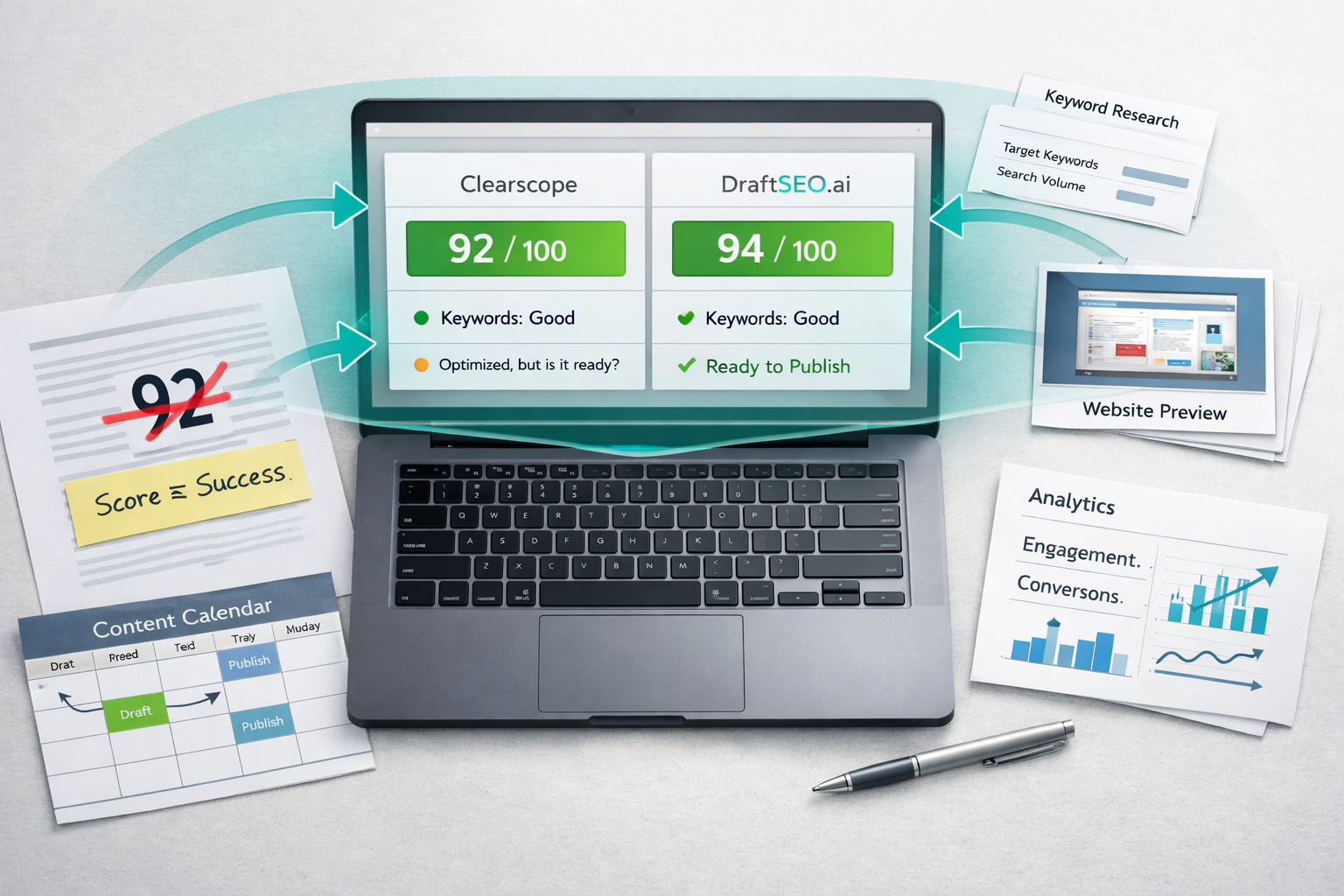
A high content score doesn't guarantee a high ranking. Clearscope's grade reflects term coverage relative to current top-10 pages for a keyword — it says nothing about backlinks, page speed, domain authority, or search intent match, all of which factor into where Google actually places a page.
Teams sometimes chase a 90+ Clearscope grade on a page that still sits on page two, then blame the tool. In reality, the score is one signal among many that Google's ranking systems weigh. Treating it as a pass/fail gate rather than a directional guide leads to wasted revision cycles.
What Actually Correlates With Rankings
Term coverage matters, but structure and freshness matter too. A well-organized article with clear headings, direct answers near the top, and reasonable length tends to outperform a keyword-dense one built purely to satisfy a grader.
Where Automated Drafting Fits
Because DraftSEO.ai generates articles based on structural best practices — clear headings, answer-first sections, appropriate length for the topic — rather than optimizing a human draft after the fact, the content starts closer to the target instead of being edited toward it over multiple passes.
Switching Tools: CMS Integration and Workflow Migration

Moving off Clearscope means more than canceling a subscription. Your existing workflow (briefs, term lists, revision cycles) has to be replaced with something your team can actually run.
- Audit which sites and content types currently depend on Clearscope reports, including any agency client accounts tied to shared seats.
- Check CMS compatibility for any replacement tool — WordPress is the most common target, and integration quality varies widely between platforms.
- Decide whether you need grading only, or full drafting and publishing, since that determines which category of tool you're actually evaluating.
- Migrate keyword lists and existing content briefs into the new platform's input format.
- Run a trial batch of articles or reports before canceling Clearscope outright, so you can compare output quality side by side.
- Set a publishing cadence (weekly or monthly) that matches your team's review capacity, even if the tool can publish faster.
- Review the first month's published pages for indexing and formatting issues before scaling volume up.
WordPress site owners in particular should confirm publishing permissions and category mapping before switching tools, since a broken CMS integration mid-migration can leave draft articles stuck in limbo on either platform.
Getting Started Without Committing to a Full Contract
You don't need a signed annual contract to test whether an automated approach fits your workflow. DraftSEO.ai includes a free trial with initial credits, so you can generate real articles for your own site before deciding anything.
I'd recommend running the trial against a content type you already understand well — a product category page, a comparison post, a local service page — so you can judge the output against your own editorial standards rather than a generic sample. That's a more honest test than reading a demo article on someone else's blog.
The tradeoff worth naming honestly: automated drafting won't replace a subject-matter expert reviewing technical or legal content before it goes live. Treat the generated draft as a strong first pass, not a final one, especially in regulated or high-stakes niches.
If the writing bottleneck is what's driving your search for a Clearscope alternative, it's worth comparing plans directly on the DraftSEO.ai pricing page and starting the free trial with the included credits before your next Clearscope renewal comes due.
Frequently Asked Questions
Is Clearscope worth it if I already have a strong writing team?
Yes, if your team writes but struggles with keyword coverage and competitive gaps, Clearscope's grading can sharpen drafts. It adds less value if your bottleneck is writing volume, not writing quality.
Can I use DraftSEO.ai alongside Clearscope instead of replacing it?
You could run both, but most teams find the value drops once articles are generated and published automatically, since there's no manual draft left to grade against a term list.
How many articles can DraftSEO.ai publish per month?
DraftSEO.ai generates 30 articles monthly for each connected site and publishes them directly through CMS integrations, removing the manual writing and upload steps entirely.