Aug 18, 2026

News Article Generator for Fast SEO News Drafts
DraftSEO Team
Google News surfaces roughly 50,000 to 60,000 new articles from publishers every hour worldwide. That pace is the real reason speed matters for anyone writing time-sensitive content: if your draft takes three hours while a competitor's takes fifteen minutes, the story has already been indexed, shared, and forgotten before you hit publish. A news article generator closes that gap, but only if you understand what it's actually doing behind the scenes.
Most people searching for this tool already run some kind of content automation. What they want to know is narrower: can AI handle news specifically, where facts, dates, and attribution carry legal and reputational weight, without wrecking trust or rankings. The honest answer is yes, with a specific workflow, not a set-it-and-forget-it button.
What a News Article Generator Actually Does
A news article generator is software that pulls a topic, headline, or source material and produces a structured draft in the inverted-pyramid style newsrooms use: lead, supporting detail, background, context. It is not the same as a spinning tool that reshuffles someone else's article to dodge plagiarism checks.
The Input Side
You typically feed it a topic, a press release, a set of bullet points, or a trending keyword. Better tools also accept a target publication style and word count. The output quality depends heavily on input quality — vague prompts produce generic drafts that need heavy rewriting anyway.
The Output Side
The draft comes back with a headline, subheadings, and a body organized for scanning. Some platforms, including DraftSEO.ai, also generate the on-page SEO layer at the same time: meta description, header structure, and internal keyword placement, so the draft isn't just readable but already shaped for search.
The distinction that matters most: a generator drafts, it does not report. It has no independent way to confirm a fact happened at a specific place and time unless that information is in the source material you gave it. Treat the output as a fast first pass, not a wire-service story.
Speed vs. Accuracy: Where Fast Drafts Go Wrong
Speed alone doesn't earn rankings, and unverified AI news content carries real accuracy risk. A generator can produce a 600-word draft in under two minutes, but if a name, date, or statistic is wrong, that draft can spread misinformation before anyone catches it.
This matters more in news than in evergreen content because news lives or dies on timeliness and correctness together. A blog post about "best running shoes" can survive a minor error for months. A news piece about a company earnings report or a local ordinance change gets scrutinized immediately, often by people who were at the event or read the primary source.
The fix isn't slowing everything down — it's adding one deliberate checkpoint. Before publishing, someone verifies names, dates, figures, and quotes against a primary source: the press release, the court filing, the official transcript. This step usually takes 10 to 20 minutes for a short news piece, which is still far faster than writing from scratch.
Here's a realistic breakdown of where time actually goes in a fast-but-accurate workflow:
- Topic and source gathering (5-10 minutes)
- AI draft generation (1-3 minutes)
- Fact verification against primary sources (10-20 minutes)
- Editorial pass for tone, attribution, and originality (10-15 minutes)
- SEO formatting check: headings, meta description, internal links (5 minutes)
- Plagiarism/originality scan (2-5 minutes)
- Publish to CMS (2-5 minutes)
Total: roughly 35 to 60 minutes from idea to published, verified news post. That's still a fraction of a traditional 2-3 hour writing process, and it's the version that actually protects your site's credibility.
Google News Eligibility and E-E-A-T Signals
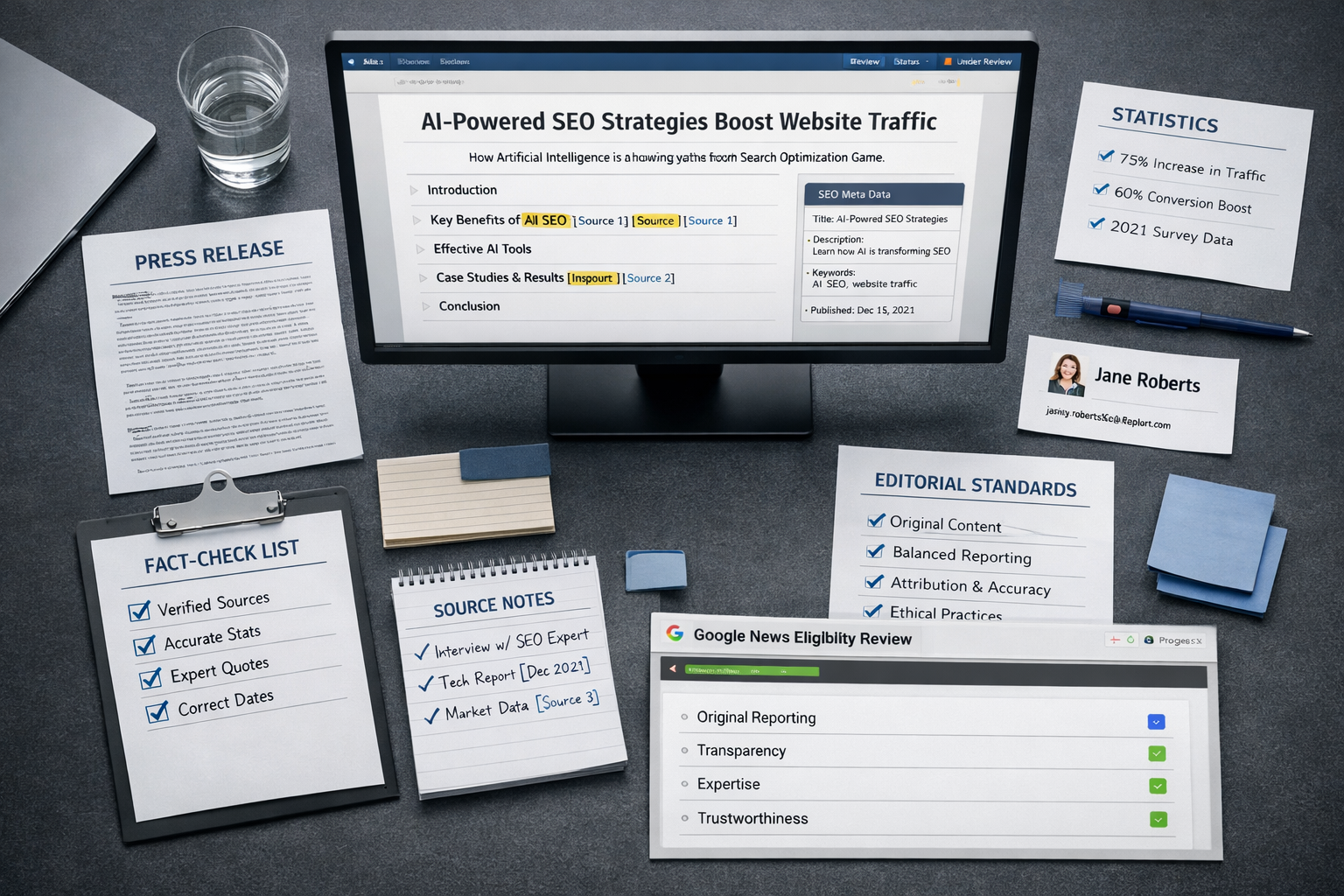
Getting into Google News isn't about submitting a sitemap and waiting. Google evaluates sites on originality, expertise signals, and structured data, and unedited AI content tends to fail on the originality front because it reads generic and lacks a clear point of view.
Structured Data and Technical Basics
You need valid NewsArticle schema markup, a clear publish date, author bylines, and a fast-loading page. Technical SEO specialists should treat this as table stakes, not optional polish — Google's crawlers for news content check these signals more strictly than they do for general web pages.
The Human Layer Google Actually Rewards
E-E-A-T (experience, expertise, authoritativeness, trust) means Google is looking for signs a real person stands behind the content. A generator can produce the skeleton, but a byline with a real author bio, an editorial correction policy, and original quotes or analysis are what separate a page that ranks from one that gets filtered out of the News tab entirely. This is also where personalization pays off: adding a local angle, an original quote from a source you contacted, or data you pulled yourself turns a generic AI draft into something with an actual point of view.
Fitting AI Drafts Into Your Publishing Workflow
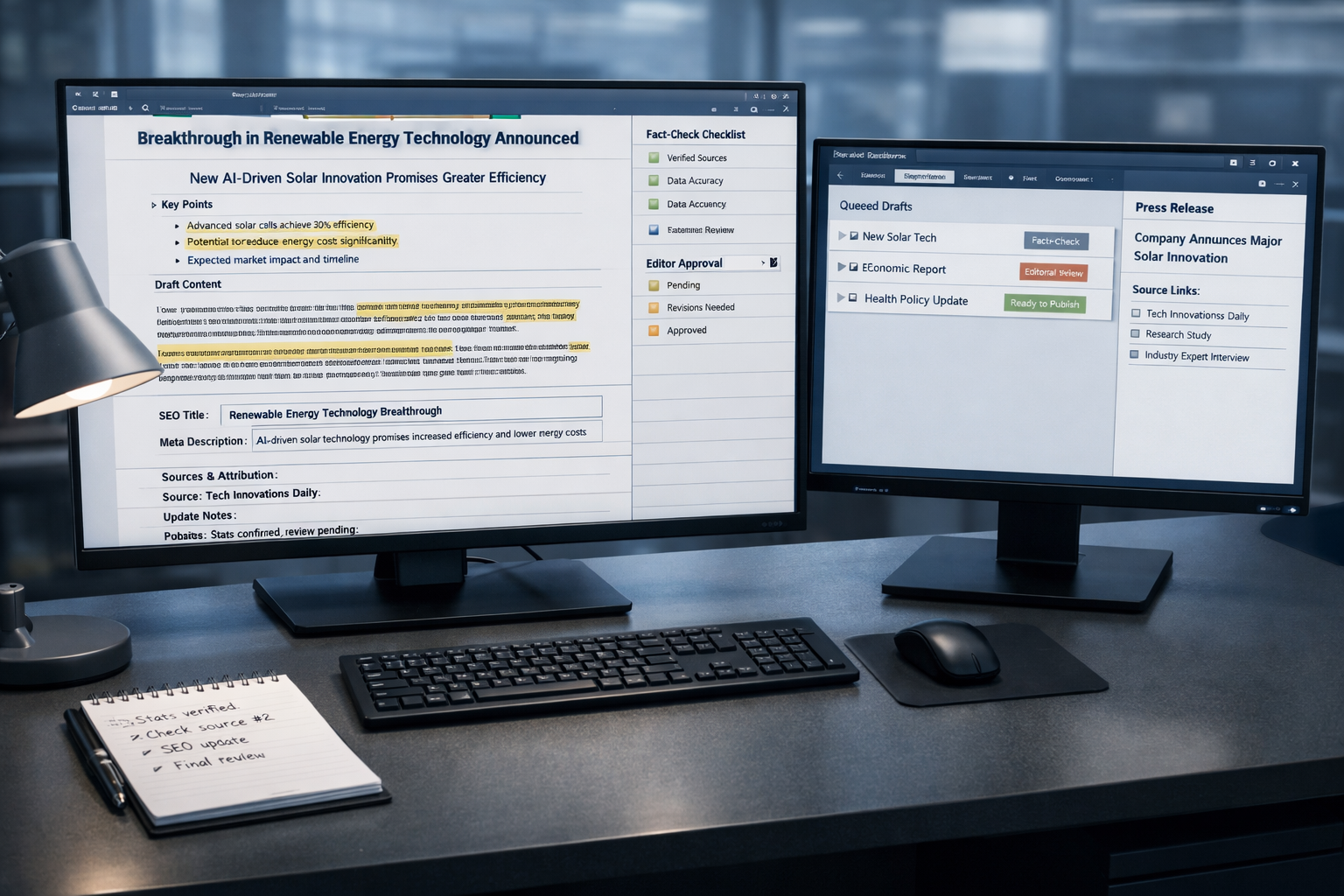
The biggest overlooked cost in AI content production isn't the writing — it's the copy-paste tax. Teams that generate drafts in one tool and manually move them into WordPress or another CMS lose time on formatting, image placement, and metadata re-entry, and that friction adds up fast across 20 or 30 articles a month.
An automated draft-to-CMS workflow solves this by pushing the finished draft, formatted headers, and meta description directly into your site's publishing queue, so your job shifts from data entry to review and approval. DraftSEO.ai connects to popular CMS platforms and handles that publishing step directly, generating up to 30 articles a month for a connected site without a manual export-import cycle.
That doesn't remove the editorial step — it just removes the busywork around it. Your editor still reads the draft, checks facts, and approves the piece before it goes live; they just aren't reformatting HTML or re-uploading images to make that happen.
| Workflow Step | Manual Copy-Paste | Automated CMS Integration |
|---|---|---|
| Time per article (formatting) | 15-25 minutes | 2-5 minutes |
| Metadata entry | Manual, per article | Auto-populated |
| Risk of formatting errors | Higher | Lower |
| Scalability at 30 articles/month | Difficult | Built for volume |
If you're weighing whether to add this to your stack, the lowest-risk way to test it is a free trial: DraftSEO.ai's pricing page (https://draftseo.ai/pricing) includes starter credits so you can run a handful of drafts through your own editorial process before committing to a monthly plan.
Frequently Asked Questions
Can AI-generated news articles rank on Google without editing?
Rarely, and not reliably. Google's ranking systems favor original reporting and clear expertise signals, and raw AI drafts tend to read generic. Editing for accuracy, adding original analysis, and verifying facts before publishing is what makes the difference.
Is a news article generator the same as a plagiarism or article-spinning tool?
No. A spinning tool reworks existing text to avoid detection; a news article generator drafts new content from a topic or source material you provide. Running an originality scan before publishing is still good practice either way.
How fast can a verified news draft realistically go live?
Expect roughly 35 to 60 minutes total: a few minutes for the AI draft, then 20 to 30 minutes for fact-checking, editing, and formatting before publishing through your CMS.