Sep 26, 2026

Ahrefs vs. Semrush vs. Moz: The Battle of the SEO Tools
DraftSEO Team
Semrush's database tracks over 26 billion keywords, Ahrefs indexes trillions of live backlinks, and Moz has been running Domain Authority scores since 2011. Anyone comparing moz vs ahrefs vs semrush is really asking which research engine deserves a monthly budget line, not which one is "best" in the abstract. The honest answer depends on whether your bottleneck is backlink data, keyword volume, or ease of onboarding a junior team member.
This isn't a spec-sheet exercise. Agencies pay $99 to $449 a month per seat for these tools, and picking wrong means re-training a team six months in. The comparison below focuses on what actually changes your workflow, not marketing copy.
Backlink Data: Why Ahrefs Still Sets the Pace
Ahrefs built its reputation on link data, and that reputation is earned. Its crawler updates its backlink index roughly every 15-30 minutes, giving it one of the freshest link graphs in the industry, and its live index reportedly holds trillions of tracked backlinks going back to 2012.
How Semrush and Moz compare
Semrush's Backlink Analytics tool is solid for competitive gap-finding but tends to surface fewer live, unique referring domains than Ahrefs on the same query. Moz's Link Explorer is the smallest of the three indexes; it's fine for a quick authority check but weak for deep link-building prospecting.
The metric mismatch nobody flags
Here's the trap: Domain Authority (Moz) and Domain Rating (Ahrefs) are not the same metric, even though both run 0-100 and get treated interchangeably in pitch decks. DA is Moz's proprietary machine-learning score predicting ranking potential; DR is Ahrefs' measure of link profile strength alone. A site can show DA 45 and DR 62 and both numbers can be "correct" — they're just measuring different things. Never mix them in the same client report without labeling the source tool.
If backlink auditing is your main use case, Ahrefs is the stronger buy. Semrush works as a capable second opinion, and Moz is best treated as a lightweight sanity check, not your primary link database.
Keyword Research: Volume Numbers Won't Match Between Tools
Semrush leads here, mainly because of the sheer size of its keyword database and its Keyword Magic Tool, which returns thousands of variants with intent labels in one pull. Ahrefs' Keywords Explorer is close behind and often more precise on click-through-rate estimates. Moz's Keyword Explorer is usable but noticeably thinner on long-tail coverage.
The real issue teams run into isn't which tool is "right" — it's that search volume estimates differ significantly between all three, sometimes by 30% or more for the same term. That's because each tool sources clickstream and search console data differently and applies its own smoothing model. If a client asks why last month's report shows 2,400 searches and this month's shows 1,800, the answer is usually "we switched tools," not "demand dropped."
Practical fix: pick one tool as your reporting source of truth and stick with it for the life of the client relationship. Mixing tools mid-campaign creates confusing, inconsistent numbers that erode trust faster than any actual ranking dip.
None of these platforms writes the article that targets the keyword they just found. That gap between research and production is where budgets quietly leak — teams spend hours building keyword gap spreadsheets and then stall at the writing stage. Some agencies close that gap by routing the exported keyword list straight into a service like DraftSEO.ai's pricing plans, which turn niche input into scheduled articles instead of another to-do list.
Site Audits, Rank Tracking, and Content Tools Compared
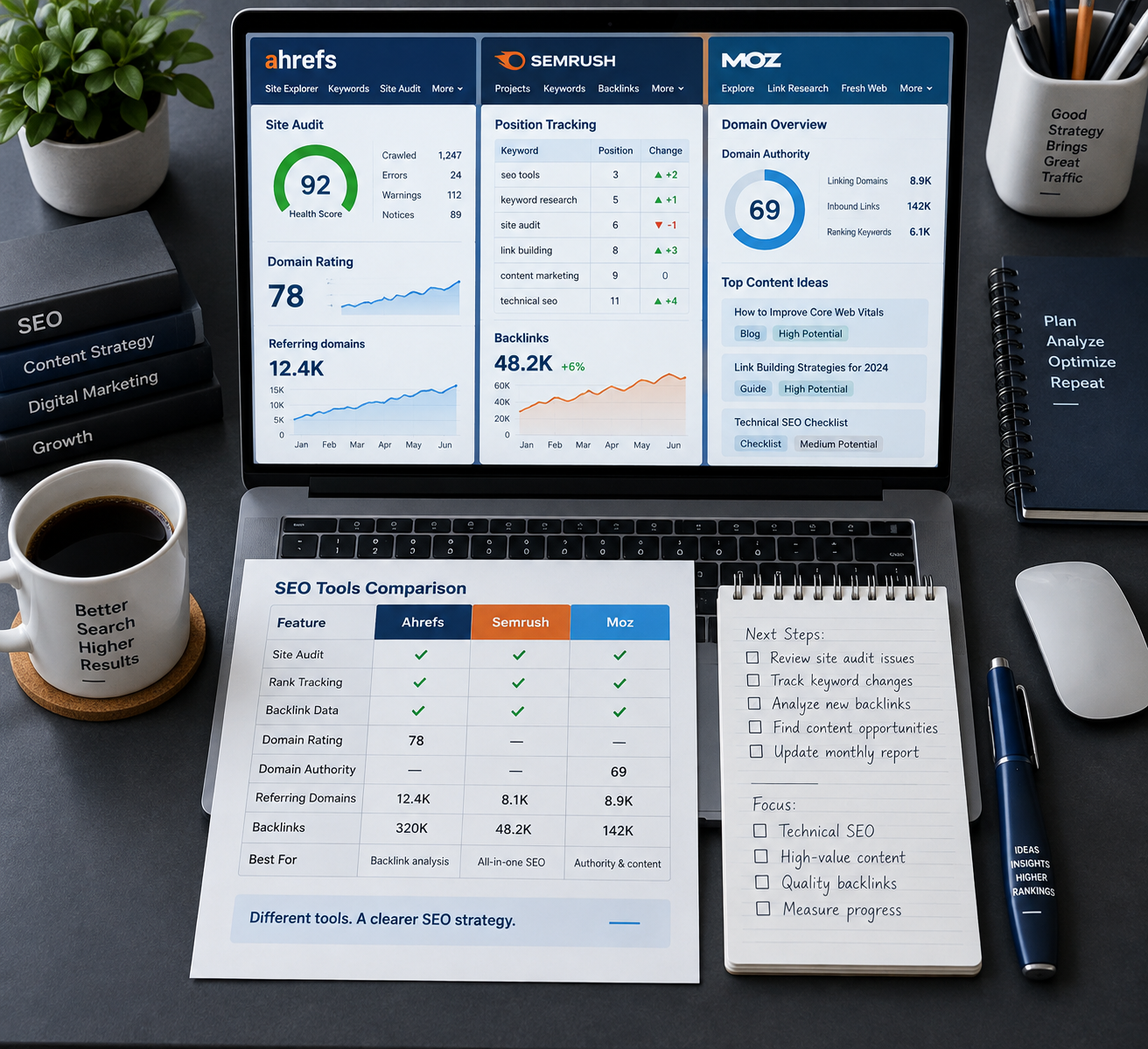
All three platforms run technical site audits and rank tracking, but the depth and refresh rates differ enough to matter for a technical SEO's daily work.
Site audit depth
Semrush's Site Audit checks over 140 technical issues per crawl and is the most beginner-friendly of the three. Ahrefs' Site Audit is built for larger sites and handles crawls into the millions of URLs without choking, which matters for enterprise e-commerce catalogs. Moz's Site Crawl is lighter, better suited to small business sites under a few thousand pages.
Rank tracking and content scoring
Semrush updates rank tracking daily and includes an SEO Content Template that scores drafts against top-ranking pages. Ahrefs' Rank Tracker is accurate but sold partly as an add-on depending on plan tier. Moz's Rank Tracking is reliable for a handful of core terms but not built for tracking thousands of keywords at once.
| Tool | Backlink Index Size | Keyword DB Size | Site Audit Crawl Limit | Starting Price/mo |
|---|---|---|---|---|
| Ahrefs | Trillions of links | ~18 billion keywords | Millions of URLs | $129 |
| Semrush | Large, refreshed weekly | 26+ billion keywords | Enterprise-scale | $139.95 |
| Moz | Smallest of the three | ~500 million keywords | A few thousand URLs | $99 |
Every one of these tools stops at diagnosis. They tell you which pages are thin, which keywords have gaps, and which backlinks you're missing — but none of them drafts the replacement content. That's a separate cost most budgets forget to plan for.
Pricing, Learning Curve, and Support: The Deciding Factors
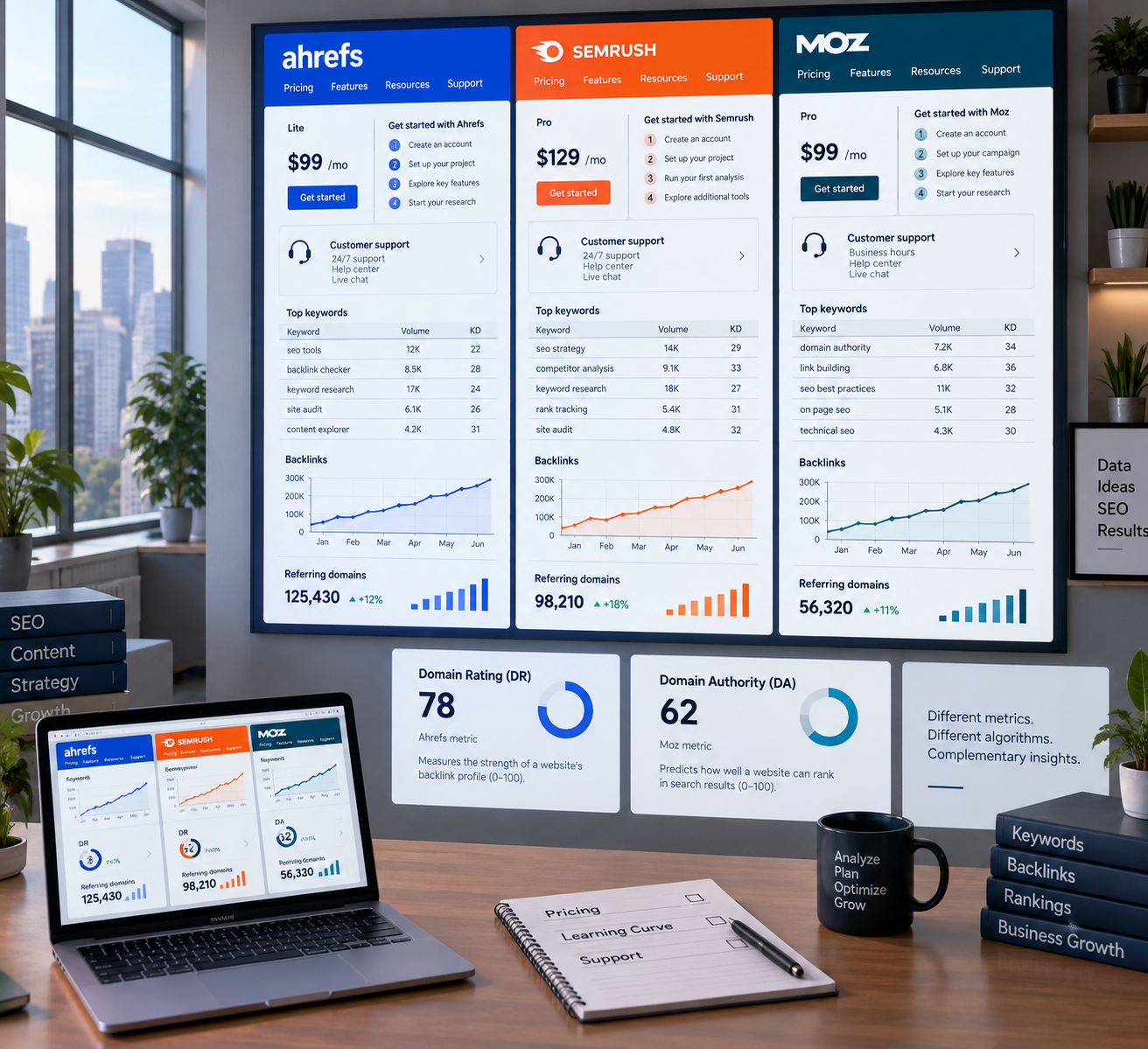
Price alone is a bad reason to choose. A $99/month Moz Pro plan looks cheaper than Semrush's $139.95 Pro tier, but if Moz's data doesn't match search patterns in your specific niche, you'll waste more in wrong content decisions than you saved on the subscription.
Learning curve differs sharply. Semrush's interface is the most approachable for a junior hire on day one, with guided workflows for most tasks. Ahrefs demands more SEO fluency to interpret correctly but rewards that with sharper data once you know where to look. Moz sits in between, simple but limited once you outgrow the basics.
Support quality tracks the price tag. Semrush and Ahrefs both offer email and chat support with reasonable response times on paid plans; Moz's support is smaller and slower on lower tiers. All three offer some form of free trial or limited free access, so testing before committing is realistic:
- Sign up for Semrush's free trial and run a 7-day audit on your own site.
- Test Ahrefs' free Webmaster Tools tier against a verified property.
- Try Moz's 30-day free trial on a smaller client site to gauge DA drift.
- Export identical keyword lists from all three and compare volume variance.
- Check backlink counts for the same domain across all three dashboards.
- Decide based on which data matched your actual ranking movements.
Once the keyword gaps and content briefs are sitting in a spreadsheet, the next bottleneck is production speed, and that's a fair place to bring in automated help. DraftSEO.ai turns that research into 30 published articles a month per connected site, integrating directly with common CMS platforms, and a free trial with starting credits lets you test the workflow at https://draftseo.ai/pricing before committing budget to it.
Frequently Asked Questions
Is Moz's Domain Authority the same as Ahrefs' Domain Rating?
No. DA (Moz) predicts overall ranking potential using a machine-learning model; DR (Ahrefs) measures link profile strength only. A page can score differently on each without either number being wrong.
Can I use Ahrefs, Semrush, or Moz to write my content?
No, none of the three generates finished articles. They surface keyword gaps and content scores; turning that data into published pages is a separate step most teams handle manually or with AI writing tools.
Which tool should a small agency pick if budget is tight?
Semrush at $139.95/month covers keyword research, audits, and rank tracking in one plan, which usually beats paying separately for Moz's cheaper $99 tier plus a second tool to fill its gaps.