Aug 3, 2026

Ahrefs vs Moz: Which SEO Tool Wins in 2026?
DraftSEO Team
Ahrefs indexes over 35 trillion known backlinks and updates its crawler data every 15-30 minutes, while Moz's Link Explorer index sits at a much smaller scale and refreshes on a slower cycle. That gap alone drives most of the ahrefs vs moz debate, but backlink counts are only one piece of the decision. If you're choosing between the two for 2026, the real question is which platform's data you'll actually use.
Both tools are strong at research. Neither one writes or publishes anything for you.
Tool Research vs. Content Output: The Part Nobody Talks About
Ahrefs and Moz are research and audit platforms, not content production engines. They tell you what to write about; they don't write it, format it, or push it live to your site. That gap is where most SEO budgets quietly leak.
I've seen teams spend hours a week pulling keyword lists from either tool and then stall at the writing stage. The bottleneck isn't Ahrefs vs Moz. It's turning a spreadsheet of keyword opportunities into published, optimized pages before a competitor beats you to them. A platform like DraftSEO.ai exists specifically for that second half of the problem, generating 30 articles a month for connected sites so the research you're paying Ahrefs or Moz for doesn't sit unused in an export file.
Pick your research tool first. Then solve the publishing gap separately, because no amount of backlink data closes it.
Pricing and Plans: What You Actually Get for the Money
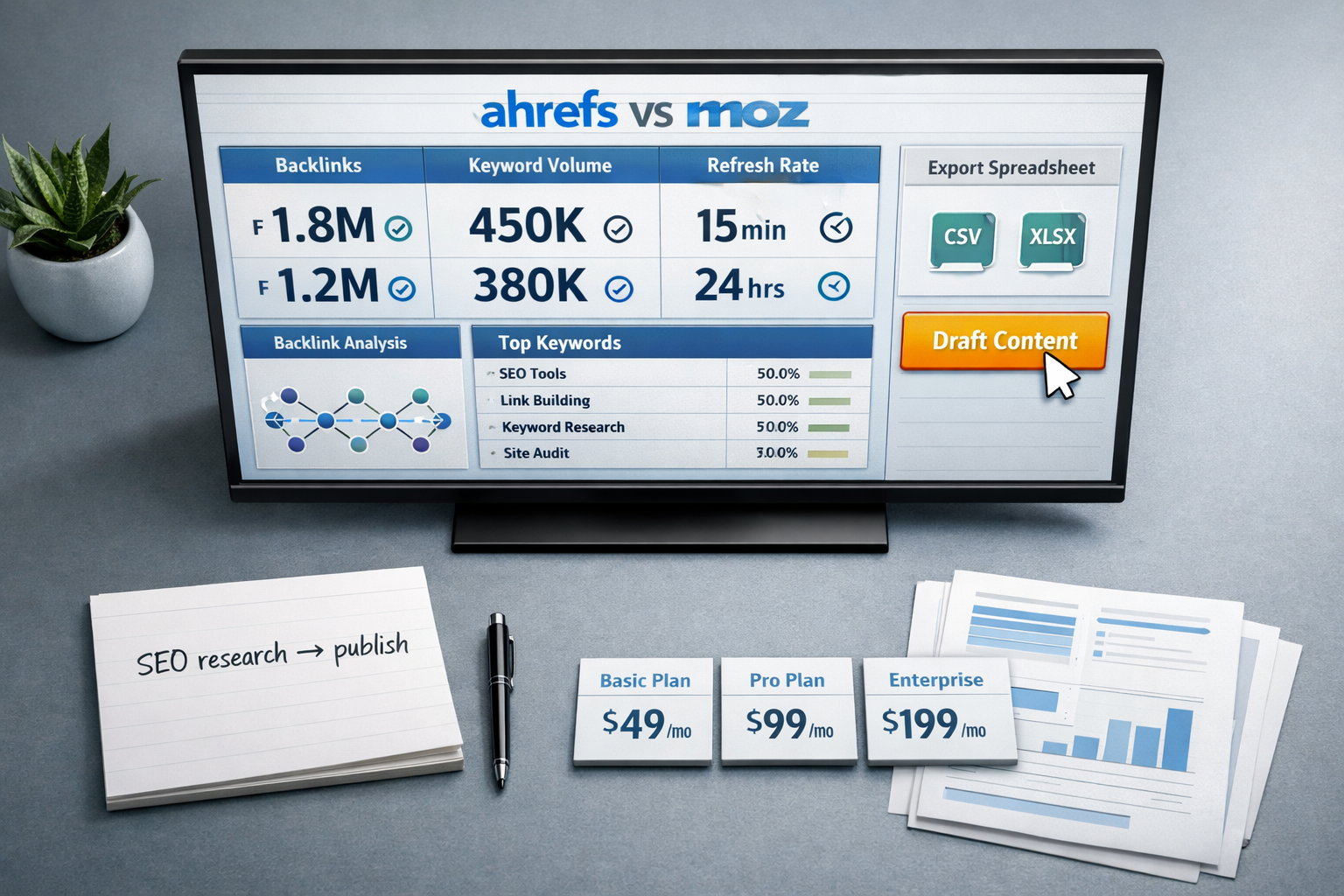
Ahrefs starts at $129/month for the Lite plan and moves up to $249 for Standard, $449 for Advanced, and custom Enterprise pricing above that. Moz Pro starts lower, at $99/month for its Standard plan, scaling to $179, $299, and $599 for higher tiers. On paper Moz looks cheaper at entry level, but the comparison isn't that simple once you factor in what each tier actually includes.
Ahrefs' Lite plan caps you at a smaller number of tracked keywords and crawled pages than Moz's equivalent tier, but its backlink and keyword volume data is more current across every plan level. Moz's higher tiers add more Moz Local listings and campaign slots, which matters if you're running local SEO for multiple clients.
Where the Money Actually Goes
Agencies managing 10+ client sites often outgrow Ahrefs' Standard plan quickly because of crawl and rank-tracking limits, pushing them toward Advanced at $449. Solo site owners or small ecommerce operators rarely need that tier at all.
The Overpaying Trap
Don't buy Enterprise-level access because a sales page implies you need it. Most single-site owners and small agencies run fine on Ahrefs Standard or Moz's mid-tier plan; the jump to top-tier pricing is justified mainly by API call volume and multi-user seats, not by better core data.
| Plan Tier | Ahrefs | Moz Pro |
|---|---|---|
| Entry | $129/mo (Lite) | $99/mo (Standard) |
| Mid | $249/mo (Standard) | $179/mo (Medium) |
| Upper | $449/mo (Advanced) | $299/mo (Large) |
| Top | Custom (Enterprise) | $599/mo (Premium) |
Domain Authority vs Domain Rating: Why the Numbers Don't Match
Domain Authority (Moz) and Domain Rating (Ahrefs) are not measuring the same thing, even though both output a 0-100 score. DA predicts how likely a site is to rank based on Moz's own link index and machine learning model; DR measures the strength of a site's backlink profile relative to Ahrefs' index alone.
A site can show DA 45 in Moz and DR 62 in Ahrefs simultaneously, and neither number is wrong. They're built from different link databases with different weighting. Treating them as interchangeable is a common mistake I still see in client pitch decks and vendor comparisons.
What Each Score Is Actually Good For
Use DA when you're benchmarking against sites already tracked heavily in Moz's ecosystem, particularly in niches where Moz has stronger historical coverage. Use DR when your link-building targets skew toward sites Ahrefs crawls more aggressively, which in practice covers most mainstream commercial niches.
The Bigger Mistake: Chasing the Score Itself
Neither score is a Google ranking factor. Optimizing for a higher DA or DR number instead of earning links from relevant, traffic-generating pages is backward. A DR 70 backlink from an irrelevant directory does less for you than a DR 40 link from a competitor's actual customer base.
Keyword Research, Site Audit, and Rank Tracking: The Feature-Level Breakdown
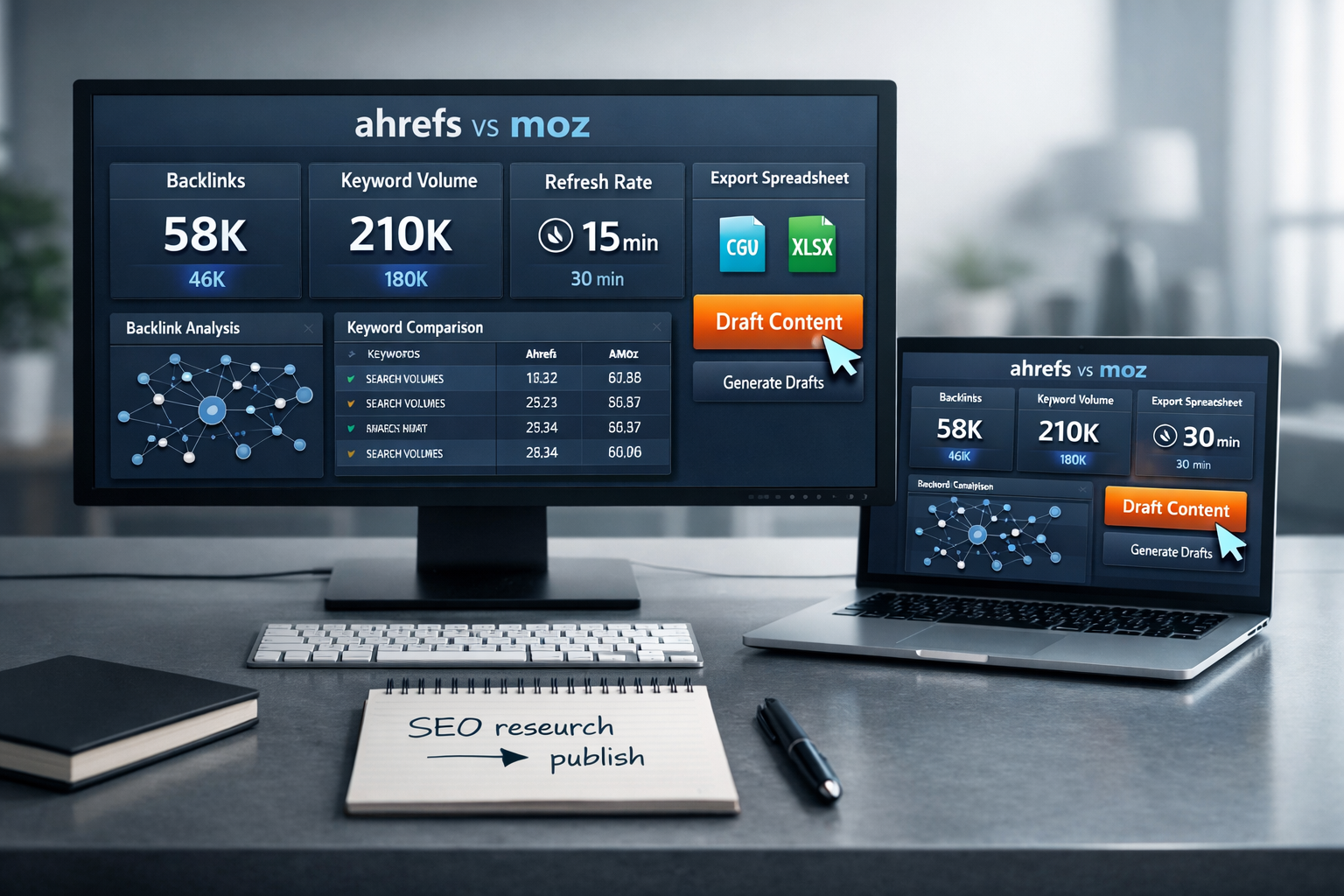
Ahrefs' Keywords Explorer pulls from its own clickstream-informed data and shows Traffic Potential alongside search volume, which Moz's Keyword Explorer doesn't replicate at the same depth. Moz counters with a cleaner Priority score that blends volume, difficulty, and opportunity into one number, which some teams find faster to act on.
- Run your seed keywords through both tools' free trial or free keyword tool before committing to either subscription.
- Compare Site Audit results on your own domain, not a demo site, since crawl behavior varies by CMS.
- Check rank tracking accuracy against Google Search Console data for a two-week window.
- Test the content gap and competitor analysis reports against a competitor you know well.
- Review Moz Local listings coverage if local SEO matters to your business.
- Confirm integration support for your CMS or reporting stack before renewing.
Site Audit is close between the two for technical issue detection, crawl errors, redirect chains, thin content, but Ahrefs' crawler generally processes larger sites faster and surfaces more granular JavaScript rendering issues. Moz's audit interface is friendlier for teams new to technical SEO, with clearer prioritization for non-specialists.
Once you've pulled keyword opportunities and content gaps from either platform, the next problem is speed. A content gap report showing 40 unclaimed keyword opportunities is worthless if your team can only publish two articles a week. Turning that data into actual published pages, at a pace that outruns competitors, is exactly the workflow gap you can close by reviewing the plans available on DraftSEO.ai's pricing page, which is built around monthly article output rather than research alone.
Learning Curve, Support, and Getting Started Without Wasting a Month
Moz Pro has a shorter learning curve for teams without a dedicated technical SEO hire; its dashboard groups tasks in a way that matches how marketing generalists think about campaigns. Ahrefs rewards technical fluency, its data depth pays off once you know how to cross-reference reports, but the interface throws more numbers at a new user in the first session.
Support quality is close. Ahrefs leans on documentation and a large community; Moz offers similar self-serve resources plus onboarding webinars for new Pro accounts. Neither offers live chat as a first-line support channel, so expect email response times measured in hours, not minutes.
Both offer limited free tools and trial access, Ahrefs through its free Webmaster Tools and short trial periods, Moz through its free Moz Local listing check and a 30-day Pro trial. Test both against your own domain before paying for a year upfront; brand reputation alone tells you nothing about how either tool handles your specific site's crawl depth or backlink profile.
Once you've settled on a research tool, don't let the decision stall your publishing schedule. Start the free trial on DraftSEO.ai's pricing page to connect your site and start turning whichever tool's keyword data you trust into published articles automatically, instead of leaving another month of research sitting in an unused export.
Frequently Asked Questions
Is Ahrefs or Moz better for backlink analysis?
Ahrefs generally wins on raw index size and crawl freshness, which matters most for competitive link-building research. Moz's index is smaller but still useful for spot-checking anchor text patterns and toxic link flags on smaller sites.
Can I use Ahrefs and Moz together?
Yes, and many agencies do, using Ahrefs for backlink and content gap research while keeping Moz Local for client location listings. Running both costs more, so only double up if each tool covers a gap the other genuinely misses.
Does a higher Domain Authority or Domain Rating guarantee better rankings?
No. Both scores are third-party estimates, not Google ranking factors, and sites with lower DA or DR scores regularly outrank higher-scored competitors when their content and relevance are stronger.