Nov 21, 2026
How to Optimize for ChatGPT Search With FAQs
DraftSEO Team
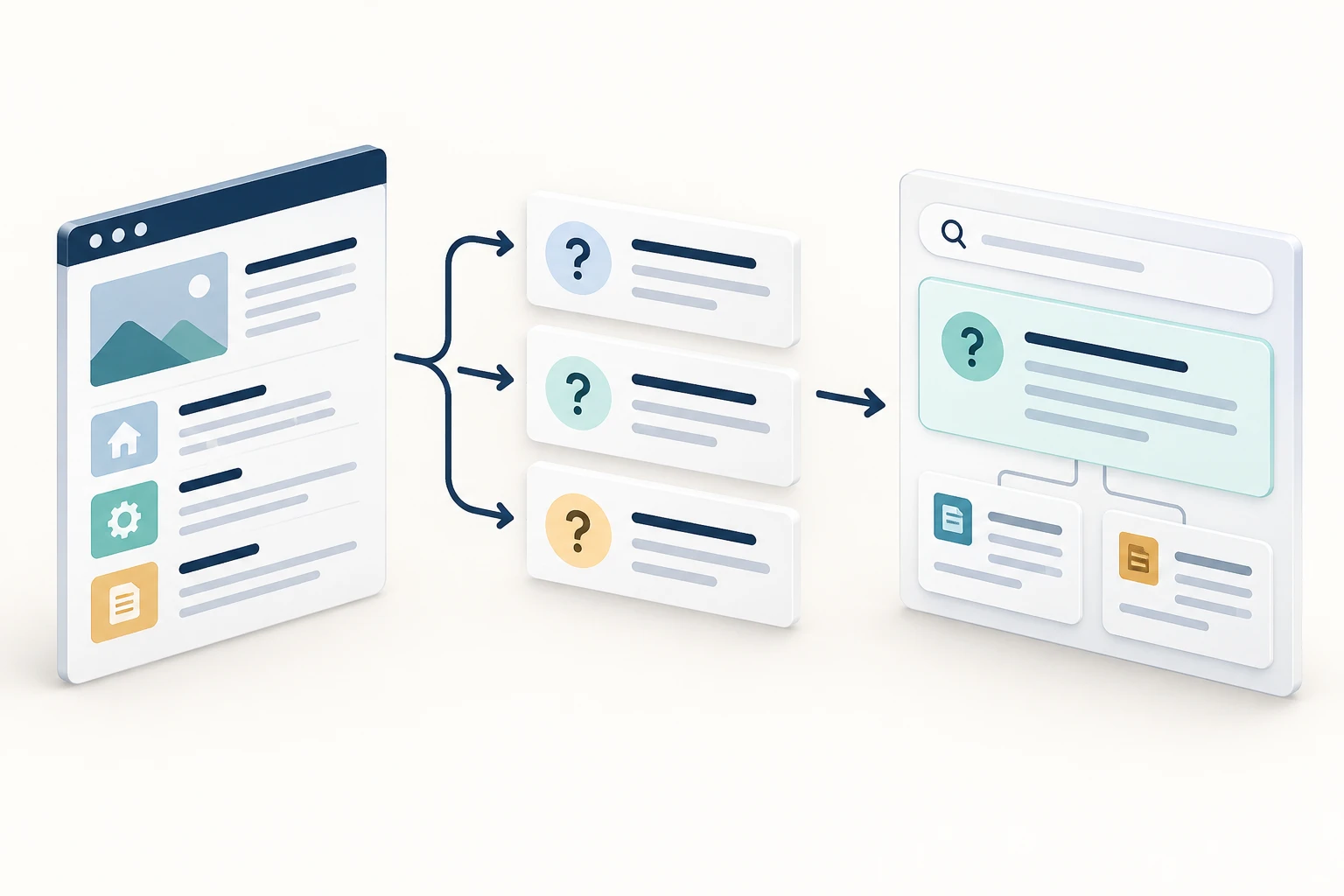
You already publish content that ranks. The open question is how to optimize for ChatGPT search without starting over, and FAQs are the fastest lever you have. Each question-and-answer pair gives ChatGPT one more clean, extractable answer to match against a conversational prompt.
ChatGPT Search runs on Bing results, so your existing SEO still matters. On top of that base, the work comes down to four steps. Let the right crawler in, answer real questions in self-contained blocks, put those blocks on the right pages, and log citations separately from clicks.
Let OAI-SearchBot crawl your pages first
Your FAQ answers can only be cited if ChatGPT can fetch them. OpenAI runs separate user agents, and OAI-SearchBot is the one that controls ChatGPT search visibility. Sites that block it don't appear in ChatGPT search answers, though they can still show up as navigational links.
GPTBot and OAI-SearchBot do different jobs
GPTBot relates to training OpenAI's foundation models. OAI-SearchBot surfaces pages in search. The two settings are independent, so you can allow search and block training:
User-agent: OAI-SearchBot
Allow: /

User-agent: GPTBot
Disallow: /
OpenAI says changes to robots.txt take about 24 hours to reach its search systems. ChatGPT-User, the agent that fetches a page when someone asks about it, doesn't decide search inclusion. Robots.txt rules may not apply to it at all.
Check what the crawler actually sees
Firewalls and CDN bot rules often block crawlers that robots.txt allows. Allowlist the IP ranges OpenAI publishes at openai.com/searchbot.json. Make sure each FAQ answer is in the server-rendered HTML, not hidden behind JavaScript that only loads after a click. Native <details> elements are fine, because their text is in the source.
Find questions worth answering
Good FAQ questions come from people, not keyword variants. AI prompts are long and conversational. People type "how do I stop my WordPress site blocking AI crawlers", not "AI crawler WordPress".
Pull candidates from four places:
- Support tickets and sales emails, phrased the way customers wrote them
- Google Search Console queries that start with how, what, can or does
- People Also Ask boxes for your main keywords
- Your own test prompts in ChatGPT, noting which pages it cites today
Keep a question only if it is distinct and you can answer it with something specific: a number, a rule, a named tool or a step. Two questions with the same answer should become one.
Rewrite answers so they stand alone
ChatGPT extracts passages, not whole pages. Each answer has to make sense when it is lifted out with nothing around it. Think of it as featured-snippet writing with stricter rules.
A weak-to-strong rewrite
Weak: "It depends on your setup, but generally you'll want to make sure bots can reach your content, which is something we can help with."
Strong: "Allow OAI-SearchBot in robots.txt and allowlist OpenAI's published IP ranges. ChatGPT search only shows pages that crawler can fetch. Updates take about 24 hours to apply."
The strong version gives the direct answer first, names the exact agent, and adds one verifiable figure. It runs to about 30 words, with no pronouns that point back to earlier text.
Add evidence a model can't find elsewhere
Information gain, meaning facts that exist only on your page, is what sets you apart. Your own pricing, test results, support data or measured timings count. Cite outside figures with their named source, and date anything that changes, such as "as of November 2026". Stale answers lose ground to fresher ones.
Choose placement and publish cleanly in WordPress

Put each FAQ where the question comes up. One page can answer five questions in its body and many more in an FAQ block, all from the same URL.
| Question type | Best location | Why |
|---|---|---|
| Product fit, pricing, specs | Product or pricing page | Answers sit next to the evidence |
| How-to and troubleshooting | Related blog post | Matches informational prompts |
| Policies, shipping, account | Dedicated FAQ page | One reference URL for site-wide facts |
Don't copy the same block onto ten pages. Duplicates split the signals across URLs.
Before you publish in WordPress, run this check:
- Each question is an H3 or uses the Yoast or Rank Math FAQ block.
- The answer text appears in "View source", not only in the rendered page.
- FAQPage schema, if you add it, matches the visible text word for word.
- The page is in your XML sitemap and submitted to Bing Webmaster Tools.
Schema helps machines read the page, but ChatGPT doesn't require it. Google also limits FAQ rich results to a small set of authoritative sites, so markup alone earns neither placement.
If you publish on a schedule, the slow part is producing FAQ-rich posts every week. DraftSEO researches keywords, writes articles, and auto-publishes through a one-click WordPress plugin, at 30 articles a month per site. You can test the workflow with three free articles on DraftSEO's starter trial, with no credit card needed.
Measure citations and clicks separately
ChatGPT citations shift between queries and over time, often with no announcement. In July 2026 several major US news publishers lost most of their citations within days, with no change to robots.txt and no Google update. A single check proves nothing, so keep a log.
| Date | Prompt | Your URL cited? | Competing source | ChatGPT referrals (week) |
|---|---|---|---|---|
| 11/02/2026 | how to block GPTBot but allow search | Yes | openai.com | 14 |
| 11/09/2026 | how to block GPTBot but allow search | No | Bing help page | 9 |
Run 15 to 20 fixed prompts every week, logged out, and record each result. In GA4, track referrals from chatgpt.com in a separate channel. Then check your server logs for OAI-SearchBot. If the crawler still fetches your page but ChatGPT stops citing it, the cause is a change in how sources are picked, not a crawl problem.
Frequently Asked Questions
Do FAQs improve visibility in AI answers?
They can. Each distinct question gives ChatGPT another passage to match against a conversational prompt. They still don't guarantee a citation, and vague or repeated answers add nothing.
Does ChatGPT Search require FAQ schema?
No. ChatGPT reads the visible HTML that OAI-SearchBot fetches. FAQPage markup is optional, and it must match the visible text exactly. It doesn't guarantee ChatGPT citations or Google rich results.
How long before changes show up in ChatGPT?
Robots.txt updates take about 24 hours to apply. Content changes depend on recrawling and on Bing's index. Log the same prompts weekly for at least a month before you judge the results.
References
- ChatGPT Search (SearchGPT) Optimization: The Guide
- Your guide to optimizing content for AI search
- FAQ SEO for AI Search: Optimize for ChatGPT, Google Gemini &
- Optimizing for ChatGPT Search: A Complete Guide to Conversational
- How to Structure FAQs for SEO, GEO, and AI Search
- ChatGPT optimization : must-haves 2026 and actionable framework
- AI Search Optimization Guide – How to Rank on ChatGPT & Google
- Overview of OpenAI Crawlers
- Schema Markup for AI Search: Structured Data That Gets Cited
- ChatGPT citation drops look like unannounced Google core updates