Sep 25, 2026

Best AI Tools for Content Creation in 2026
DraftSEO Team
Google's John Mueller has said publicly that AI-written content isn't penalized just for being AI-written — but most sites publishing it in bulk still don't rank. That gap is the whole story behind ai powered content generation tools in 2026: the writing part got solved years ago, and the publishing-and-ranking part didn't. If you're comparing tools for an agency or a multi-site portfolio, that distinction decides whether you save 20 hours a week or just move the bottleneck from writing to editing.
What "AI Content Generation" Actually Covers Now
The term gets used for two very different products, and mixing them up is the most common buying mistake in this category. One category writes a single article when you give it a prompt. The other researches a topic, structures it for search intent, writes it, and pushes it live to your CMS without you touching it.
Single-Article Writers
Tools like ChatGPT, Claude, and Jasper are excellent at producing a draft from a prompt. They don't know your site's existing content, your keyword gaps, or your publishing calendar. Every article still needs a human to research the angle, format it for SEO, and upload it.
Full Automation Platforms
A smaller group of tools — DraftSEO.ai among them — handle research, drafting, internal linking, and CMS publishing as one connected workflow. You set a niche and a cadence; the platform does the rest on a schedule. That's a fundamentally different job than "help me write this post."
For a solo blogger, a single-article writer is fine. For an agency running 15 client sites, it isn't — the editing overhead alone will eat any time savings the AI provided.
End-to-End Automation Is the Real 2026 Differentiator
Most comparisons rank tools by writing quality alone. That's the wrong lens for anyone managing more than one site. Manual editing and manual publishing, not the AI's prose, are what kill ROI at scale — a copy-paste-into-WordPress workflow defeats the entire point of automation, no matter how good the sentences are.
Think about the actual math. If a tool generates a clean 1,500-word draft in 90 seconds but you still spend 25 minutes formatting it, adding images, and publishing it manually, you've automated maybe 15% of the job. Multiply that across 30 articles a month and 10 client sites, and you're back to a full-time content operations role.
This is where CMS integration stops being a nice-to-have and becomes the deciding factor. A tool that connects directly to WordPress (or Shopify, Webflow, Ghost) and publishes on a schedule removes the bottleneck entirely. DraftSEO.ai, for example, generates 30 articles a month per connected site and integrates with popular CMS platforms so the content goes live without a manual export-import step.
Here's how the two models compare in practice:
| Capability | Single-Article Writer | End-to-End Automation Platform |
|---|---|---|
| Drafts content from a prompt | Yes | Yes |
| Researches keywords and topics | No | Yes |
| Publishes directly to CMS | No | Yes |
| Runs on a monthly schedule | No | Yes |
| Requires manual formatting/upload | Yes | No |
Comparing Tools on Pricing, Output, and Quality Control

Pricing structures vary widely, and the sticker price rarely tells the whole story once you factor in editing labor. A $20/month single-writer subscription that requires an hour of manual work per article isn't cheaper than a $99/month platform that publishes on its own.
What to Actually Check Before Signing Up
Volume claims mean little without quality controls attached. Check whether the tool builds in keyword targeting per article, structures content around search intent (not just topic), and avoids generic filler that reads as thin. Google's helpful content guidance and the E-E-A-T framework (experience, expertise, authoritativeness, trustworthiness) still apply to AI-assisted content — a tool that ignores them will produce pages that publish fine and rank nowhere.
A Practical Evaluation Sequence
Run through this checklist before committing budget to any platform:
- Confirm it connects to your actual CMS, not just a generic export.
- Check whether it does keyword research or expects you to supply target terms.
- Ask if it structures articles with proper headings, internal links, and metadata automatically.
- Test AI detection risk by running a sample article through a checker like Originality.ai.
- Review whether output cadence matches your site's realistic publishing capacity.
- Confirm pricing includes a free trial so you can test on a real site before paying.
Output volume matters less than fit. A tool pushing 100 articles a month into a site that can't support that link structure or crawl budget will do more harm than one publishing 10 well-targeted pieces.
Ranking on Google and Showing Up in ChatGPT Answers
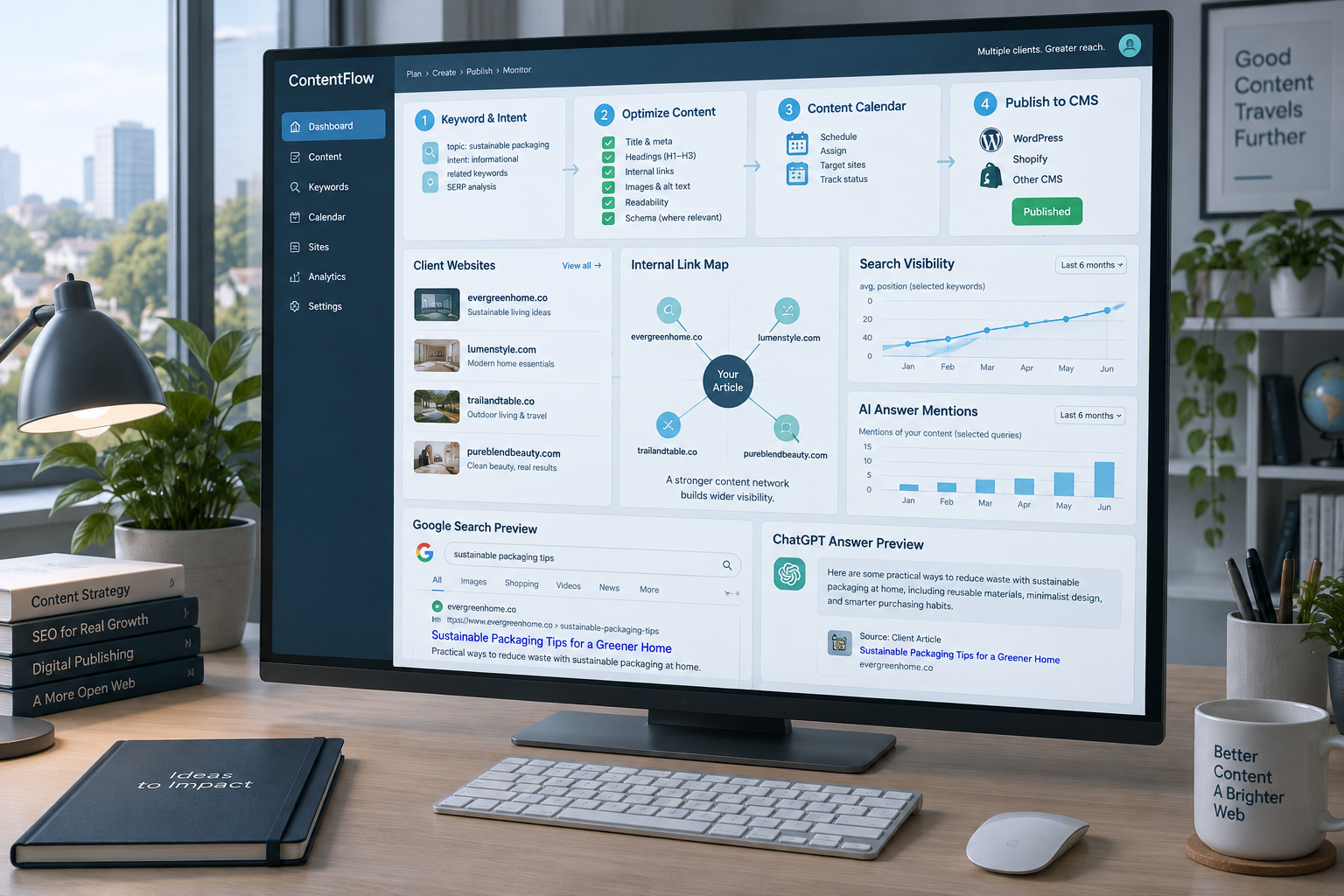
No tool guarantees rankings — that claim alone should disqualify a vendor. What a good platform can do is structure content the way both search engines and AI answer engines actually parse it: clear headings, direct answers near the top, and internal linking that signals topical depth.
Getting cited inside ChatGPT or Perplexity answers depends heavily on how directly a page answers a specific question in its first few sentences, similar to how featured snippets work on Google. Content that buries the answer under three paragraphs of preamble rarely gets pulled into an AI-generated summary, regardless of how well it's written.
Competitor analysis features matter here too. A platform that checks what's already ranking for a target keyword before drafting can avoid duplicating an angle that's already saturated. That's different from just avoiding plagiarism — it's about finding the gap a competitor's article missed.
If you're testing platforms before committing budget, starting with a free trial on one real site is the lowest-risk way to see how the automation actually performs against your own analytics, rather than trusting a demo. DraftSEO.ai offers a free trial with initial credits, and you can check current plans on the DraftSEO.ai pricing page before deciding how many sites to connect.
Frequently Asked Questions
Can AI-generated content actually rank on Google in 2026?
Yes, if it's structured around real keyword research and search intent — Google doesn't penalize content for being AI-written, only for being thin or unhelpful. Proper heading structure and internal linking matter more than the writing tool used.
Will AI detection tools get my content flagged or penalized?
Google doesn't use AI detectors to penalize rankings directly, but low-effort, unedited AI text often reads as thin content and underperforms anyway. Running samples through a checker like Originality.ai is more useful for catching quality issues than avoiding a phantom penalty.
Is more content volume always better for SEO?
No. Publishing 30 unfocused articles a month usually underperforms 10 well-targeted ones, since each page still needs to earn its own keyword relevance and internal links to matter.