Jul 22, 2026

Tool for Content Writing: AI Articles on Autopilot
DraftSEO Team
Google's own systems evaluate hundreds of billions of pages, and the sites that keep pace publish on a schedule, not in bursts. That's the math behind why a tool for content writing has become standard infrastructure for anyone chasing organic traffic in 2024, rather than a nice-to-have. The real question isn't whether AI can write a blog post. It's whether the tool you pick can write 30 of them a month, structure each one for ranking, and actually get it published without you touching a CMS dashboard.
That distinction separates two very different product categories, and most comparison articles miss it entirely.
What Counts as an Autopilot Content Tool
An autopilot content tool is software that researches, writes, structures, and publishes SEO articles on a recurring schedule with minimal manual input, distinct from a chatbot you prompt one article at a time. The word "autopilot" refers specifically to the publishing cadence, not just the writing step.
This distinction matters because most people searching for a tool for content writing have already tried the manual route: opening a general-purpose AI chat window, pasting in a topic, copying the output into WordPress, formatting it, adding a featured image, and hitting publish. That works for one article. It falls apart at scale, because every step still requires a human.
A genuine autopilot platform removes the copy-paste layer entirely. You give it a niche, a set of target keywords or a sitemap to learn from, and a publishing cadence. From there it handles topic selection, drafting, internal linking, and delivery straight to your site's content management system. DraftSEO.ai is built around exactly this model: it generates 30 articles a month for each connected site and pushes them out through direct integration, so the output isn't a folder of drafts waiting on you.
The practical test for whether a tool qualifies as "autopilot" is simple. Ask what happens if you don't log in for three weeks. With a chatbot, nothing happens, because nothing runs without your input. With a real autopilot platform, articles are still being written, checked, and published on schedule. That gap is the entire value proposition, and it's worth testing before you commit budget to any option.
Where Generic AI Chatbots Fall Short
Tools like general-purpose chat assistants are excellent at producing a single well-written paragraph or draft when you supply detailed prompts. They are not built to track a content calendar, apply consistent SEO structure across dozens of articles, or publish anywhere. Every output still needs a human to format, optimize, and upload it.
Where Dedicated SEO Platforms Differ
A dedicated content platform treats each article as one unit inside a recurring production system. It applies the same heading structure, keyword placement, and internal linking logic to article one and article thirty, then delivers both the same way: directly to your site.
SEO Structuring: Why Article Format Decides Rankings More Than Prose Quality
Article structure, not sentence-level writing quality, is the bigger lever for ranking, because Google's crawlers and large language models alike parse headings, answer patterns, and internal links before they evaluate prose style. A beautifully written article with no clear H2/H3 hierarchy will underperform a plainer one that's structured correctly.
This is a hard truth for a lot of content teams who spent years optimizing for "great writing" alone. Ranking systems reward clear signals: a direct answer near the top of a section, descriptive subheadings, schema-friendly formatting, and internal links that establish topical relationships between pages. None of that is about vocabulary or sentence variety. It's information architecture.
The Structural Elements That Actually Move Rankings
A well-structured SEO article typically includes a handful of load-bearing elements. Skipping any one of them tends to cap how well a page performs, regardless of how good the prose is.
- A meta description under 160 characters that states the article's core benefit and includes the target keyword.
- An introduction that answers the search intent in the first 60-100 words, before any background context.
- H2 and H3 headings that carry information on their own, not vague labels like "Overview" or "More Details."
- At least one data table, numbered list, or comparison element where the content is genuinely enumerable.
- Internal links to related pages on the same site, placed where they add context rather than as an afterthought.
- A closing FAQ section addressing real search queries, formatted with direct answers in the first sentence.
Why This Format Also Wins in AI Search Results
The same structure that ranks in Google's organic results tends to get quoted directly inside AI-generated answers on platforms like ChatGPT and Google's AI Overviews. Those systems extract self-contained passages: a clear question, a direct answer, a specific number. Articles built loosely, without that pattern, rarely get pulled into an AI-generated summary at all, even when the underlying information is accurate.
A tool for content writing that ignores this structure will hand you passable prose that still needs a rewrite before it can compete. One built around SEO-first formatting saves that rewrite entirely, because the structure is baked into generation, not bolted on afterward.
Keyword Research Automation: What the Tool Should Do Before It Writes Anything
Keyword research automation means the tool identifies target terms, search intent, and content gaps on its own, rather than requiring you to hand it a finished keyword list before every article. This step happens before a single sentence gets drafted, and it's where a lot of "AI writer" tools quietly cut corners.
Feeding a generic chatbot a single keyword and asking for an article skips the entire research layer. You get content built around one phrase, with no sense of related terms, no competitive gap analysis, and no read on what a searcher actually wants at that stage of intent. That's how you end up with technically correct articles that never rank, because they solve the wrong problem.
A platform designed for automated SEO production works differently. You describe your niche once, and the system builds out a recurring list of topics based on what your site should logically cover next, factoring in gaps against what's already published on your domain. That's a meaningfully different workflow from prompting a chat window thirty separate times and hoping the topics don't overlap.
There's a caveat worth stating plainly: automated keyword research is strong at breadth and consistency, weaker at nuance in highly specialized or regulated niches. If you operate in medical, legal, or financial content where every claim needs a human compliance check, automated topic selection is a starting point, not a final word. Review the topic list before it becomes a publishing calendar, even on an autopilot system.
Volume also matters more than people expect here. A site publishing four articles a month off manually researched keywords will typically lose ground to a competitor shipping 30 articles a month against a broader, automatically maintained keyword map, even if the per-article research is less exhaustive. Coverage compounds. Perfection on four pages doesn't.
CMS Integration and Publishing Volume: The Differentiator Most Comparisons Skip
CMS integration is what separates a content generator from a content operation, because writing an article and publishing an article are two different jobs, and most comparisons only test the first one. A tool that drafts brilliant copy but dumps it into a text box you have to manually format and upload isn't actually automating anything past the writing step.
This is the gap that decides whether a tool for content writing saves real time or just moves the bottleneck. If you're running a WordPress site, an agency managing a dozen client blogs, or an ecommerce store with a product blog on a hosted platform, the publishing step is where hours disappear: formatting headings, adding featured images, setting categories, scheduling the post, checking for broken shortcodes.
Direct CMS integration removes that layer. The article lands in your site already formatted, with headings intact and internal links placed, ready to go live on the schedule you set. That's a fundamentally different product than a writing assistant, even if the underlying AI model producing the sentences is similar.
DraftSEO.ai connects directly to popular CMS platforms and pushes 30 articles a month to each connected site without a manual upload step. For a full view of what's included at each plan tier and how the publishing volume scales with your site count, the DraftSEO.ai pricing page lays out the specifics.
Volume consistency is the part that's easy to underestimate until you've tried to sustain it manually. Writing one exceptional article is a Tuesday afternoon. Writing, formatting, and publishing 30 structured articles every month, month after month, without missing a week, is an operations problem. Most in-house teams and even most agencies quietly stop hitting their publishing cadence within two or three months, because the manual steps pile up faster than anyone budgeted for.
The honest tradeoff is that autopilot publishing gives you less line-by-line control over every single post before it goes live. If your brand requires legal sign-off on every article before publication, you'll want a review step inserted into the workflow rather than pure hands-off publishing, and that's a reasonable adjustment to make, not a reason to avoid automation altogether.
Tone, Brand Voice, and Originality Checks: Keeping Output On-Brand at Scale
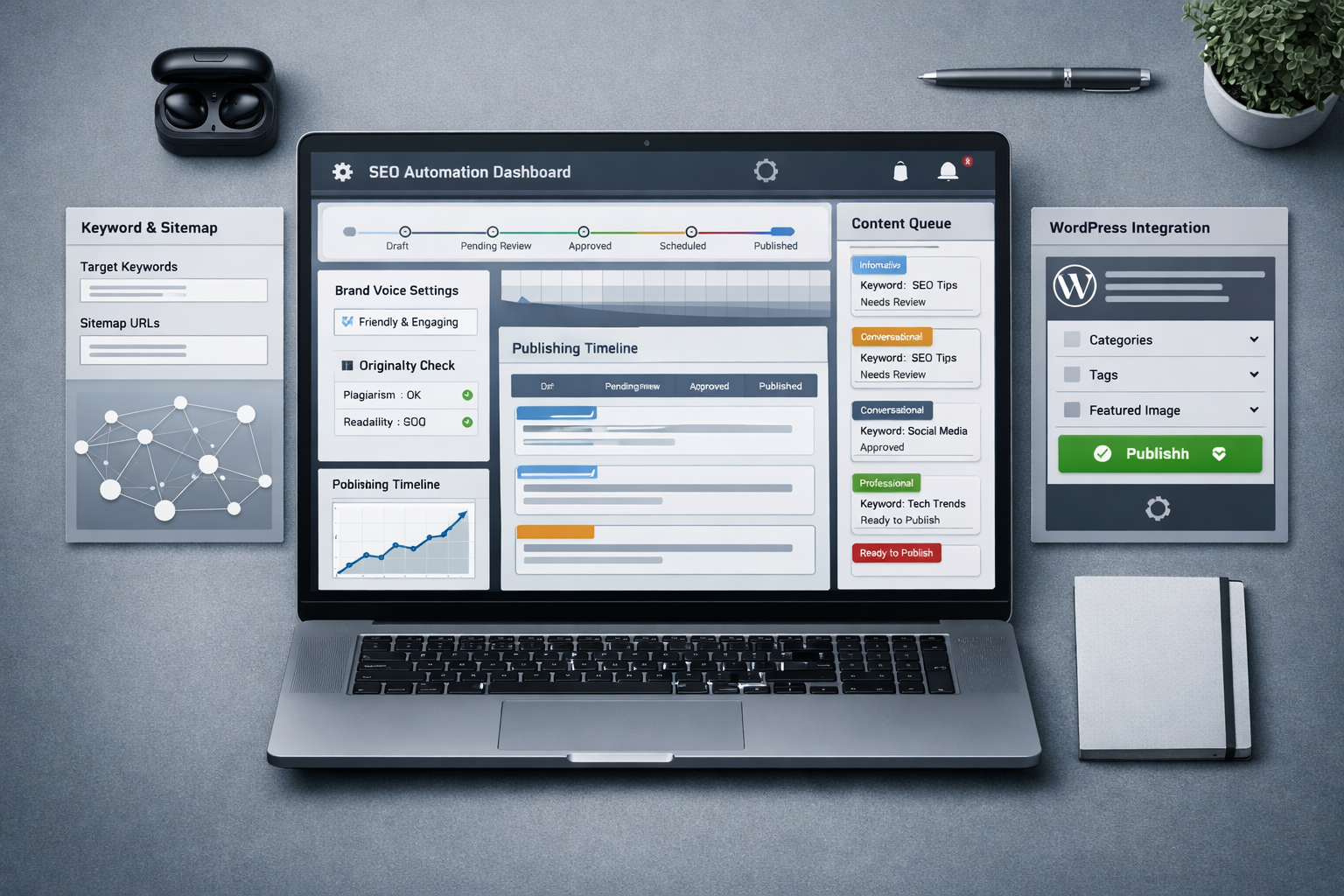
Tone and brand voice control means the tool applies a consistent writing style across every article it generates, rather than producing generic AI-sounding prose that reads the same regardless of your industry. Originality checks confirm each article is unique content, not a rehash of existing pages elsewhere.
Both matter more as volume increases. One off-brand article is a quick edit. Thirty off-brand articles a month is a pattern readers and search engines both notice, and it undercuts the credibility a site is trying to build.
Matching Voice to Niche
Voice control in a dedicated content platform typically works by learning from the niche and site context you provide, rather than a single style guide upload. An ecommerce site selling outdoor gear should read differently than a B2B SaaS blog covering compliance software, and a tool that outputs the same flat, neutral register for every niche isn't actually solving the tone problem, even if it claims to.
Why Originality Checks Aren't Optional at 30 Articles a Month
Publishing at volume raises the stakes on duplicate or near-duplicate content, both across your own site and against the broader web. Search engines penalize thin or repetitive content, and an autopilot system generating dozens of articles a month needs some built-in check against overlap, both internally and externally, before anything goes live.
The practical takeaway: don't treat tone and originality as a one-time setup step. Review a sample of output every few weeks, particularly in the first month or two, and adjust the niche description or topic scope if the voice drifts. Automation reduces manual work; it doesn't remove the need for oversight entirely.
Comparing the Main Options: Chatbots, Point Solutions, and Full Autopilot Platforms
Most buyers researching a tool for content writing are really choosing between three categories, and each one solves a different piece of the problem. Understanding what each category is actually built for prevents the common mistake of comparing a chatbot's writing quality against a dedicated platform's publishing consistency, as if they're competing on the same axis.
General-purpose AI chat assistants are strong at flexible, prompt-driven writing for a single piece at a time. They have no native SEO structuring, no publishing integration, and no memory of what your site has already covered unless you feed that context in manually every time. Point solutions, like a standalone AI writing plugin, often add SEO scoring on top of a chatbot's output but still require a human to trigger each article and manage the publishing step. Full autopilot platforms handle research, structuring, and publishing as one continuous pipeline.
| Category | SEO structuring built in | CMS publishing | Typical monthly output without manual work |
|---|---|---|---|
| General AI chatbot (prompted manually) | No | No | 0 (fully manual upload) |
| SEO-focused writing plugin | Partial (scoring, not structuring) | Rarely direct | 4-8, with manual review each time |
| Full autopilot platform (e.g., DraftSEO.ai) | Yes | Yes, direct to CMS | 30 per connected site |
The gap in that last column is the whole story. A chatbot can produce a genuinely well-written article, but the moment you need consistent monthly volume delivered to a live site, the manual steps become the bottleneck, not the writing itself. A platform built to publish 30 articles a month automatically removes that bottleneck by design, not by asking you to work faster.
It's worth being direct about a limitation here too: no autopilot tool, including the ones in that top row, guarantees rankings. Search rankings depend on domain authority, backlink profile, competition in your niche, and Google's ongoing algorithm changes, none of which any content tool controls. What a well-structured autopilot platform controls is whether your content is technically positioned to compete once those other factors are in play. Skipping that positioning step and assuming any AI writer guarantees a ranking outcome is the single most common mistake buyers make in this category.
Pricing, Free Trials, and What to Test Before You Commit

Pricing across this category typically scales with the number of connected sites and the monthly article volume, and most credible platforms offer some form of free trial so you can evaluate output before paying. The trial period is the single most useful part of the buying process, because writing samples on a marketing page never tell you how a tool handles your actual niche.
Treat the free trial as a structured test, not a casual look. Pick a real topic from your existing content calendar, one you'd normally assign to a writer, and run it through the trial. Check the heading structure, verify the keyword placement feels natural rather than stuffed, and confirm the article would need minimal editing before going live. If it needs a full rewrite, that tells you something concrete about how much ongoing work the tool actually saves.
DraftSEO.ai offers a free trial with starting credits, which is enough to generate real articles against your own niche before deciding on a paid plan. That's a meaningfully different evaluation than reading a sample article on a homepage, because it uses your actual keywords and your actual site context rather than a cherry-picked demo.
A few questions are worth answering during any trial period, regardless of which platform you're testing: Does the output integrate with your CMS without manual reformatting? Does the tone match your niche without heavy editing? Does the tool maintain quality at article five the same way it did at article one? That last question matters more than people expect, since consistency across volume is exactly where manual and semi-automated workflows tend to break down first.
If you're ready to run that test on your own site, the DraftSEO.ai pricing page is where the trial credits and plan details are laid out, and starting there costs nothing but the time it takes to describe your niche and pick a first topic. The honest way to judge any tool for content writing is against your own content calendar, not a demo article written for someone else's industry.
Frequently Asked Questions
Is an AI content tool enough to rank on Google by itself?
No. SEO structuring, keyword targeting, and consistent publishing volume improve a page's chances, but rankings also depend on domain authority, backlinks, and competition that no content tool controls directly.
How is a dedicated SEO content platform different from just using ChatGPT?
A dedicated platform automates research, SEO structuring, and direct publishing to your CMS on a recurring schedule. A general chatbot writes one draft per prompt, with no built-in publishing or topic-calendar automation.
How many articles a month should a small site realistically publish?
Volume depends on niche competitiveness and site age, but many autopilot platforms, including DraftSEO.ai, are built around generating 30 articles a month per connected site, which suits most growth-stage content plans.
Do I still need to edit AI-generated articles before they go live?
A quick review is worth doing, especially in regulated niches, but well-structured autopilot output needs far less editing than raw chatbot drafts, since formatting, headings, and internal links are already applied before publishing.