Sep 19, 2026

Tone Writing Examples for Better SEO Content
DraftSEO Team
Google's helpful content system, rolled out in 2022 and folded into core updates since, specifically targets sites that read like they were written by ten different people with ten different goals. That's what inconsistent tone looks like to an algorithm and to a reader. If you're publishing 20+ articles a month across a blog and a handful of landing pages, tone writing examples aren't a style exercise — they're a quality control tool you need before you scale content production any further.
What Tone Actually Means in SEO Content (And Why It's Not the Same as Voice)
Tone is how your content sounds in a specific moment; voice is who your brand is across every moment. A product page can turn more persuasive without abandoning the brand voice, the same way a person stays themselves while shifting from a work email to a text to their sister.
Confusing the two is the single most common mistake in style guides. A brand voice document might say "friendly, expert, no jargon." That's voice — stable, defined once. Tone is the variable layer on top: formal on a legal disclaimer page, warm on a welcome email, urgent on a cart-abandonment notice. Writers who treat tone as fixed end up either flattening every page to the same register or drifting randomly because nobody defined the boundaries.
Why This Distinction Matters at Scale
When a site publishes across multiple authors or an AI pipeline, voice should stay locked while tone flexes by page type. Skip that separation and you get one of two failure modes: robotic sameness, or chaos where every writer interprets "professional" differently.
The SEO Consequence
Google's quality raters, per the publicly available Search Quality Rater Guidelines, look for signals of expertise and trustworthiness. A site that reads like a patchwork — clinical on one post, breezy slang on the next — signals low editorial control. That's a trust signal problem, not just a style complaint.
Five Core Tones and What They Look Like in Practice
Most SEO content draws from a short list of tones, and seeing them side by side makes the differences concrete rather than theoretical.
- Formal — "Users must complete verification within 24 hours to avoid account suspension." No contractions, no slang, precise obligation language.
- Casual/conversational — "Just finish verifying within a day, or your account gets locked." Contractions, shorter clauses, direct address.
- Persuasive — "Verify now — accounts left unverified after 24 hours lose access to saved data." Urgency plus consequence, action-first sentence structure.
- Authoritative — "Verification within 24 hours is required under our security policy, based on standard two-factor protocols." Cites a rule or standard, no hedging.
- Friendly/supportive — "No rush, but pop in and verify your account within a day so nothing gets interrupted." Softened directive, reassurance built in.
Same fact, five deliveries. The sentence structure shifts along with word choice: formal tone favors longer clauses and passive constructions ("must be completed"), while casual and friendly tones favor short imperative sentences and second person. Persuasive tone leans on the imperative mood and named consequences. Authoritative tone often inserts a reference point — a policy, a number, a standard — to earn the confidence it projects.
Matching Tone to Content Type Without Breaking Brand Voice
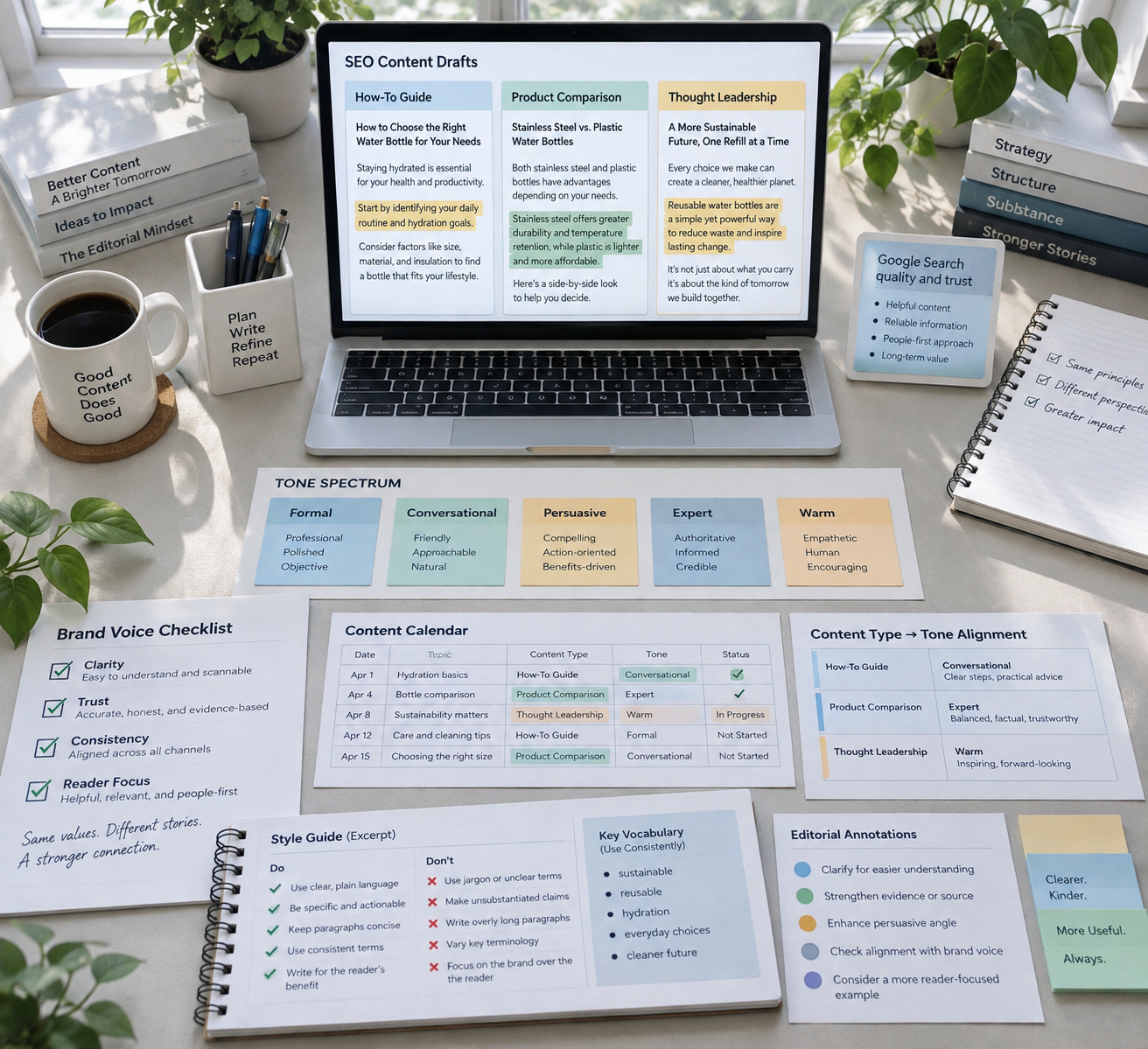
The most common overcorrection I see is sites deciding "professional" tone is safest, then applying it to a blog post, a product page, and a support article alike. That flattens engagement everywhere, because professional isn't one tone — it's a register that still needs to flex with intent.
Blog Posts: Conversational With Authority Underneath
Readers land on blog content looking for a fast, credible answer. Conversational tone with occasional authoritative asides (a stat, a named source, a specific number) performs better than either extreme alone. Pure casual tone reads thin on a technical topic; pure formal tone reads like a manual nobody asked for.
Landing Pages: Persuasive, Compressed, Specific
Landing pages carry commercial intent. Tone should be persuasive but grounded — vague hype ("the best solution ever") reads as filler and often gets buried by users scanning for real detail. A landing page that names a price, a timeframe, or a concrete outcome earns more trust than one leaning on adjectives alone.
Product Pages: Informational First, Persuasive Second
Product pages need tone that answers "what is this and will it work for me" before it tries to close. Specs and use cases in plain, direct sentences, then a persuasive nudge near the CTA — not the reverse.
| Content type | Primary tone | Secondary tone | Common mistake |
|---|---|---|---|
| Blog post | Conversational | Authoritative | Over-formalizing, losing readability |
| Landing page | Persuasive | Direct/urgent | Vague superlatives with no specifics |
| Product page | Informational | Persuasive | Leading with sales copy before specs |
| Support/help doc | Formal | Friendly | Robotic phrasing with zero reassurance |
Keeping Tone Consistent Across Multi-Author or AI-Generated Content
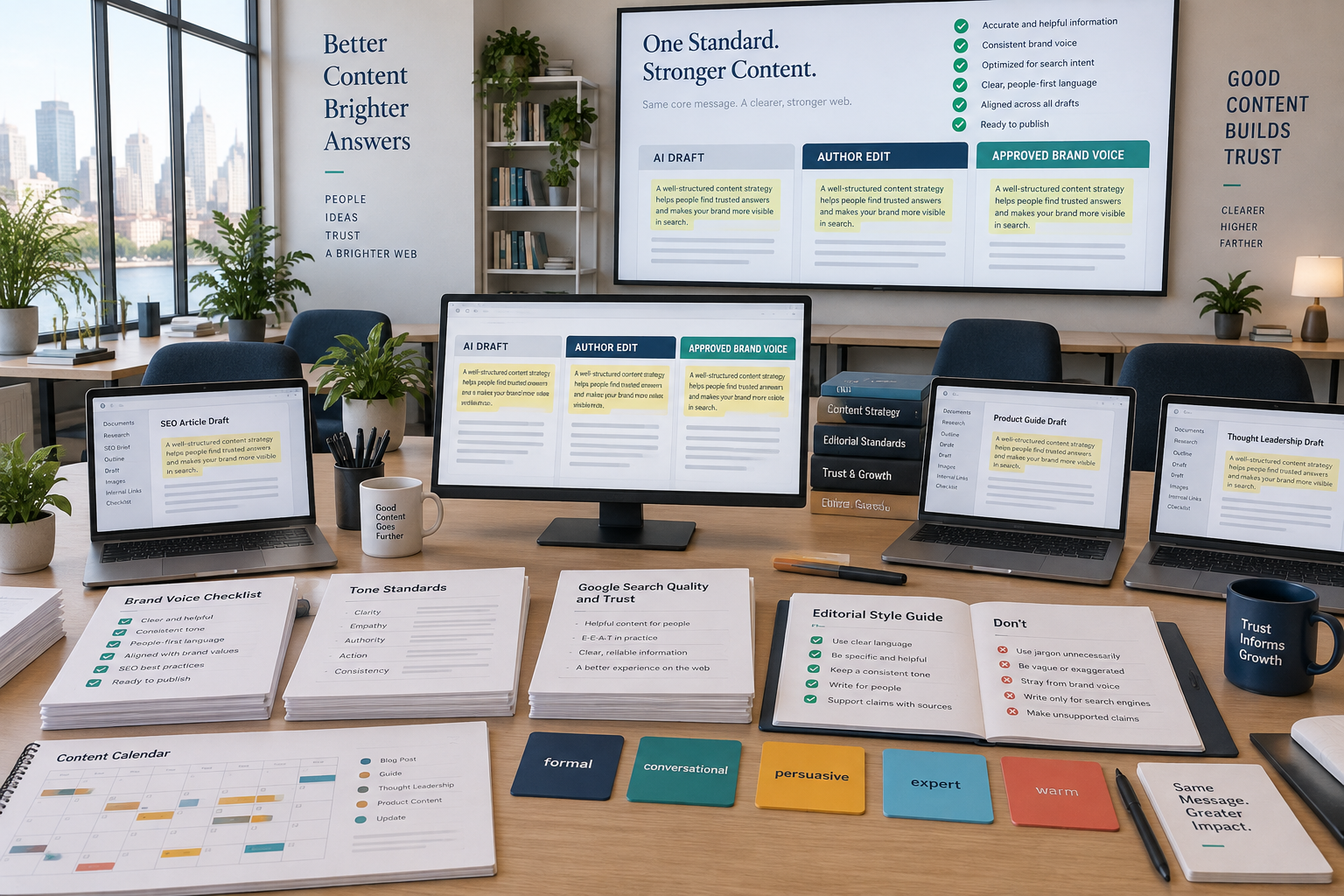
Tone drift happens fastest when multiple writers — or an AI model without explicit constraints — produce content for the same site without a shared reference. The fix is a written tone brief, not a vague "sound professional but friendly" note in Slack.
A usable tone brief names the register (formal-to-casual, on a defined scale), gives 2-3 sentence-level examples per content type, and lists banned patterns (excessive exclamation points, hedge words like "might possibly," AI-sounding filler like "in today's digital world"). Hand that brief to a freelancer, an in-house writer, or an AI tool, and the output stays inside a predictable range instead of swinging wildly post to post.
This is where automated content pipelines either help or hurt. A platform like draftseo.ai, which generates SEO articles on a recurring schedule, needs those tone parameters set once at the niche or brand level so every monthly batch stays aligned instead of needing a manual tone edit on every draft. Skipping that setup step is the most common reason automated content programs get flagged as inconsistent by editors reviewing six months of output at once.
Readability and tone interact more than most style guides admit. A formal tone with 25-word average sentence length will often push a Flesch reading score down into territory that hurts skimmability, even if every sentence is grammatically correct. Casual tone naturally shortens sentences and lowers pronoun-heavy complexity, which is part of why conversational blog tone tends to outperform stiff, formal blog tone on time-on-page metrics.
Frequently Asked Questions
What's the difference between tone and voice in content writing?
Voice is your brand's fixed personality across all content; tone is how that personality adjusts per page or situation. A brand voice stays "direct and knowledgeable" while tone shifts from persuasive on a landing page to reassuring on a support article.
How do I fix inconsistent tone across old blog content?
Audit a sample of 10-15 posts against a written tone brief, flag the outliers, and prioritize rewrites on pages ranking near page one — since those get the most reader and crawler attention. A full rewrite of every post is rarely worth the time; targeted fixes on high-traffic pages matter more.
Can AI-generated content match a specific brand tone reliably?
Yes, if you give the model explicit tone rules — sentence length range, banned phrases, 2-3 worked examples — rather than a one-word descriptor like "professional." Vague prompts produce generic, detectable AI tone; specific briefs produce output close to what a trained human writer would deliver.