Jul 28, 2026

SEO Do-It-Yourself for Content Creators in 2026
DraftSEO Team
Google's algorithm updates in 2024 and 2025 pushed out an estimated wave of thin, outdated content — the Helpful Content system merged into core ranking signals in 2024 specifically to penalize pages that add nothing new. That shift changed what SEO do-it-yourself actually means for a solo creator or small team in 2026. It's no longer about writing one great post a month. It's about output.
Most people attempting SEO do-it-yourself already know the fundamentals: keywords, backlinks, on-page structure. What they lack isn't knowledge. It's the publishing volume to compete with sites that ship three times as much optimized content, every month, without adding staff.
Why Knowledge Alone No Longer Wins Rankings
The bottleneck in SEO do-it-yourself work has moved. It used to be information — figuring out what Google wanted. Now it's throughput: how many well-structured, well-researched pages you can get live per month, consistently, without burning out or hiring a content team.
A solo creator who fully understands search intent, internal linking, and Core Web Vitals can still lose to a competitor publishing 15-20 articles a month versus their 4-5. Google rewards topical depth across a site, not just quality on individual pages. Ranking for a competitive commercial term often requires dozens of supporting pages covering adjacent long-tail queries, comparison content, and FAQ-style pages that capture featured snippets.
This is the part most DIY guides skip. They'll tell you to write "high-quality, in-depth content" without addressing the math: if quality content takes 4-6 hours to research, draft, and format, a single person tops out around 15-20 articles a month even working full-time on content alone. Most solo creators and small agencies don't have that much time to spare — they're also doing client work, product development, or running the business the site supports.
The fix isn't lowering your standards. It's changing your workflow so research and drafting take a fraction of the time they used to, freeing you to focus on editing, strategy, and the technical work that AI tools can't do for you yet.
Treat SEO as an ongoing production system, not a project with an end date. A site that published 20 solid articles in January and nothing since is going to plateau and then decline, because competitors who kept publishing will out-rank it on freshness and topical coverage within two or three months.
Keyword Research That Actually Feeds a Publishing Calendar
Keyword research for SEO do-it-yourself in 2026 means building a running list of 50-100+ target terms organized by intent and difficulty, not picking five keywords and writing about them once. The goal is a pipeline, not a one-time list.
Tools Worth Paying For
Ahrefs and Semrush remain the standard for keyword difficulty scoring and competitor gap analysis — both run roughly $99-129/month at entry tiers as of 2025 pricing. Google Keyword Planner is free but tuned for ad spend, not organic difficulty, so use it for volume sanity checks rather than primary research. For smaller budgets, Ubersuggest and the free tier of Google Search Console cover basic query discovery, though Search Console only shows terms you already rank for to some degree.
Turning a List Into a Calendar
The practical move is clustering: group 8-12 related keywords into a single pillar topic, then plan one comprehensive article per cluster plus 3-5 supporting pieces targeting the long-tail variations. A site selling espresso machines, for example, might cluster "best espresso machine under $500," "espresso machine vs drip coffee," and "how often to descale an espresso machine" under one buying-guide pillar.
Competitor analysis feeds this directly. Run your top three organic competitors through a content gap tool and you'll usually find 20-40 keywords they rank for that you don't touch at all. Those become your next month's calendar before you've written a single new sentence from scratch.
One caution: don't chase every keyword a tool surfaces. A term with 200 monthly searches and near-zero commercial intent isn't worth a slot in your calendar if you're capacity-constrained. Prioritize by intent match to your product or audience first, difficulty second, volume third.
On-Page Optimization: What Still Moves the Needle in 2026
On-page SEO still comes down to matching search intent precisely, structuring content so both readers and crawlers parse it fast, and answering the query in the first 100 words. That last part matters more now that Google and AI answer engines both pull direct quotes for snippets and generated overviews.
Structure for Humans and Crawlers
Use one H1, logical H2/H3 hierarchy, and headings that state something concrete rather than vague labels like "Overview" or "More Information." A heading such as "Descaling Frequency: Every 200 Cycles or 3 Months" tells a scanning reader — and a scanning algorithm — exactly what's below it.
Formatting for AI Answer Engines
Answer engines including ChatGPT and Google's AI Overviews favor content with self-contained answers: a direct response in the first sentence or two of a section, understandable without reading the rest of the page. This is a meaningful shift from 2020-era SEO advice, which optimized purely for human scroll behavior. Write your first paragraph under each heading as if it might get pulled out and quoted alone.
Title tags and meta descriptions still matter for click-through rate, even though they carry limited direct ranking weight. Keep title tags under roughly 60 characters and meta descriptions in the 105-155 character range, with the primary keyword near the front of both.
Internal linking deserves more attention than most DIY checklists give it. Every new article should link to at least 2-3 existing pages using descriptive anchor text, and older cornerstone pages should get updated with links to new supporting content as it publishes. This is one of the few genuinely free ranking boosts left, and it's also one of the most commonly skipped steps because it requires going back into old posts rather than just publishing something new.
The Technical Health Check You Can't Skip
A content strategy built on a slow, broken, or badly indexed site is wasted effort. Technical SEO audits catch problems keyword research and content quality can't fix — and they need to happen on a schedule, not once at launch.
Core Web Vitals and Site Speed
Google's Core Web Vitals — Largest Contentful Paint (LCP), Interaction to Next Paint (INP), and Cumulative Layout Shift (CLS) — measure real loading and interaction performance. Target an LCP under 2.5 seconds and a CLS score under 0.1. On WordPress, the most common speed killers are unoptimized images, too many active plugins, and shared hosting that chokes under traffic spikes. A caching plugin like WP Rocket combined with an image compression tool such as ShortPixel fixes a large share of speed problems without touching code.
Crawl and Index Health
Google Search Console is the free tool for this and should be checked weekly, not quarterly. Watch the Coverage and Page Indexing reports for pages marked "Crawled – currently not indexed," which usually signals thin or duplicate content Google decided wasn't worth including. The Core Web Vitals report inside Search Console flags URLs failing performance thresholds directly.
Run a full technical audit — crawl errors, broken links, duplicate title tags, orphaned pages with no internal links pointing to them — at minimum once a quarter. Tools like Screaming Frog (free up to 500 URLs) or the site audit modules in Ahrefs and Semrush automate most of this. Treating a technical audit as a one-time setup task instead of a recurring maintenance job is one of the most common DIY mistakes, and it's why sites that ranked well 18 months ago quietly lose ground: link rot, slow-creeping page speed regressions, and plugin bloat accumulate without anyone noticing until traffic drops.
WordPress SEO Plugins and the Tooling Stack
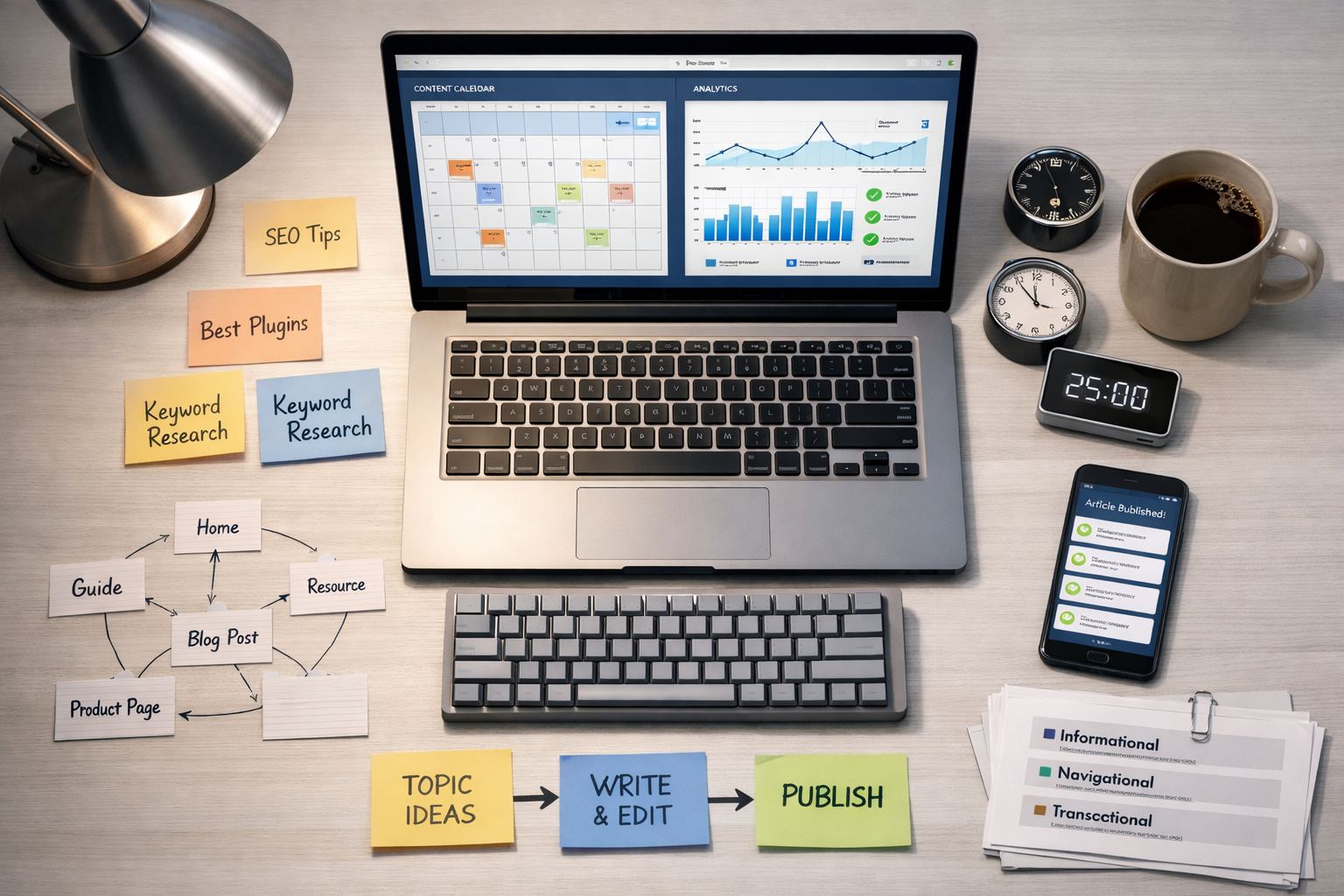
For most content creators, WordPress remains the default platform, and plugin choice affects a meaningful slice of the technical work. Yoast SEO and Rank Math both handle meta tags, XML sitemaps, and schema markup out of the box, with Rank Math's free tier including more built-in schema types as of its 2025 feature set.
Pick one SEO plugin and configure it fully rather than running two that conflict with each other's sitemap generation — a surprisingly common setup mistake that creates duplicate sitemap files and confuses crawlers.
Beyond the core SEO plugin, a workable 2026 stack includes a caching plugin, an image optimizer, and a backup solution, plus whatever content workflow tool handles research and drafting. Here's how the common options stack up on cost and core function:
| Tool Category | Example Tool | Approx. Monthly Cost | Core Function |
|---|---|---|---|
| SEO Plugin | Rank Math (Free/Pro) | $0-9 | Meta tags, sitemaps, schema |
| Caching | WP Rocket | ~$6 (billed annually) | Page speed, LCP improvement |
| Image Optimization | ShortPixel | $0-8 | Compression, CLS reduction |
| Keyword Research | Ahrefs (Lite) | ~$99 | Difficulty scoring, gap analysis |
| Content Generation | DraftSEO.ai | Free trial credits, paid tiers vary | Automated research, drafting, publishing |
Total stack cost for a serious solo operation typically lands in the $110-140/month range before content generation, which is exactly the line item most DIY budgets don't account for when they plan to write everything by hand.
Backlink building rounds out the technical stack conversation, even though it's less "technical" than strategic. Guest posts on relevant niche sites, digital PR around original data or tools, and reclaiming unlinked brand mentions are the three approaches that still work in 2026 without paying for obviously manipulative link schemes that risk a manual penalty.
Scaling Publishing Without Adding Headcount
This is where SEO do-it-yourself either works or quietly fails. A creator who nails every technical and on-page element above but publishes twice a month is still losing to a competitor shipping 20-30 optimized pieces in the same window, because Google's ranking signals reward sustained topical coverage and freshness across a domain.
The old assumption was that scaling meant hiring writers, which meant payroll, editing overhead, and inconsistent quality across contributors. That math worked in 2018. It doesn't work as well now, because AI-assisted drafting has closed the gap between "one person writing" and "a small content team writing," at a fraction of the cost and none of the management overhead.
Here's a realistic monthly production sequence for a solo creator using an AI-assisted workflow rather than a fully manual one:
- Run keyword and competitor gap research to build or refresh the content calendar for the month.
- Group keywords into 5-8 topic clusters with a pillar page and 2-4 supporting articles each.
- Feed cluster topics into an AI content generation tool configured for the site's niche and tone.
- Review and edit each draft for factual accuracy, brand voice, and internal linking opportunities.
- Add schema markup, optimize images, and set meta titles/descriptions before scheduling.
- Publish on a fixed weekly cadence rather than in irregular batches.
- Check Search Console weekly for indexing issues and Core Web Vitals regressions on new pages.
Solo creators and small agencies handling every one of those seven steps by hand typically cap out around 15-20 articles monthly if content is their sole job — and far fewer if it isn't. Tools like DraftSEO.ai are built specifically to close that volume gap: the platform generates 30 articles monthly for connected sites and integrates with popular CMS platforms for publishing, which turns steps 3 through 6 above into something closer to a review-and-approve workflow instead of a from-scratch writing job. That's the difference between a site adding four articles a month and one adding thirty, using the same one or two people.
If budget is the real constraint rather than time, it's worth comparing what a part-time freelance writer costs against a monthly content generation plan before deciding how to scale — the pricing math usually favors an automated workflow once you're past 10-15 articles a month, and full plan details are on the DraftSEO.ai pricing page.
The honest caveat here: AI-drafted content still needs human review before it goes live. Skipping the edit pass to publish raw output is how sites end up with factual errors, awkward brand voice, or duplicate phrasing patterns across articles — all things that hurt trust signals even when the technical SEO is sound.
Building a Cadence That Search Engines Actually Reward

Publishing consistency is a ranking factor in practice, even though Google doesn't name it directly as one. Sites that publish on a predictable schedule tend to get crawled more frequently, which means new content and updates get indexed faster.
Choosing a Realistic Frequency
A cadence of 2-3 posts per week is a strong target for a site actively trying to build topical authority in 2026, though even a firm weekly schedule beats sporadic bursts of ten articles followed by two months of silence. Search engines seem to interpret irregular publishing as a signal that the site isn't actively maintained, which can slow crawl frequency over time.
Auditing and Refreshing Old Content
Cadence isn't only about new articles. Set a recurring quarter-by-quarter review of your highest-traffic pages, updating statistics, screenshots, and outdated claims. A page that ranked in position 4 a year ago can slide to page two simply because a competitor refreshed their content and yours sat static — this is one of the most overlooked parts of SEO do-it-yourself, since publishing something new always feels more productive than fixing something old.
Don't confuse cadence with padding. Ten mediocre articles a month that don't answer the query fully will not outperform six that do — but ten well-researched articles will consistently outperform six, given equal quality per piece. That's the entire argument for AI-assisted drafting over cutting scope to meet a schedule.
For a creator or small team trying to hit that 8-12 article-per-month range consistently without hiring, an automated content pipeline that handles the drafting workload is worth testing before committing budget, and DraftSEO.ai offers a free trial with starter credits so you can see the output quality against your own niche before paying for a plan.
Frequently Asked Questions
How long does it take to see results from SEO do-it-yourself efforts?
Expect 3-6 months before new content shows meaningful ranking movement, and longer for competitive commercial terms. Sites publishing consistently on a weekly cadence tend to see compounding gains faster than those publishing sporadically, since Google needs repeated crawl signals to trust a domain's topical authority.
Can I really do SEO myself without hiring an agency?
Yes, for most small to mid-sized sites — the core skills (keyword research, on-page structure, technical audits) are learnable and don't require specialized certification. The real constraint is output volume, which is why AI-assisted drafting tools matter more than agency budgets for solo creators in 2026.
Do I need to know how to code to fix technical SEO issues on WordPress?
No. Most technical fixes — caching, image compression, schema markup, sitemap generation — are handled through plugins like Rank Math and WP Rocket with no code required. Coding knowledge helps for advanced fixes like custom schema or server-level redirects, but it isn't a prerequisite for a solid DIY setup.
How many articles per month should a content creator actually publish?
Aim for 8-12 articles monthly at minimum to build topical authority, with 15-30 being competitive for sites targeting commercial or high-difficulty keywords. Manual writing caps most solo creators around 15-20 monthly; AI-assisted workflows are what make the higher end of that range achievable without hiring.