Sep 8, 2026

Posting Format for SEO Articles That Rank
DraftSEO Team
Google's own documentation on featured snippets confirms that roughly 40-50% of search queries trigger some kind of snippet result, and the pages that win those spots almost always share one trait: a posting format built for extraction, not just reading. If you're still formatting articles the way you did in 2018 — big paragraphs, sparse headings, one CTA at the bottom — you're leaving those placements on the table. The posting format question isn't cosmetic. It decides whether Google and tools like ChatGPT can actually parse what you wrote.
Heading Hierarchy: Why H2s Without Structure Confuse Crawlers
A clean heading hierarchy means one H1, several H2s for main sections, and H3s nested only under the H2 they support. This isn't a style preference — it's how crawlers and language models build a map of your content's logical structure. Break the nesting and you break the map.
The most common mistake here is stacking H2s one after another with no H3s at all, even when a section clearly has sub-points. A "Best Running Shoes for Flat Feet" article that lists five shoe brands as five separate H2s, instead of nesting them as H3s under one H2 called "Top Picks," reads as flat and directionless to both a skimming human and a parsing algorithm.
Getting the Nesting Right
Every H3 should belong to exactly one H2 above it — never orphaned, never skipping a level straight to H4. Keep H2s to genuine main sections; five to eight per 1,500-word article is typical. If a section needs sub-points, use H3s rather than bolding fake headings inside a paragraph, which crawlers can't interpret as structure at all.
The Slug and Title Connection
Your URL slug should mirror the H1 in shortened form — lowercase, hyphenated, no stop words. A post titled "The Complete Posting Format Guide for SEO Articles" should live at a slug like /posting-format-seo-articles, not a auto-generated string of numbers. Consistency between slug, title tag, and H1 gives search engines three matching signals instead of three competing ones.
Meta Title and Description: The 155-Character Rule Nobody Follows Correctly
Google typically displays 50-60 characters for a title tag and 105-155 characters for a meta description before truncating. Miss that range and your snippet either gets cut off mid-sentence or wastes space that could carry more keyword-relevant information.
Writing a meta description isn't the same job as writing ad copy, even though it functions like it. The description needs to state, plainly, what the page answers — include the primary keyword once, state the concrete benefit, and stop. "Learn how X works" is weak; "See the exact 5-step process for X, with real cost ranges" gives the searcher a reason to click over a competing result.
Search intent match matters more here than density. A description stuffed with keyword variations but no clear answer will get outranked by a plainer one that actually tells the searcher what they'll get. Google's snippet rewriting also kicks in more often when your written description doesn't match the page content — so write the description last, after the article is final.
Featured Snippet Formatting: Lists, Tables, and the 40-60 Word Answer Box
The direct-answer paragraph is the single highest-leverage formatting habit for ranking in position zero. Answer the question in the first 40-60 words under a question-shaped heading, then expand. Google's snippet algorithm pulls short, self-contained chunks — usually a paragraph, a list, or a table — and prioritizes the one that answers cleanest.
Numbered lists win snippets for anything sequential: steps, rankings, "top 5" content. Tables win for anything comparative: prices, specs, feature-by-feature breakdowns. Plain paragraphs still win for definitional or single-fact questions. Picking the wrong format for the intent is why some well-written pages never surface in a snippet at all.
| Content Type | Best Format | Why It Gets Picked |
|---|---|---|
| Step-by-step process | Numbered list | Google extracts sequence directly |
| Price/spec comparison | Table | Rows map cleanly to attributes |
| "What is X" definition | Short paragraph | No sequence or comparison needed |
| Pros and cons | Bulleted list | Enumerable, non-sequential items |
A repeatable sequence for building any answer section looks like this:
- State the direct answer in one to two sentences immediately under the heading.
- Add one concrete number, example, or named detail in the next sentence.
- Expand with a caveat or edge case in a short second paragraph.
- Insert a list or table only if the content is genuinely enumerable or comparative.
- Link internally to a related, deeper page on the same subtopic.
- Add an image with descriptive alt text if the section benefits from a visual.
- Close with a detail, not a summary restating the answer.
Readability and On-Page Elements: Paragraph Length, Links, Alt Text, and Schema
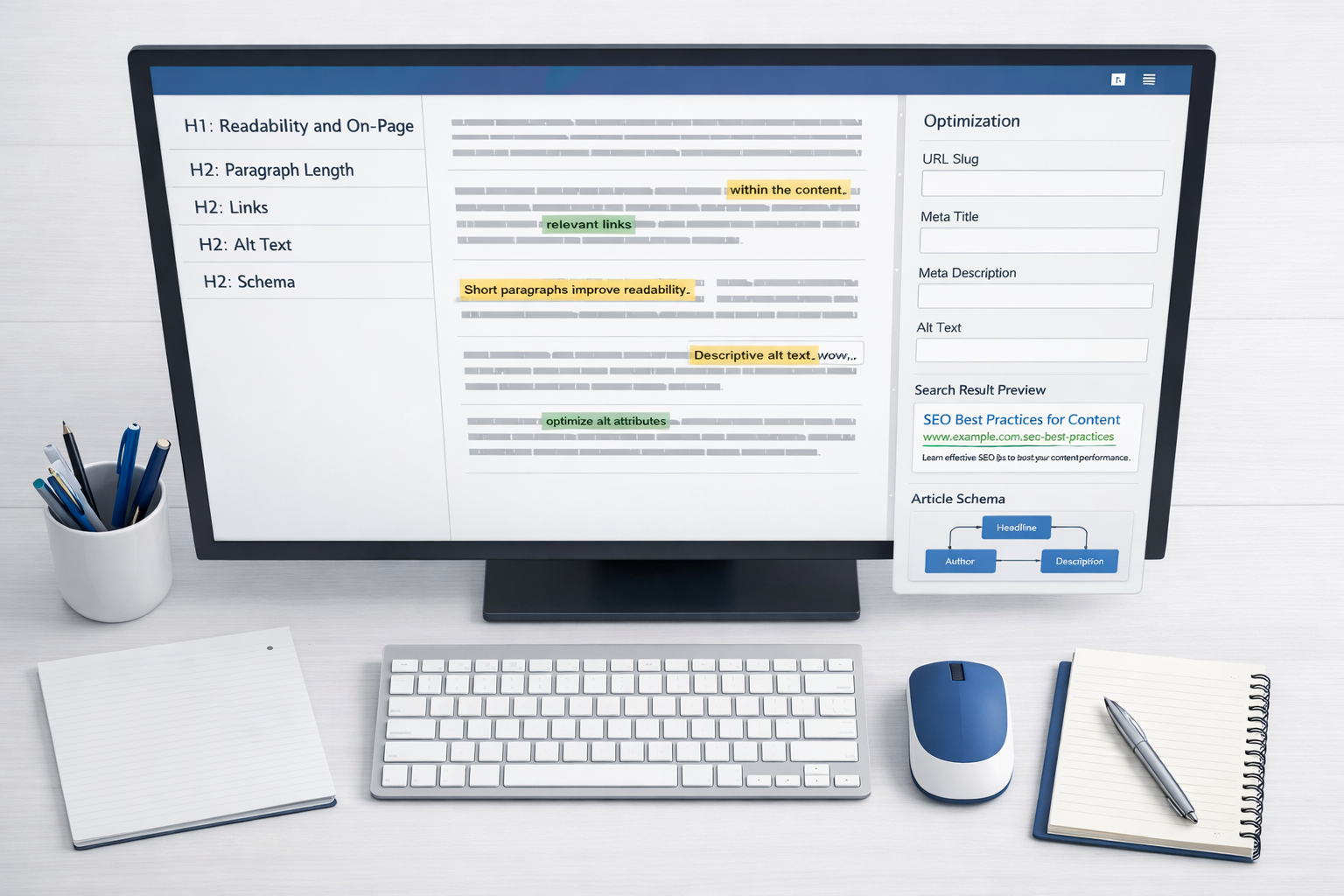
Paragraphs longer than roughly 80-100 words hurt readability scores and increase bounce rate on mobile, where over 60% of organic search traffic now happens. Keep most paragraphs to two to four sentences. A wall of text isn't a ranking penalty by itself, but the behavioral signals it produces — fast bounces, short time on page — correlate with lower rankings over time.
Internal and External Linking
Link internally to two or three related articles using descriptive anchor text, not "click here." Link externally to one or two authoritative sources when citing a statistic — this signals topical credibility without sending all your link equity outward. Both should happen naturally in the first half of the article, not bunched at the end.
Images, Alt Text, and Schema Markup
Every image needs alt text that describes its content in plain language, not stuffed keywords — "chart comparing paragraph length to bounce rate," not "posting format SEO best practices image 1." Add FAQ schema and Article schema markup where your CMS supports it; this is what lets Google render rich results and what AI engines use to extract clean question-answer pairs for their own summaries.
Scaling the Format Without Losing It
The real payoff of a fixed posting format isn't any single rule above — it's speed. A team that locks down heading hierarchy, answer-box placement, and schema once can apply that template to every new article without relitigating structure each time. That consistency is what lets a content operation scale from a handful of posts a month to dozens without every article needing a manual formatting pass. Platforms like DraftSEO.ai build that repeatable structure into the generation process itself, applying the same heading logic, snippet-ready answer formatting, and schema markup automatically to every article a site publishes, which is where format stops being a checklist and starts being infrastructure.
Publishing at Scale: Consistency Over One-Off Perfection
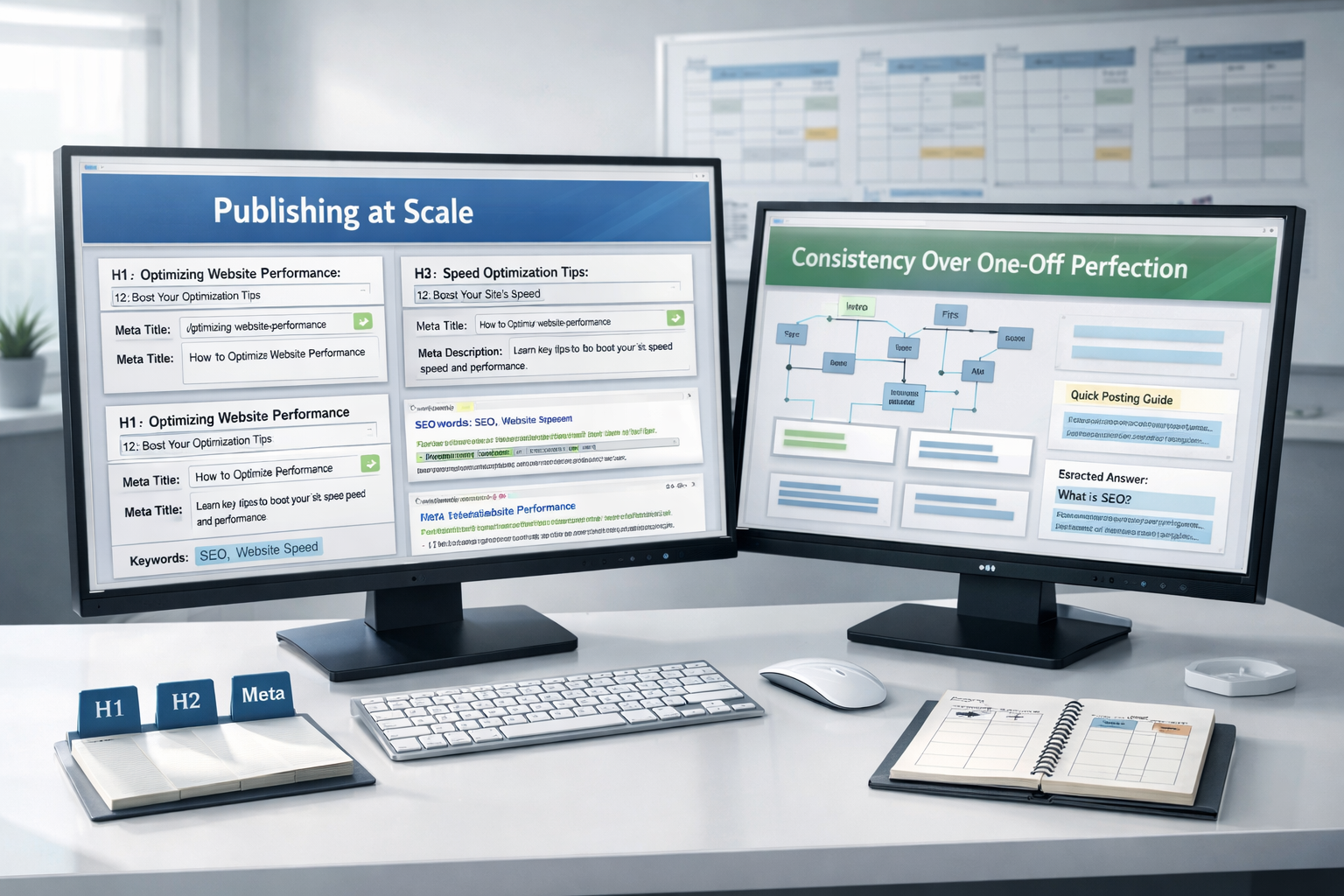
Formatting one article well is a few hours of work. Formatting 30 articles a month, correctly and consistently, without a documented system, is where most content teams fall apart — headings drift, schema gets skipped, alt text becomes an afterthought on article twenty-two. Consistency, not any single formatting trick, is what separates sites that scale organic traffic from sites that plateau.
If your CMS is WordPress, or another major platform, publishing formatted content at scale gets easier when the structure — heading hierarchy, meta fields, schema, internal links — is built into the generation step rather than fixed after the fact. DraftSEO.ai generates 30 SEO-formatted articles a month for connected sites and integrates with popular CMS platforms for direct publishing, and you can test the formatting and output quality yourself through the free trial with starter credits on the pricing page before committing to a monthly plan.
Frequently Asked Questions
Does keyword density in the posting format actually affect rankings?
No — modern search algorithms weigh logical structure and intent match far more than keyword repetition. Stuffing a keyword into every H2 without varying phrasing reads as manipulative to both crawlers and readers.
How long should an SEO article be for good formatting?
There's no fixed word count; length should match what's needed to fully answer the query, typically 800-2,000 words for most commercial topics. A well-formatted 900-word article can outrank a poorly structured 3,000-word one.
Can good formatting alone get thin content to rank?
No. Formatting improves how well existing research and intent-matched content gets read and extracted — it can't substitute for accurate information, real examples, or a genuine answer to the searcher's question.