Sep 17, 2026

Paragraph Maker for Clear, SEO-Ready Content
DraftSEO Team
Google's own documentation on helpful content says thin, unedited AI text is a ranking risk, not a shortcut. That matters if you're one of the thousands of SEO teams now producing content at volume with AI tools in the mix. A paragraph maker can speed up drafting, but the gap between "generated" and "publishable" is exactly where most content quality problems start.
This tool category sits between blank-page writing and full content automation. Used correctly, it saves real drafting time. Used carelessly, it creates pages full of generic, repetitive paragraphs that Google's helpful content systems are specifically built to spot.
What a Paragraph Maker Actually Does
A paragraph maker takes a topic, keyword, or short brief and outputs a structured block of text: a topic sentence, two or three supporting sentences, and often a transition into the next idea. It's a generation layer, not a research or fact-checking layer.
Most tools work off a language model trained on general web text, which means the output is statistically plausible but not verified against your specific facts, pricing, or product details. That's fine for a blog intro or a definitional paragraph. It's risky for anything involving numbers, dates, or claims about your business.
Core Mechanics
The better tools in this space handle three things reasonably well: sentence variety, keyword placement, and tone matching to a prompt. They handle a fourth thing poorly: knowing when a claim needs a source. That's a human editing job, every time.
Where It Breaks Down at Scale
Generate 40 paragraphs across five articles without touching the prompts, and you'll notice the same sentence openers and transition words ("moreover," "in addition," "as a result") repeating. Search engines can detect that kind of pattern-level repetition across a domain, even when no single paragraph is plagiarized.
Paragraph Structure and Readability: Why Format Beats Word Count
Readability isn't about short words. It's about paragraph shape: one idea per paragraph, a clear topic sentence up top, and sentence length that varies instead of running the same 20-word pattern six times in a row. Google's readability signals reward scannable structure, and paragraph makers are genuinely good at enforcing that discipline.
A well-formed paragraph follows a simple order: claim, evidence, consequence. Say what's true, back it up, then say why it matters to the reader. Tools built for SEO content tend to default to this shape because it's what ranks. Tools built for general writing (a lot of the free browser extensions) often default to narrative flow instead, which reads fine but buries the answer a searcher wants in sentence three instead of sentence one.
Transition words matter more than people think, but only in moderation. A paragraph maker that inserts "furthermore" or "additionally" at the start of every single block is optimizing for cohesion at the cost of sounding human. Varied transitions — or none at all, just a logical next sentence — read better and perform better in on-page dwell time.
Keyword Integration Without Triggering Over-Optimization
Keyword integration means placing your target term and its natural variants where a reader and a crawler both expect them: the first 100 words, a subheading or two, and naturally through the body. It does not mean repeating "paragraph maker" five times in one section. That reads as keyword stuffing, and it can suppress rankings rather than help them.
A paragraph maker prompted with a single rigid keyword phrase will often overuse it, because the model is following the instruction literally. The fix is prompting with the keyword plus a list of related terms — AI writing tool, content generator, paragraph rewriter — so the model has room to vary phrasing while still hitting the semantic target.
A Quick Self-Check Before Publishing
- Search your draft for the exact target keyword phrase and count occurrences.
- Confirm no paragraph repeats a sentence structure used in the paragraph before or after it.
- Check that every generated paragraph has one clear topic sentence, not two competing ideas.
- Run the section through a plagiarism-free content checker if it covers factual claims.
- Verify tone and style consistency against your last three published posts.
- Replace any generic transition word with a specific one tied to the content.
- Confirm the paragraph actually answers what the heading above it promises.
Skipping step 4 is common and it's the one that causes the most damage, because AI models can echo phrasing from source material closely enough to flag as duplicate content, even without direct copying.
Where Standalone Tools Hit a Ceiling
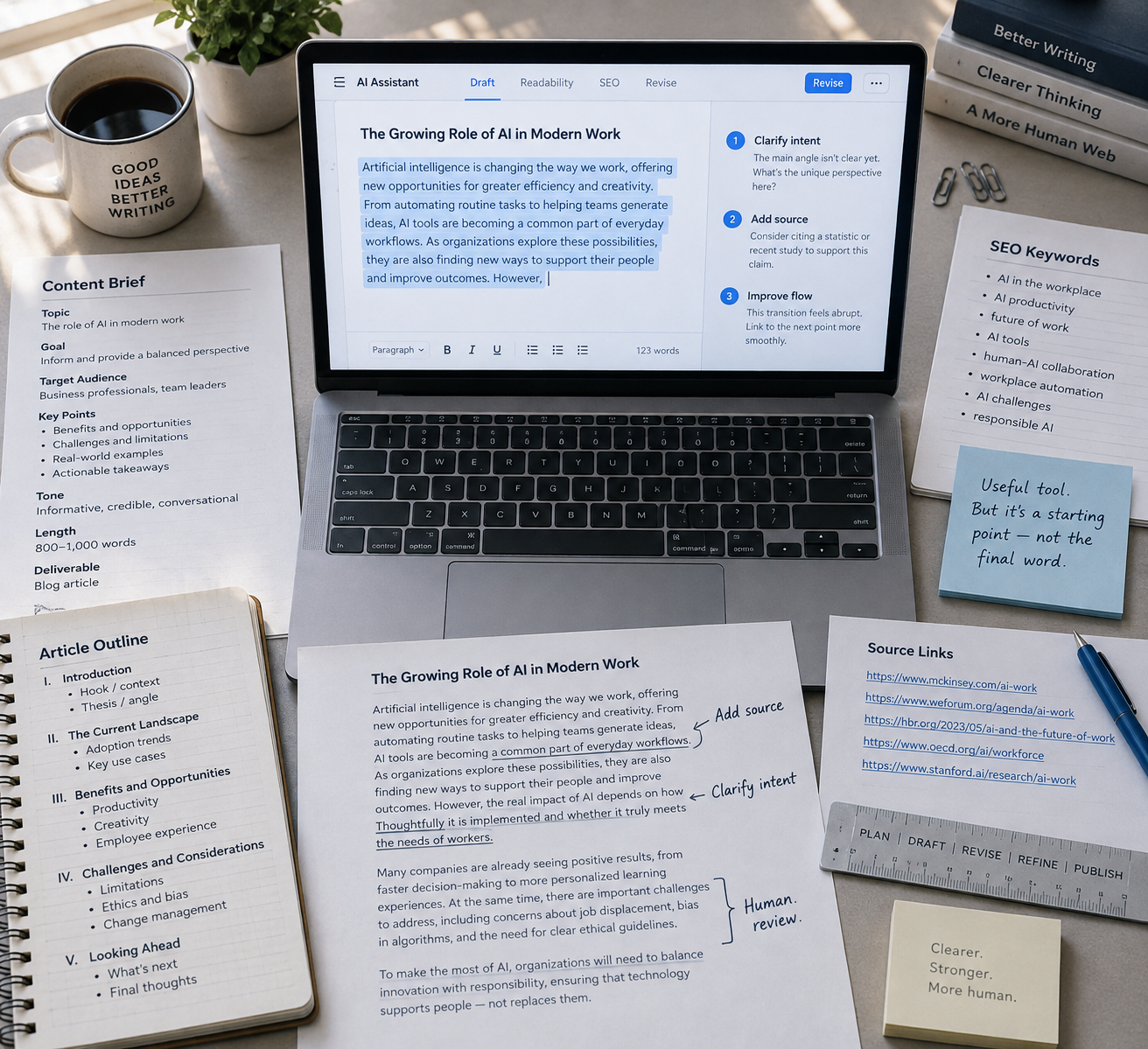
A paragraph maker fixes one paragraph. It does not fix an article. That's the core limitation for anyone trying to scale beyond a handful of posts a month: you still have to research the topic, build the heading structure, place internal links, and assemble everything into a cohesive page — and then repeat that process for every article on the calendar.
This is where the math stops working for manual paragraph-by-paragraph generation. If a team publishes 20 to 30 articles a month, editing and assembling paragraph output one section at a time turns into a full-time job by itself, on top of the actual writing.
| Approach | Handles paragraph writing | Handles structure/outline | Handles publishing |
|---|---|---|---|
| Manual writing | Yes | Yes | Manual |
| Standalone paragraph maker | Yes | No | No |
| Full content automation platform | Yes | Yes | Yes |
That's the practical argument for moving from a single-function tool to a platform that handles the whole pipeline. DraftSEO.ai generates 30 articles a month for connected sites, building the structure and keyword logic around each paragraph rather than leaving that work to a separate step, and it integrates with popular CMS platforms so finished posts publish without a manual export-and-upload routine.
Common Mistakes When Relying on Generated Paragraphs
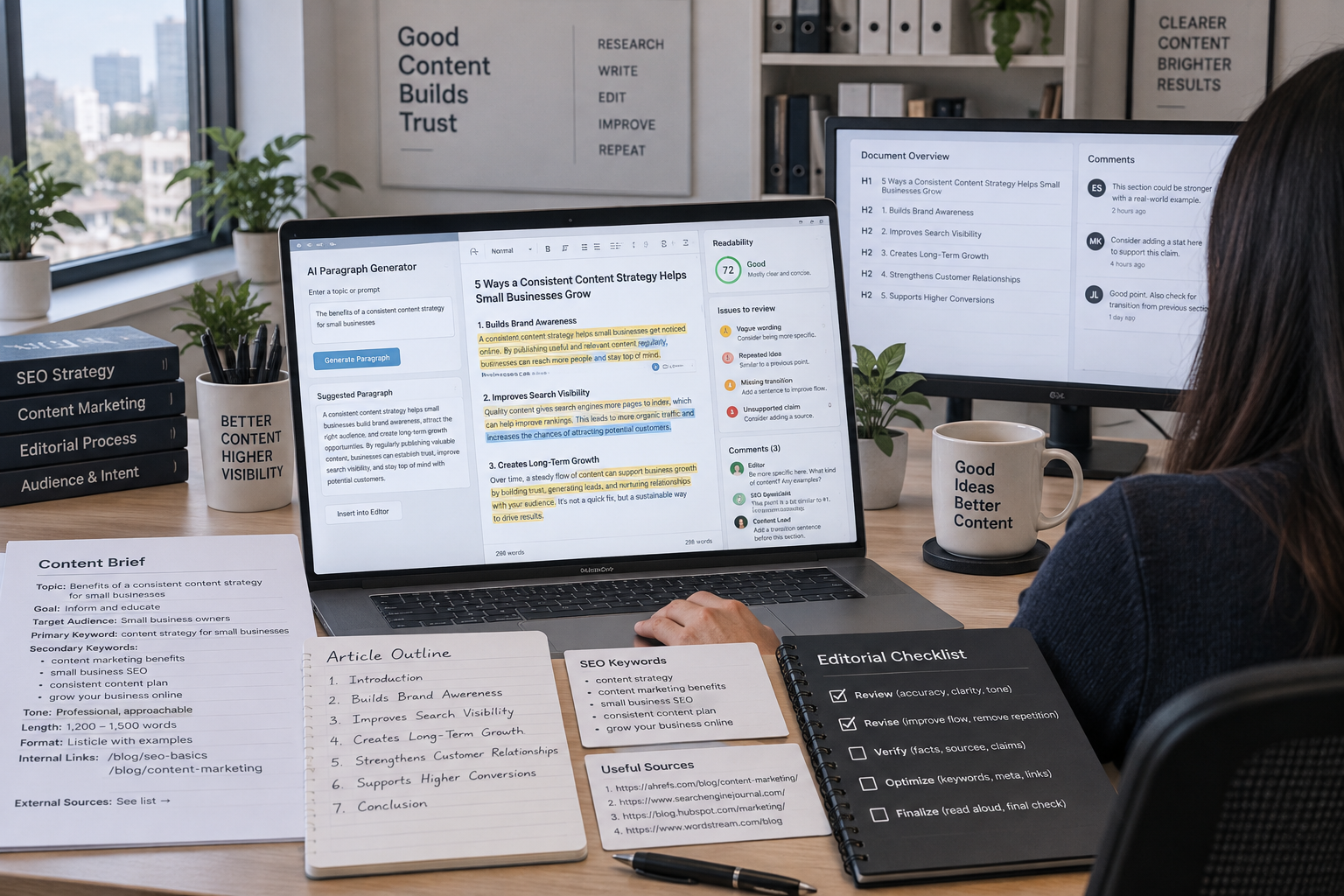
The biggest mistake is treating one generated paragraph as publish-ready without checking it for accuracy or tone. A model has no way to confirm your pricing, your product specs, or a statistic it half-remembers from training data. Every factual sentence needs a human check before it goes live.
The second mistake is assuming a paragraph maker guarantees rankings on its own. It doesn't. Clean paragraphs help readability and dwell time, but rankings depend on topical coverage, internal linking, page speed, and matching search intent — structural work that happens above the paragraph level.
Third: overusing generated blocks without checking for repetition across a page. Five well-written paragraphs can still read as five versions of the same paragraph if the model wasn't given varied instructions for each section.
Fourth, and most common among teams scaling fast: confusing a paragraph tool with a full pipeline. A paragraph maker writes sentences. It doesn't do keyword research, doesn't build the outline, and doesn't push the finished piece to WordPress. Trying to run 30 articles a month through a tool that only does step one means someone is doing steps two through five by hand, every time, and that's usually where budgets and timelines quietly blow up. Teams that want to skip that manual assembly step can start with a free trial that includes initial credits at draftseo.ai/pricing and see the full pipeline output before committing to a monthly plan.
Frequently Asked Questions
Is content from a paragraph maker considered plagiarism-free?
Generally yes, since output is generated fresh from a prompt rather than copied. Still run a plagiarism checker on factual or statistic-heavy paragraphs, since models can echo phrasing close to source material without direct copying.
Can a paragraph maker replace a content writer entirely?
No. It replaces the first-draft sentence-writing step, not research, fact-checking, structural planning, or the final edit for tone and accuracy — all of which still need a person or a full content pipeline behind them.
How many paragraphs can I realistically generate per article before quality drops?
There's no fixed limit, but quality drops when every paragraph uses the same prompt template. Vary instructions per section (topic sentence, keyword, tone note) and quality holds even across 8-10 paragraphs in one article.