Sep 12, 2026

List of Tones in Writing: 30 Examples
DraftSEO Team
Google's own algorithm documentation has talked about "helpful content" since the 2022 update, and one of the quiet signals behind that phrase is tone: whether a page sounds like it was written for a person or assembled for a crawler. A list of tones in writing gives you the vocabulary to name what's working (or drifting) across a blog, a product page, or a client's editorial calendar. Below are 30 examples, organized by where they actually show up in content work, not just in a grammar textbook.
What Tone Actually Means (and Why It's Not Voice)
Tone is the attitude a piece of writing takes toward its subject and its reader at a given moment. Voice is the underlying personality of the brand or writer that stays fixed across everything they publish. Confusing the two is the single most common mistake in content teams, and it causes real damage once you're publishing at volume.
Here's the distinction in practice: a company's voice might be "direct, no-nonsense, slightly witty." That voice shows up in a support article, a product page, and a founder's LinkedIn post. But the tone in each of those pieces should shift — supportive and patient in a help doc, confident and persuasive on a pricing page, looser and more conversational in a social caption. Same voice, three different tones.
Treating tone and voice as interchangeable is why so many brand style guides fail in the wild. A guide that says "be friendly" doesn't tell a writer what friendly sounds like when the topic is a billing error versus a product launch. Voice is the constant; tone is the variable — and the variable is what actually needs a reference list.
Why This Distinction Matters for SEO Content Specifically
Search engines don't grade tone directly, but readers do, and bounce rate and dwell time respond to it. A page that's tonally flat — same register for a listicle intro, a comparison table, and a call to action — reads as generated rather than written, and readers notice before any algorithm does.
30 Tones in Writing, Grouped by Use Case
Some tones overlap in feel but differ in application. Grouping them by where they typically appear makes the list more useful than an alphabetical dump.
Everyday and Relationship-Building Tones
- Conversational — "You've probably run into this before, right?"
- Friendly — "We're glad you're here, let's get you set up."
- Empathetic — "That's a frustrating problem, and you're not alone in hitting it."
- Warm — "Thanks for sticking with us through the update."
- Playful — "Yes, we know, another popup. Bear with us."
- Humorous — "This feature took three engineers and one very stubborn bug to ship."
- Nostalgic — "Remember when a 56k modem felt fast?"
- Encouraging — "You're closer to launch than it feels right now."
Formal and Authority-Building Tones
- Formal — "The following report outlines quarterly performance metrics."
- Authoritative — "This is the correct configuration for production environments."
- Objective — "The data shows a 12% increase in conversion."
- Academic — "Prior research suggests a correlation between page speed and retention."
- Instructional — "Set the value to 300ms before deploying."
- Confident — "This is the fastest way to fix a broken sitemap."
- Diplomatic — "There are trade-offs worth weighing before switching platforms."
Persuasive and Sales-Oriented Tones
- Persuasive — "Every day without a sitemap is a day of lost crawl budget."
- Urgent — "Fix this before your next crawl, not after."
- Optimistic — "Traffic dips like this are almost always recoverable."
- Assertive — "Stop guessing. Test the headline instead."
- Inspirational — "Small technical fixes compound into real ranking gains."
- Trustworthy — "We'll tell you when a tactic won't work for your site."
Critical, Sharp, or Distinctive Tones
- Sarcastic — "Sure, because nobody's ever lost rankings from duplicate content."
- Cynical — "Another 'growth hack' that's really just spam with better branding."
- Blunt — "Your title tag is too long. Cut it."
- Skeptical — "That traffic spike probably won't hold past the next algorithm update."
- Provocative — "Most content calendars are just guesswork with a due date."
Narrative and Descriptive Tones
- Descriptive — "The dashboard loads in under two seconds, with metrics laid out left to right."
- Reflective — "Looking back, the redesign should've started with mobile, not desktop."
- Dramatic — "One missed redirect took down a decade of backlinks overnight."
- Curious — "What happens to rankings when a site switches CMS mid-quarter?"
Matching Tone to Audience and Content Type
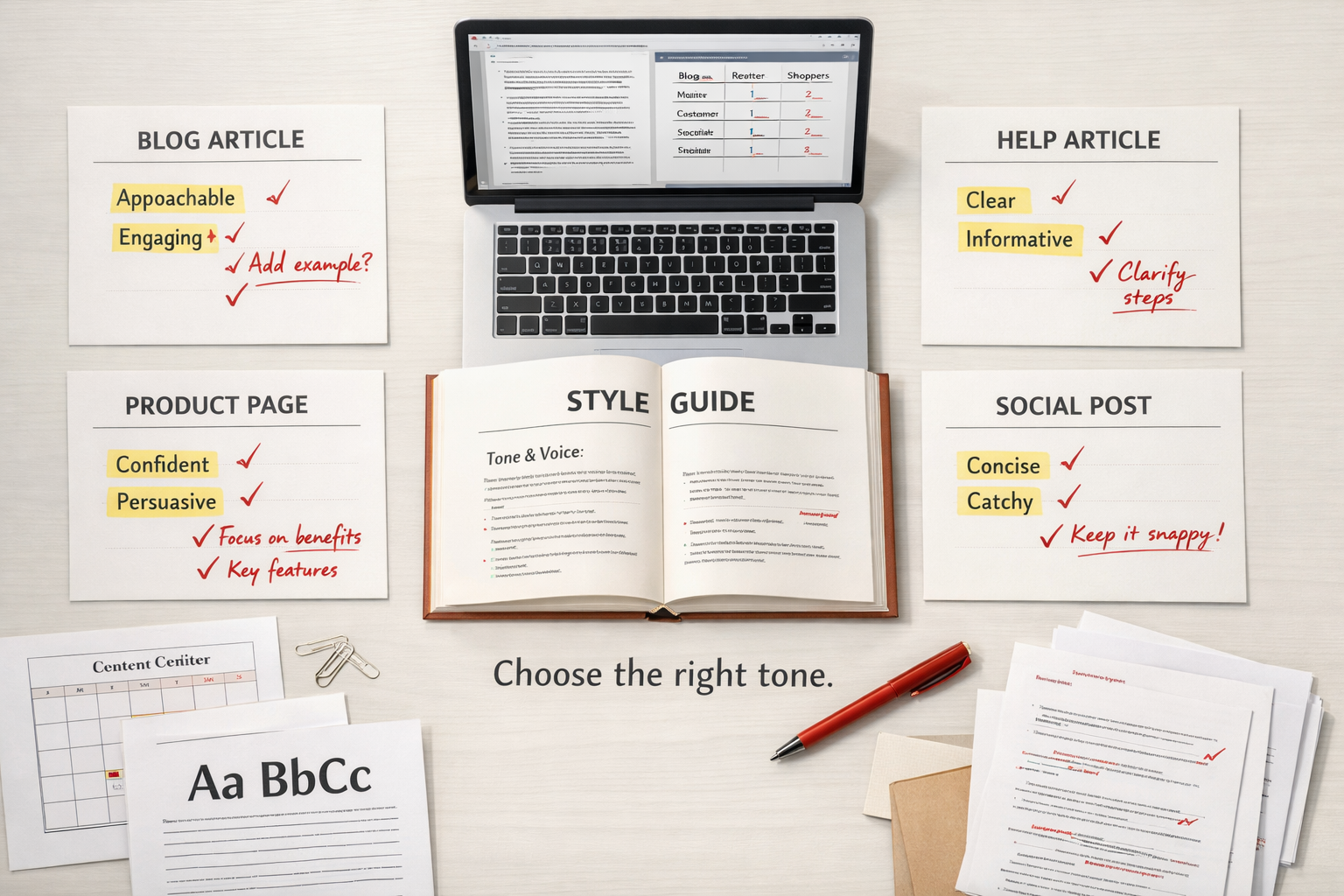
Pick tone based on two questions: who's reading, and what decision are they trying to make? A CFO reading a case study needs objective and confident; a first-time shopper reading a product FAQ needs friendly and reassuring. Mismatch either one and the content underperforms regardless of how well it's optimized.
Content type matters as much as audience. A comparison table on a SaaS pricing page works best in a confident, mildly persuasive tone — it's making a case. A troubleshooting guide needs an instructional, patient tone, because the reader is already frustrated. A blog post meant to build topical authority for SEO often blends conversational and authoritative tones: approachable enough to read start to finish, precise enough to earn a citation.
This table maps common content types to a primary tone and a tone to avoid:
| Content Type | Recommended Tone | Tone to Avoid |
|---|---|---|
| Product landing page | Confident, persuasive | Overly formal |
| Support/help article | Empathetic, instructional | Sarcastic |
| Comparison or "vs" post | Objective, confident | Dramatic |
| Company blog (top of funnel) | Conversational, authoritative | Academic |
| Legal or policy page | Formal, objective | Playful |
Avoid the common trap of applying one tone across an entire site because it feels safer. An all-formal site reads stiff on a blog and cold on a support page; an all-casual site loses credibility on a pricing or legal page. Tone should shift section by section, the way a person naturally adjusts how they talk depending on who's in the room.
Keeping Tone Consistent Once You're Publishing at Scale
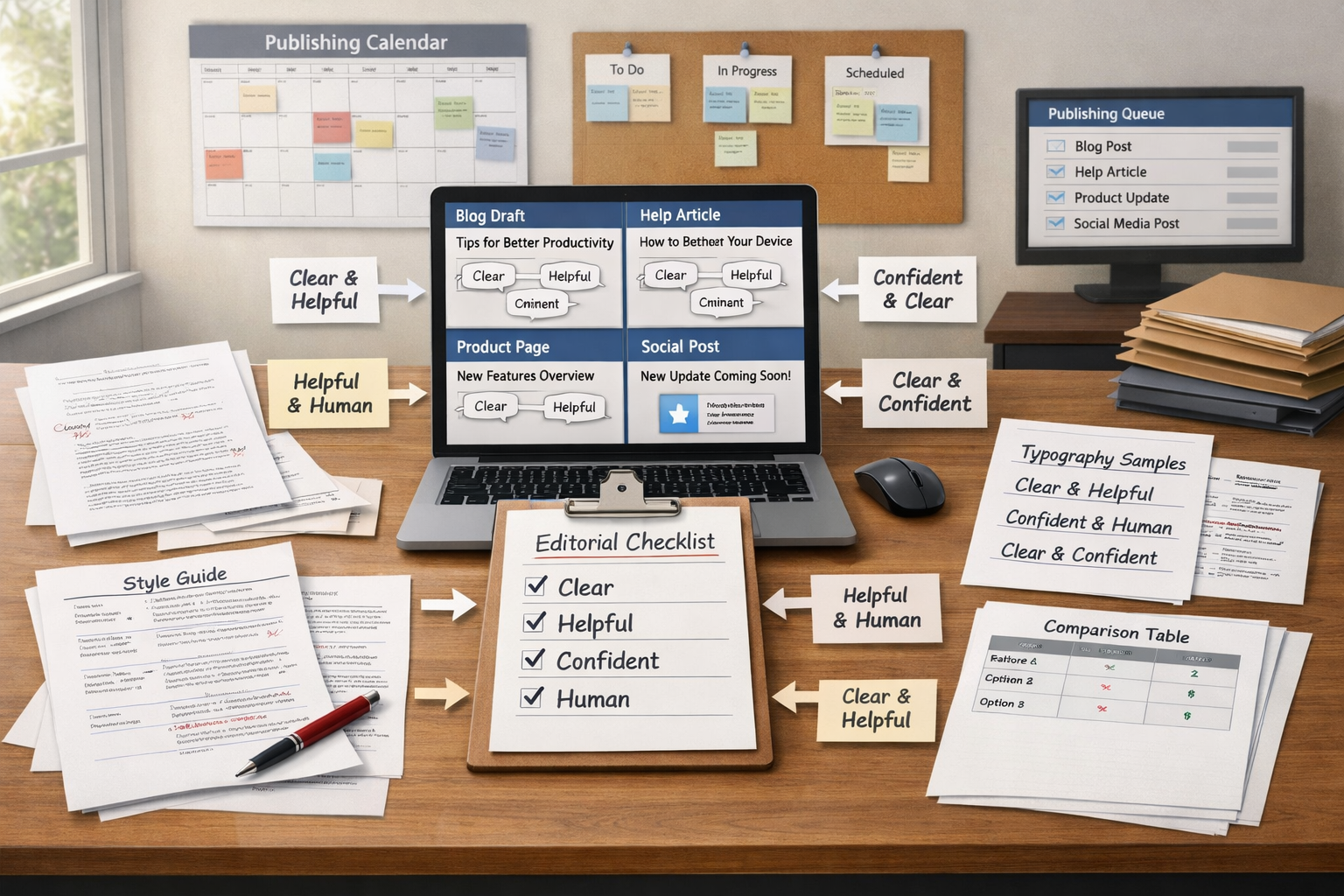
Tone consistency is easy in a single article and hard across fifty of them. The failure mode isn't picking the wrong tone once — it's picking the right tone in post one and drifting from it by post twenty, especially with multiple writers or freelancers rotating through a content calendar.
This is where most SEO content operations quietly lose quality. A brand guide might specify "conversational but authoritative," yet without a system for checking every draft against that standard, tone drifts toward whatever each individual writer defaults to. Readers don't always consciously notice, but they feel a site that sounds like five different people wrote it, and that inconsistency undercuts brand trust even when the SEO fundamentals — keywords, structure, internal links — are solid.
A few practical checks help here:
- Define tone per content type, not just per brand, in a shared reference doc.
- Give writers 2-3 example sentences per tone, not just an adjective.
- Review a sample of live pages quarterly for tone drift, not just for grammar.
- Flag any page that reads noticeably more formal or more casual than its neighbors.
- Re-brief freelance writers with tone examples before every large batch, not just once at onboarding.
Manually enforcing this across dozens of monthly articles is realistic for a small blog, but it gets expensive fast for agencies managing multiple client sites or ecommerce catalogs publishing weekly. This is the specific gap DraftSEO.ai is built around: it generates 30 articles a month per connected site with a tone calibrated to the site's niche, and it publishes directly through CMS integrations so tone doesn't degrade as volume goes up. A free trial with starter credits lets you test whether the tone holds up on your own pricing plan before committing to a monthly volume.
Frequently Asked Questions
What's the difference between tone and mood in writing?
Tone is the writer's attitude toward the subject and reader; mood is the emotional atmosphere the reader experiences. A sarcastic tone can still create an uneasy mood, and the two often align but aren't identical.
Can a single article use more than one tone?
Yes, and long-form SEO content usually should. An intro might be conversational, a data section objective, and a call to action persuasive — the shifts should feel intentional, not accidental or jarring.
How many tones should a brand style guide define?
Most brands need 3-5 core tones mapped to content types (blog, product pages, support, email), rather than one blanket tone. More than that becomes hard for writers to apply consistently.