Sep 16, 2026

Keywords Price: 2026 Guide
DraftSEO Team
Ahrefs' entry-level Starter plan runs $29 a month if you commit to annual billing, while its Standard tier lands closer to $149 a month billed monthly. That's before you factor in the hours someone spends turning those keyword lists into actual published pages. Keywords price isn't just the subscription line item on your credit card statement — it's the whole cost of getting from a spreadsheet of search terms to content that ranks.
Most comparisons stop at the sticker price. That's a mistake if you're a solo site owner or an agency billing for output, because the tool is rarely the expensive part.
What Determines Keywords Price in 2026
Keyword tool pricing depends on four things: data freshness, database size, the number of tracked projects, and whether you need API access. A tool pulling live search volume across 170+ countries costs more to run than one refreshing monthly, and that overhead shows up in your invoice.
Data Source and Update Frequency
Search volume isn't a fixed number — it's an estimate, and different vendors calculate it differently. Google Keyword Planner rounds its free-tier volume into broad ranges (think "1K-10K") unless you're spending on active Google Ads campaigns, in which case it sharpens up. Ahrefs and SEMrush build volume off clickstream data and search partnerships, which is why the same keyword can show 2,400 monthly searches in one tool and 3,600 in another.
Feature Bundling Drives the Jump Between Tiers
Entry tiers usually cap the number of tracked keywords and reports you can export. Mid tiers add competitor gap analysis, content grading, and keyword difficulty scoring. Enterprise tiers add API access, multi-user seats, and white-label reporting — features an in-house marketer at a mid-size ecommerce brand rarely touches, but that agencies managing a dozen client accounts need daily.
Ahrefs, SEMrush, Moz, and Ubersuggest: A Direct Price Comparison
Here's where the actual numbers matter, because the gap between tools is bigger than most buyers expect going in.
| Tool | Entry Plan (Monthly) | Entry Plan (Annual, per mo.) | Mid-Tier Plan (Monthly) |
|---|---|---|---|
| Ahrefs | $29 (Starter) | $29 | $149 (Standard, billed monthly) |
| SEMrush | $139.95 (Pro) | ~$117/mo billed annually | $249.95 (Guru) |
| Moz Pro | $49 (Standard) | ~$39/mo billed annually | $99 (Medium) |
| Ubersuggest | $12 (Individual) | ~$10/mo billed annually | $20 (Business) |
Why the Same Keyword Costs Different Amounts Across Tools
CPC and keyword difficulty figures diverge because each tool sources ad auction data differently. SEMrush leans on its own advertiser database; Ahrefs cross-references its backlink index against SERP volatility. Neither is "wrong" — they're measuring slightly different signals and rounding them differently. Treat any single tool's CPC number as directional, not exact, especially for niche or local-service keywords where auction volume is thin.
Annual Billing Is the Real Discount Lever
Switching from monthly to annual billing typically cuts the effective monthly rate by 15% to 25% across these vendors. On Ahrefs Standard, that's the difference between $149 and roughly $124 a month. If you're committing to keyword research as a permanent part of your workflow rather than a one-off audit, annual billing is the obvious move — the only real downside is losing flexibility if your niche or budget shifts mid-year.
Free vs. Paid Keyword Tools: What You Actually Lose
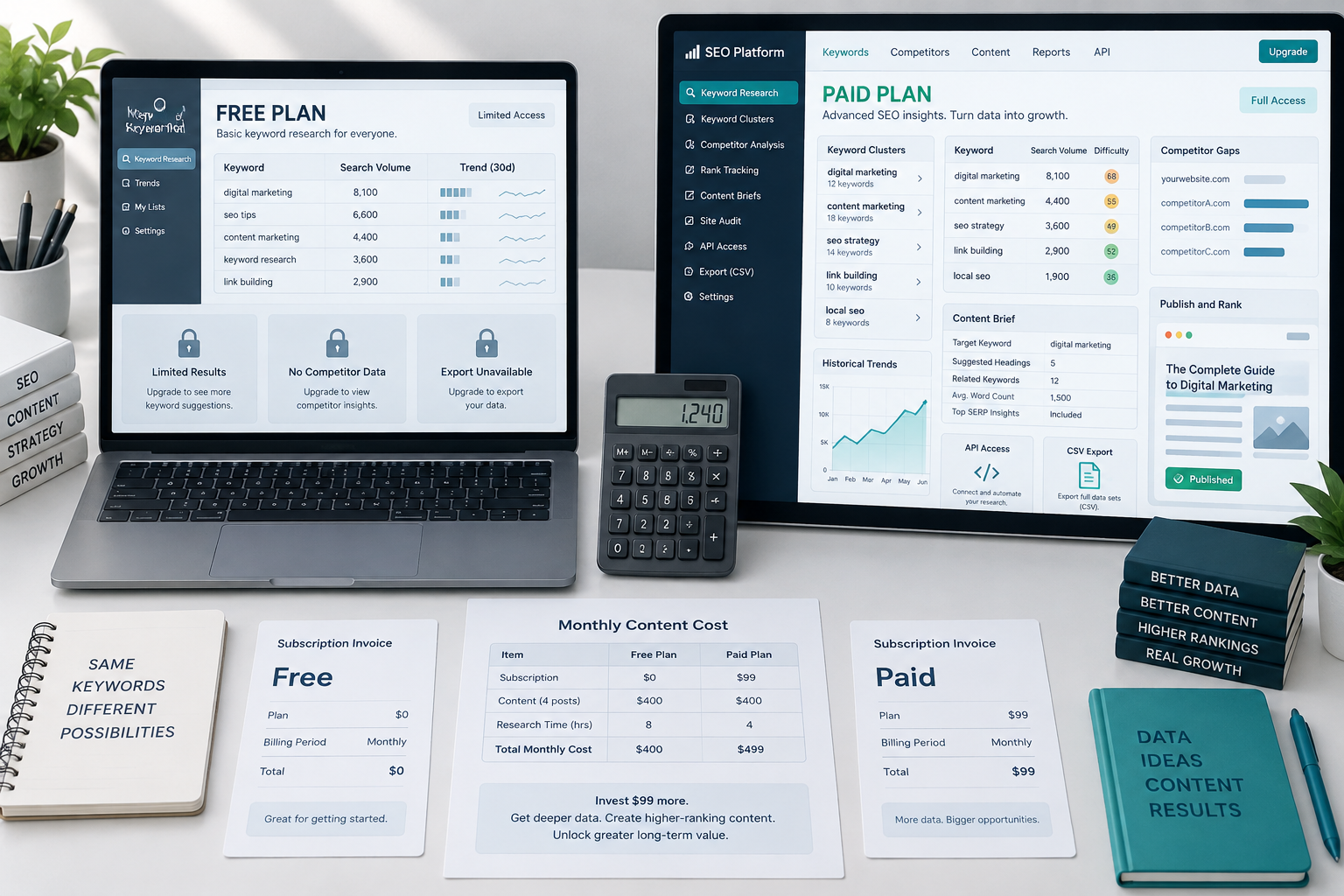
Free tools like Google Keyword Planner and Google Trends cost nothing but come with real limits: rounded volume ranges, no keyword difficulty score, and no historical trend export beyond what Trends shows on-screen. Ubersuggest's free tier gives a handful of daily searches before it locks you out. That's fine for spot-checking one or two terms. It falls apart fast once you're building a content calendar with 50+ target keywords a month.
Paid tools earn their price through three things a free tool won't give you:
- Keyword difficulty scoring calibrated against a live backlink index, not a guess.
- Bulk export and API access for feeding hundreds of keywords into a workflow at once.
- Competitor gap reports showing which terms a rival ranks for that you don't.
- Historical volume trends going back 24 months or more, useful for spotting seasonality.
- SERP feature tracking (featured snippets, People Also Ask boxes) tied to each keyword.
None of that changes the core problem, though: a tool only produces a list. Someone still has to read the list, cluster the terms by intent, brief a writer, and get a page published. That step is where most budgets actually leak, and it's rarely counted when people compare keywords price across platforms.
The Hidden Cost: Turning Keyword Data Into Published Content
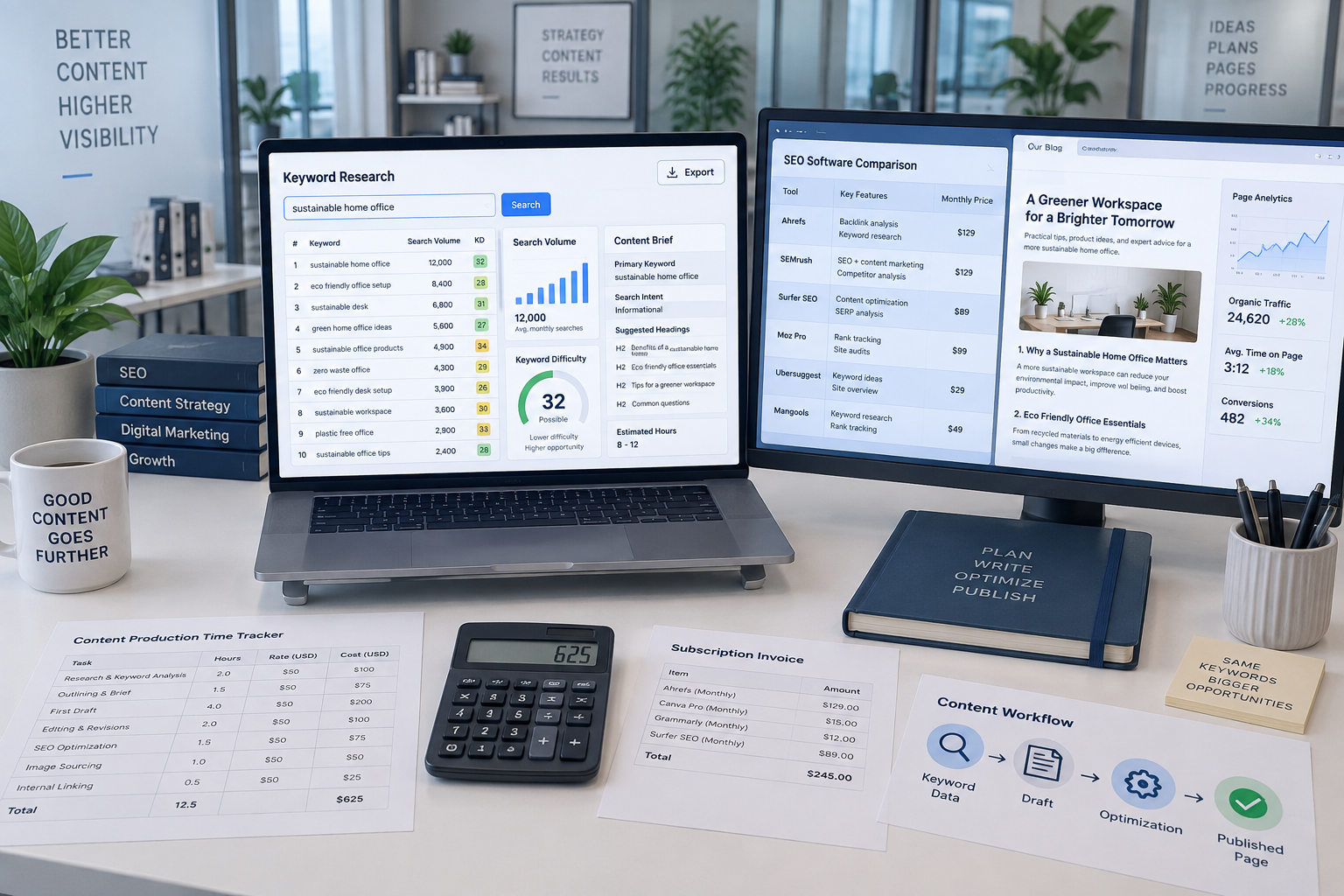
The real cost of keyword research isn't the $29 to $250 a month you pay for Ahrefs, SEMrush, or Moz — it's the time spent manually converting that data into finished articles. A freelance SEO writer producing one well-researched post from a keyword brief typically takes 3 to 6 hours per piece, and at even $40 an hour that's $120 to $240 per article before the tool subscription is counted at all.
Run that math across 30 articles a month — a realistic volume for a site trying to build organic traffic at scale — and labor costs can hit $3,600 to $7,200 monthly. Compare that to a $149 SEMrush or Ahrefs subscription, and the "expensive" line item was never the software.
This is the gap DraftSEO.ai is built to close. It takes the keyword and niche input, then automates the research-to-draft pipeline, generating 30 articles a month for connected sites and publishing through CMS integrations without someone manually briefing each piece. The tool subscription still matters for research depth, but the labor bottleneck is the bigger lever most budgets ignore.
If you're weighing keyword tool subscriptions against the cost of actually producing content every month, it's worth comparing that hourly labor math against a flat monthly plan. DraftSEO.ai offers a free trial with starting credits, and the current plans are listed on the DraftSEO.ai pricing page if you want to run your own numbers before committing budget.
Frequently Asked Questions
Is Google Keyword Planner's search volume data accurate enough for content planning?
It's directionally useful but not precise. Planner rounds free-tier volume into broad ranges (like "1K-10K") unless you're running active Google Ads spend, which sharpens the estimate considerably.
Do I need an enterprise-tier SEO tool, or does mid-tier cover most needs?
Most single-site owners and small agencies never need enterprise features like API access or white-label reporting. Ahrefs Standard ($149/mo) or SEMrush Guru ($249.95/mo) covers keyword research, competitor gaps, and content grading for the vast majority of use cases.
Why do different keyword tools show different CPC numbers for the same term?
Each vendor pulls CPC and difficulty data from its own ad auction and backlink sources, so figures rarely match exactly. Treat CPC as a directional estimate, particularly for low-volume or local-service keywords with thin auction data.