Aug 1, 2026

Ghost vs Substack: Which Is Better for SEO?
DraftSEO Team
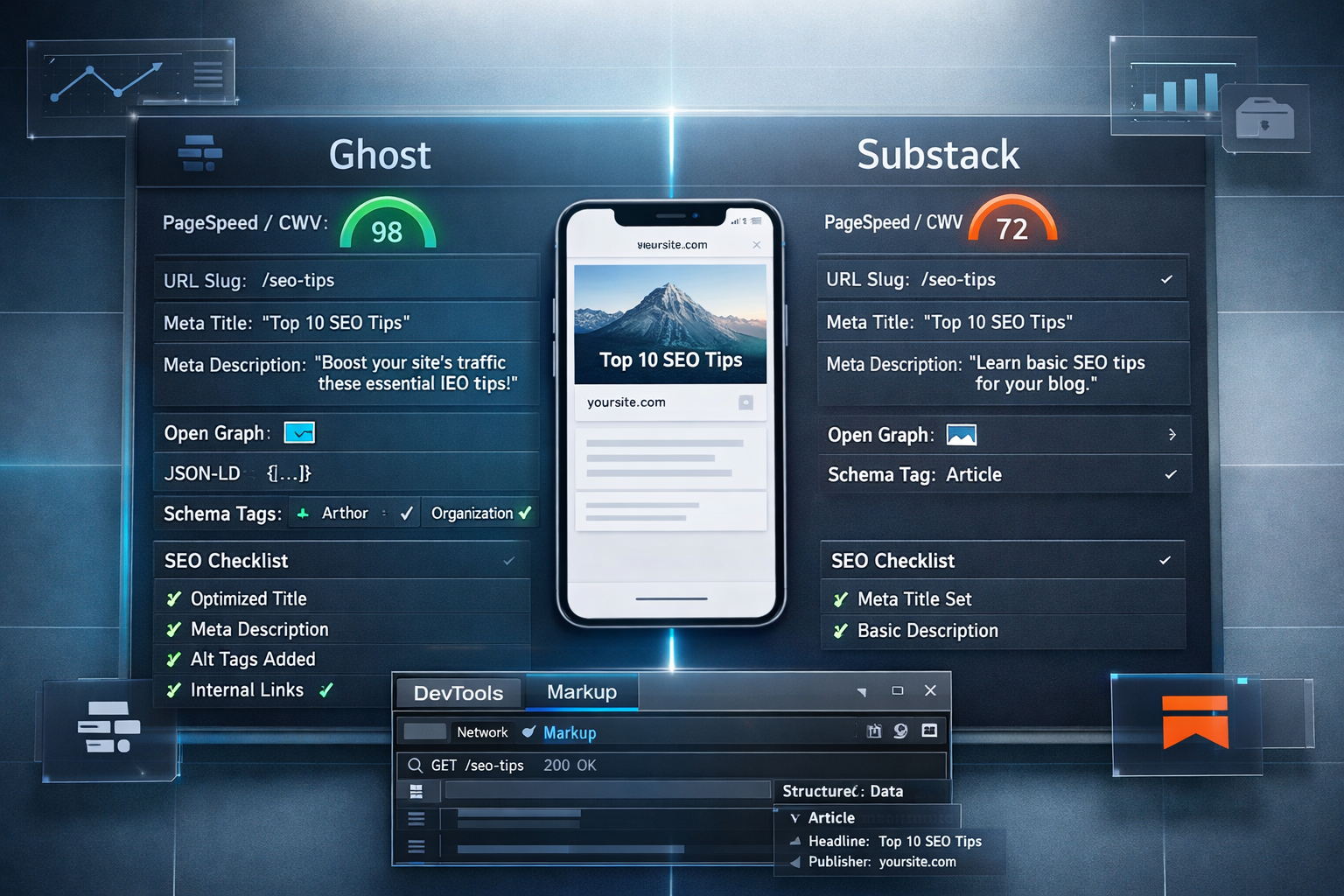
Ghost's default theme scores roughly 90+ on Google PageSpeed Insights mobile tests out of the box, while Substack's newsletter pages typically land in the 60s to 70s because of embedded fonts, tracking scripts, and fixed templates you cannot touch. That gap matters if organic search is your growth channel rather than email alone. Ghost vs Substack isn't a fight between two similar blogging tools — it's a choice between a self-hosted CMS built for technical control and a hosted newsletter platform built for distribution.
Anyone evaluating a migration or a fresh build needs to know which platform gives Google (and increasingly, AI answer engines) less friction. The answer depends less on brand reputation and more on markup, speed, and who owns the URLs.
Ghost CMS: Built for Technical SEO Control
Ghost is a Node.js-based, open-source publishing platform that you either self-host or run through Ghost(Pro), its managed hosting service. It ships with structured data, canonical tags, and clean URL routing built into the core — not bolted on through a plugin.
That built-in foundation is the biggest reason serious SEO teams pick Ghost over Substack for content that needs to rank. Ghost generates JSON-LD schema for articles, authors, and organizations automatically, and its themes (built on Handlebars) expose meta title, meta description, and Open Graph fields per post without a third-party plugin.
Schema and Metadata Out of the Box
Every Ghost post gets Article schema with headline, datePublished, dateModified, and author fields populated automatically. You can override any of it in the post settings panel, which matters when you need custom titles that diverge from your H1 for click-through optimization.
Substack, by comparison, generates a much thinner schema footprint. It marks up basic Article data but gives you no interface to edit JSON-LD directly, and no way to add FAQ, HowTo, or Product schema — which matters if you are building comparison or review content meant to earn rich results.
Site Speed and Core Web Vitals
Ghost's default theme (Casper) is lightweight, and self-hosted or Ghost(Pro) installations let you add a CDN, image compression, and lazy loading through native settings. Largest Contentful Paint on a well-configured Ghost site commonly sits under 2 seconds on 4G connections.
Substack pages load through a shared infrastructure you cannot optimize. You cannot compress images beyond what the platform auto-generates, cannot defer third-party scripts, and cannot remove the newsletter subscription overlay that adds render-blocking elements on first load. For Core Web Vitals, Ghost simply gives you levers Substack doesn't.
None of this technical advantage matters if the site sits idle for three months between posts. SEO rewards consistent, optimized publishing volume far more than it rewards a perfect Lighthouse score on a handful of pages — a truth that gets lost in most Ghost vs Substack comparisons focused purely on markup.
Substack: Distribution Strength, SEO Weakness
Substack's advantage is audience discovery inside its own network — the "Substack recommends" feature and cross-newsletter subscriber sharing genuinely move the needle on subscriber growth. That's a real strength, and it's the reason writers pick Substack over a standalone CMS in the first place.
But subscriber growth inside Substack's ecosystem doesn't translate into Google visibility. A newsletter with 20,000 email subscribers can still rank nowhere for its core topic keywords, because Substack's URL structure, template rigidity, and shared domain reputation work against organic discovery.
Why a Built-In Audience Isn't an SEO Substitute
A common assumption is that Substack's built-in audience compensates for weaker technical SEO. It doesn't — email opens and Google impressions are separate acquisition channels, and a newsletter with strong open rates can still show zero organic traffic in Google Search Console.
Open rate is a retention metric. It tells you whether people already subscribed are engaging. It says nothing about whether new readers can find you through search, which is the entire point of investing in SEO in the first place.
Custom Domains and Branding Limits
Substack does allow custom domain mapping (yourname.com instead of yourname.substack.com) on paid tiers, which helps with brand consistency. But the underlying page templates, URL slugs, and archive structure stay fixed regardless of domain — you're renting the address, not the house.
Ghost gives you full control over URL slugs, tag archive pages, and internal linking structure from day one, whether you're on Ghost(Pro) or self-hosted. That structural freedom is what lets you build topic clusters and pillar pages, which Substack's flat post-and-tag model doesn't support well.
URL Structure, Canonical Tags, and Content Ownership
Ghost gives you full control over permalink structure, canonical URLs, and content export; Substack locks your URLs to its subdomain (or a mapped custom domain with fixed templates) and offers only partial content portability. This distinction decides how much SEO equity survives a future migration.
On Ghost, you set the URL pattern in Settings, typically /%slug%/, and every post carries a self-referencing canonical tag by default. If you republish syndicated content elsewhere, you can manually set a canonical URL pointing to the original — something Substack has no interface for at all.
What Happens When You Migrate
Migrating away from Substack means every published post's canonical URL — even under a mapped custom domain — stays tied to Substack's underlying template structure. If you later move to a self-hosted setup, your old URLs typically don't map cleanly, and you lose accumulated link equity unless you build a careful 301 redirect map by hand, post by post.
Ghost migrations are far more forgiving. Because you control the routing structure, you can restructure a site (say, moving from /blog/post-name/ to /post-name/) and set 301 redirects at the server or CDN level in a single pass, preserving most of the ranking signal Google has built up for those URLs.
Data Portability Compared
Here's how the two platforms handle the practical mechanics of getting your content in and out:
| Factor | Ghost | Substack |
|---|---|---|
| Native content export | Full JSON export, including HTML/Mobiledoc content | CSV/ZIP export of posts, limited formatting fidelity |
| Custom canonical tags | Yes, per-post override available | No user-facing control |
| URL slug control | Full control over post and tag slugs | Fixed archive structure, slug editable but template locked |
| Redirect management | Native redirects.json or CDN-level rules | No built-in redirect tool |
| Self-hosting option | Yes (open source) or Ghost(Pro) managed | No, hosted only |
That table makes the ownership gap concrete: Ghost treats your content as an asset you control end to end, while Substack treats it as content living inside its platform, exportable but not architecturally portable. If long-term content ownership matters to your business, that's the deciding column — not price, not theme design.
Newsletter SEO vs Blog SEO: Different Games
Newsletter content and blog content get indexed and ranked differently, and conflating the two leads to bad platform decisions. A newsletter issue optimized for inbox engagement (short subject lines, curiosity gaps, personal tone) often makes a poor search landing page, because it lacks the keyword depth and structure Google rewards.
Blog SEO rewards comprehensive, well-linked pages that answer a specific query in full — the kind of content built around header structure, internal links to related posts, and schema markup that helps Google (and now AI answer engines like ChatGPT's browsing mode) understand context.
Site Architecture Advantages on Ghost
Ghost supports nested tag structures and a native "primary tag" field per post, which lets you build genuine topic clusters — a pillar page on, say, "ecommerce SEO," linked to a dozen supporting posts through consistent internal linking. That's the architecture Google's algorithms reward for topical authority.
Substack's flat feed-and-archive model doesn't support this kind of clustering. Every post lives in the same chronological stream, tags exist but don't generate the kind of crawlable, linkable hub pages that a Ghost tag archive does automatically.
When a Hybrid Setup Makes Sense
Plenty of teams run Substack for the newsletter relationship and a separate Ghost or WordPress site for the SEO-driven blog, syndicating select newsletter content to the blog with a canonical tag pointing back. It's more overhead — two platforms, two publishing habits — but it lets each platform do what it's actually good at instead of forcing one tool to do both jobs badly.
I'd recommend this hybrid path for any team with the bandwidth to manage two systems. If you can only run one, Ghost wins for organic growth, and Substack wins if inbox reach is genuinely your primary channel.
JAMstack and Headless Setups: When Ghost Pulls Further Ahead
Ghost supports a headless configuration where its Content API feeds a separate front end — built in Next.js, Astro, or another static-site framework — while Ghost itself just manages content and structured data behind the scenes. This setup routinely produces Core Web Vitals scores in the high 90s because the rendered pages are static HTML served from a CDN edge node.
Substack offers no equivalent. There's no public API for pulling your content into a custom front end, no way to decouple content management from Substack's rendering layer. What you build in the editor is exactly what gets served, styling and all.
Practical Cost of Going Headless
Running Ghost headless isn't free in engineering time. Expect a setup project measured in days to a couple of weeks for a developer familiar with a JAMstack framework, plus ongoing maintenance for API integration and content model changes. For agencies managing multiple client sites, that setup cost amortizes quickly across every additional site built on the same front-end template.
For a solo blogger or small business without in-house dev resources, the standard Ghost theme (non-headless) already delivers most of the SEO benefit — schema, speed, and URL control — without the engineering overhead. Headless is a lever for teams that need to push Core Web Vitals scores from good to close-to-perfect, not a requirement to see basic Ghost SEO gains.
Publishing Automation and API Access
Ghost's Admin API supports programmatic post creation, scheduling, and metadata updates, which is what makes automated publishing pipelines possible. Substack has no public API for this, meaning any automation has to happen through manual copy-paste or unsupported workarounds.
This is where automating content for either platform becomes the real lever most comparisons skip. Ghost's API lets a content pipeline push finished, schema-tagged, SEO-structured articles directly into the CMS on a schedule — which is exactly the workflow DraftSEO.ai's pricing plans are built around, since the platform integrates with CMS platforms like Ghost to publish generated articles automatically rather than requiring manual upload for every post.
Which Platform Actually Ranks Better in Practice?
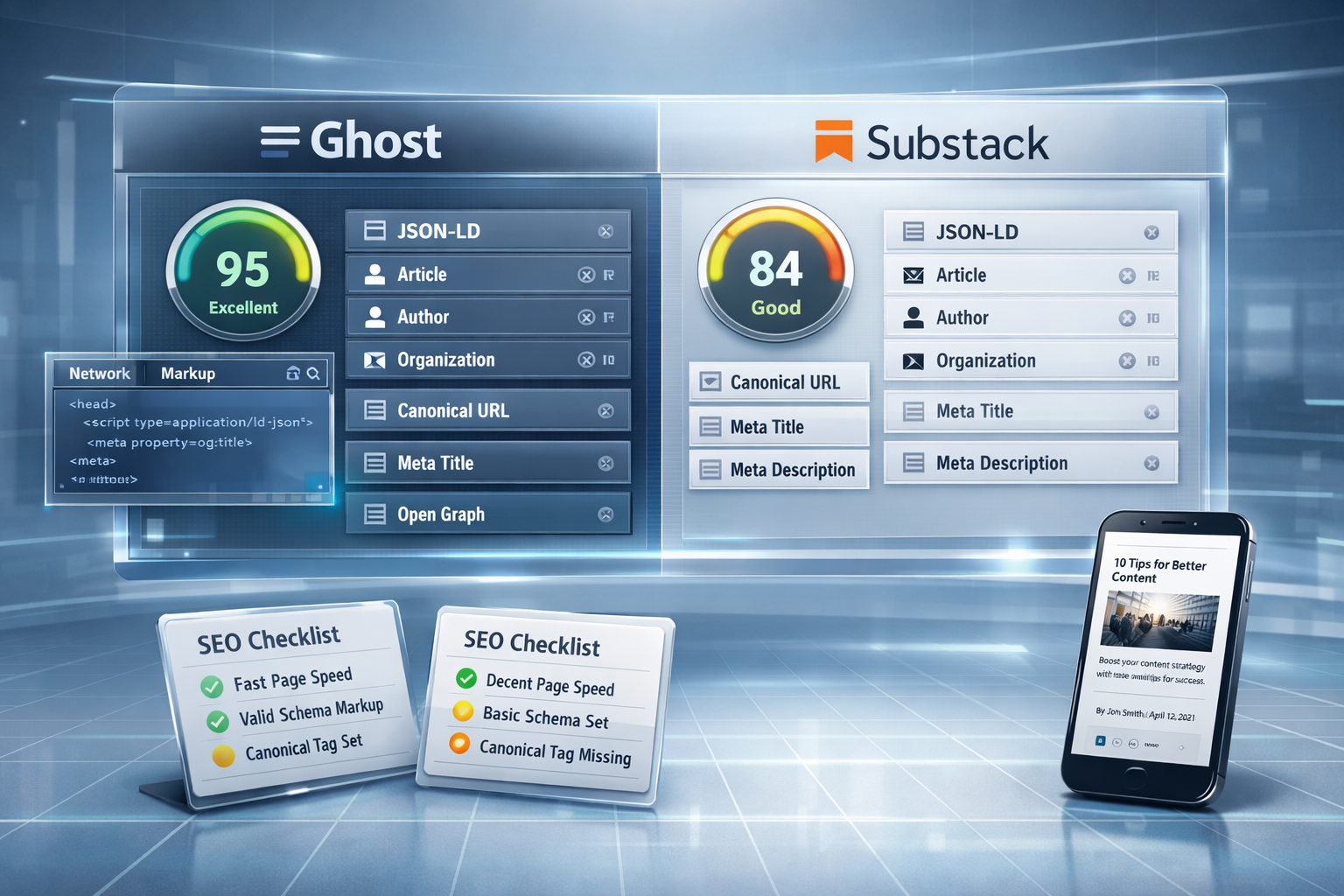
Ghost ranks better for organic search in almost every measurable technical dimension: schema depth, page speed, URL control, and content architecture. Substack wins on built-in audience distribution and zero-setup publishing, which matters for reach but not for Google visibility.
The mistake most comparisons make is treating this as a platform-only decision. Neither Ghost nor Substack ranks anything by itself — a technically perfect Ghost site with four posts a year loses to a mediocre WordPress blog publishing twice a week with reasonable on-page SEO.
The Volume Variable Nobody Talks About
Google's algorithm rewards topical depth built over time — dozens of interlinked, well-structured posts covering a niche from multiple angles. That requires sustained publishing volume, which is the actual bottleneck for most sites regardless of CMS choice.
Manually researching, writing, and formatting even five well-optimized posts a month takes most single writers 15 to 25 hours, which is why so many blogs — Ghost or Substack — stall out after the first few months. This is precisely the gap automated content generation closes: platforms that can generate a steady volume of SEO-structured articles (DraftSEO.ai generates 30 articles a month for connected sites, with a free trial that includes starting credits) remove the volume constraint so the platform's technical advantages actually have material to work with.
- Pick Ghost if organic search is your primary growth channel and you have some technical capacity (or budget for a developer).
- Pick Substack if your priority is building a direct-response newsletter audience and SEO is secondary.
- Run a hybrid model if you need both reach and rankings and can manage two publishing workflows.
- Fix your URL and canonical strategy before migrating either direction, not after.
- Set a realistic publishing cadence — at least weekly — before evaluating either platform's SEO ceiling.
- Automate research and drafting where possible so cadence survives past month three.
Scaling Content After You've Picked a Platform
Once the platform decision is made, the real work is sustaining publishing volume without burning out a writer or blowing a content budget. That's the point where most solo operators and small agencies plateau — the platform is fine, but the pipeline feeding it runs dry.
If that's the bottleneck you're hitting, starting a free trial through DraftSEO.ai's pricing page is a reasonable next step — you get initial credits to test how automated article generation fits into whichever CMS you've chosen, Ghost or otherwise, before committing to a paid plan.
Frequently Asked Questions
Does Ghost really rank higher than Substack in Google search results?
Ghost has structural advantages — better schema, faster load times, full URL control — that make ranking easier, but neither platform guarantees rankings by itself. Publishing volume and content quality still decide most outcomes.
Can I migrate a Substack newsletter to Ghost without losing SEO value?
Partially. Substack's export includes post content but not clean canonical mapping, so you'll need to manually build a 301 redirect map from old Substack URLs to new Ghost URLs to preserve link equity.
Is Ghost(Pro) hosting necessary, or should I self-host for better SEO?
Neither option changes your schema or URL control; both give you the same core SEO features. Self-hosting adds server maintenance work but can reduce cost at scale, while Ghost(Pro) trades that work for a flat monthly fee.
Does Substack's custom domain feature fix its SEO weaknesses?
No. A mapped custom domain improves branding but doesn't change the underlying template rigidity, thin schema, or lack of canonical control that limits Substack's organic search performance.