Jul 26, 2026

Free AI Writer for Monthly SEO Articles
DraftSEO Team
OpenAI's ChatGPT passed 100 million weekly users faster than almost any consumer product in history, and a good chunk of them are using it to write blog content. That popularity is exactly why so many site owners now ask whether a free AI writer can replace a paid content pipeline entirely. For a single post, sure. For 30 consistent, published articles a month, the math changes fast.
This article breaks down where free AI writing tools genuinely hold up, where they quietly cost you more than a paid plan, and how to tell the difference before you build a content calendar around one.
What a Free AI Writer Actually Does Well
A free AI writer is genuinely good at one thing: producing a readable first draft fast. Tools like the free tiers of ChatGPT, Copy.ai, or Writesonic can turn a topic and a rough outline into 800-1,200 words in under two minutes. For a single blog post, an internal FAQ page, or a product description, that's a real time saver.
The output quality on short-form content is often fine without much editing. Grammar is clean, sentence structure reads naturally, and the tone generally matches whatever you specify in the prompt. If you're writing one article this month to test a new topic, a free tool gets you 80% of the way there.
Where these tools earn their keep is speed on a single task. You're not paying for infrastructure, you're not committing to a subscription, and you can walk away after one use with no sunk cost. That's a real advantage for a freelancer testing an idea or a solo blogger publishing twice a month.
The problem is that "good for one article" and "good for a content operation" are different claims entirely. A tool that nails a single 1,000-word post doesn't automatically scale to 30 posts a month with consistent formatting, internal linking, and SEO structure. That gap is where most site owners get surprised.
Single-Post Use Cases Where Free Tools Are the Right Call
If you need one article to fill a content gap, or you're testing whether a topic resonates before investing more, a free AI writer is the correct tool. Don't overthink it here — paying for a subscription to write one piece a month is wasted budget.
This also applies to internal content: meta descriptions, product blurbs, email drafts. Free tools handle short, low-stakes writing tasks without needing SEO structuring or CMS integration behind them.
Where the Free-Tier Ceiling Shows Up Fast
The moment you need repeatable output — the same quality, the same structure, week after week — free tiers start showing cracks. Most free plans cap you at a handful of generations per day or a limited word count per month, and the writing quality on longer, keyword-targeted pieces drops noticeably compared to a single quick draft.
The Hidden Math: Editing Time vs. a Paid Plan
Here's the number that matters: if editing and formatting a free AI draft takes you even 30 minutes per article, 30 articles a month costs you 15 hours of manual labor. At any reasonable hourly rate for a marketer or content writer, that's more than most paid AI content plans charge for the entire month.
This is the calculation most site owners skip. Free is only free if your time has no value, and for anyone running an agency or managing a client account, that's never actually true.
Consider what "editing" really covers when you're working with free AI writer output. You're not just fixing typos. You're checking for factual accuracy, adding a proper H2/H3 structure, inserting internal links, formatting for readability, adding a featured image, and then manually pasting the whole thing into WordPress or whatever CMS you run. None of that is optional if you want the article to actually rank.
Multiply that by 30 articles and the picture gets uncomfortable. Even at a conservative 20 minutes per article for formatting and cleanup, you're looking at 10 hours a month of pure administrative work, before you've touched keyword research or fact-checking.
Compare that to a workflow built around automated generation and publishing. If a platform handles the SEO structure, internal formatting, and CMS delivery on its own, that 10-15 hours of manual work disappears. The math isn't close once you're past a handful of articles a month.
The Real Cost Breakdown
The table below shows a rough comparison for a 30-article monthly workload, assuming an $25/hour rate for content editing and formatting time — adjust the rate to your own situation, but the pattern holds at almost any reasonable number.
| Approach | Tool Cost/Month | Est. Manual Hours | Labor Cost (at $25/hr) | Total Effective Cost |
|---|---|---|---|---|
| Free AI writer, manual everything | $0 | 15 hrs | $375 | $375 |
| Free AI writer, light editing only | $0 | 8 hrs | $200 | $200 |
| Paid AI content platform with publishing automation | $50-150 | 1-2 hrs | $25-50 | $75-200 |
Why the Break-Even Point Arrives Faster Than Expected
Most people assume the break-even point is somewhere around 50 or 100 articles. In practice, it usually shows up between 8 and 12 articles a month, once you factor in the time spent copy-pasting into a CMS and reformatting headings that didn't survive the transfer.
Monthly Output Limits: What "Free" Actually Means
Free AI writer plans almost never mean unlimited content. Most cap you at a fixed number of generations per day (often 5-10), a monthly word limit, or a credit system that runs out well before you hit 30 articles. Read the fine print before you build a content calendar around a "free" tool.
This is one of the most common misunderstandings among people new to AI content tools. The word "free" on a landing page usually refers to a trial tier or a permanently limited plan, not an unlimited content engine. Jasper, Copy.ai, and similar platforms all use this model: a taste of the product, then a paywall once you need volume.
For a site owner planning 30 articles a month, that limit is the whole ballgame. You'll burn through free credits somewhere around week one or two, then either pay up or switch tools mid-month, which creates inconsistency in tone and formatting across your content calendar.
There's also a quality tradeoff buried in most free tiers. Free plans often run on lighter or older language models compared to their paid counterparts, which means longer, keyword-dense articles are more likely to wander off-topic or repeat themselves. That's fine for a 300-word product blurb. It's a real problem for a 1,500-word pillar article meant to rank for a competitive keyword.
A free trial with initial credits is a different thing entirely, and it's worth distinguishing the two. A trial gives you a real sample of the full product before you commit — DraftSEO.ai, for example, offers a free trial with starting credits so you can see actual output quality before deciding whether the monthly plan fits your content needs. That's a fair test. A permanently capped free tier is a different arrangement, and it's not designed to support a real publishing schedule.
Before committing to any tool for recurring work, check three things: the actual monthly cap (not the daily one, which sounds bigger than it is), whether the model degrades on longer content, and whether credits roll over or reset. Those three details determine whether "free" gets you through a real month of publishing or just a few days of it.
Does AI-Generated Text Alone Get You Ranked on Google?
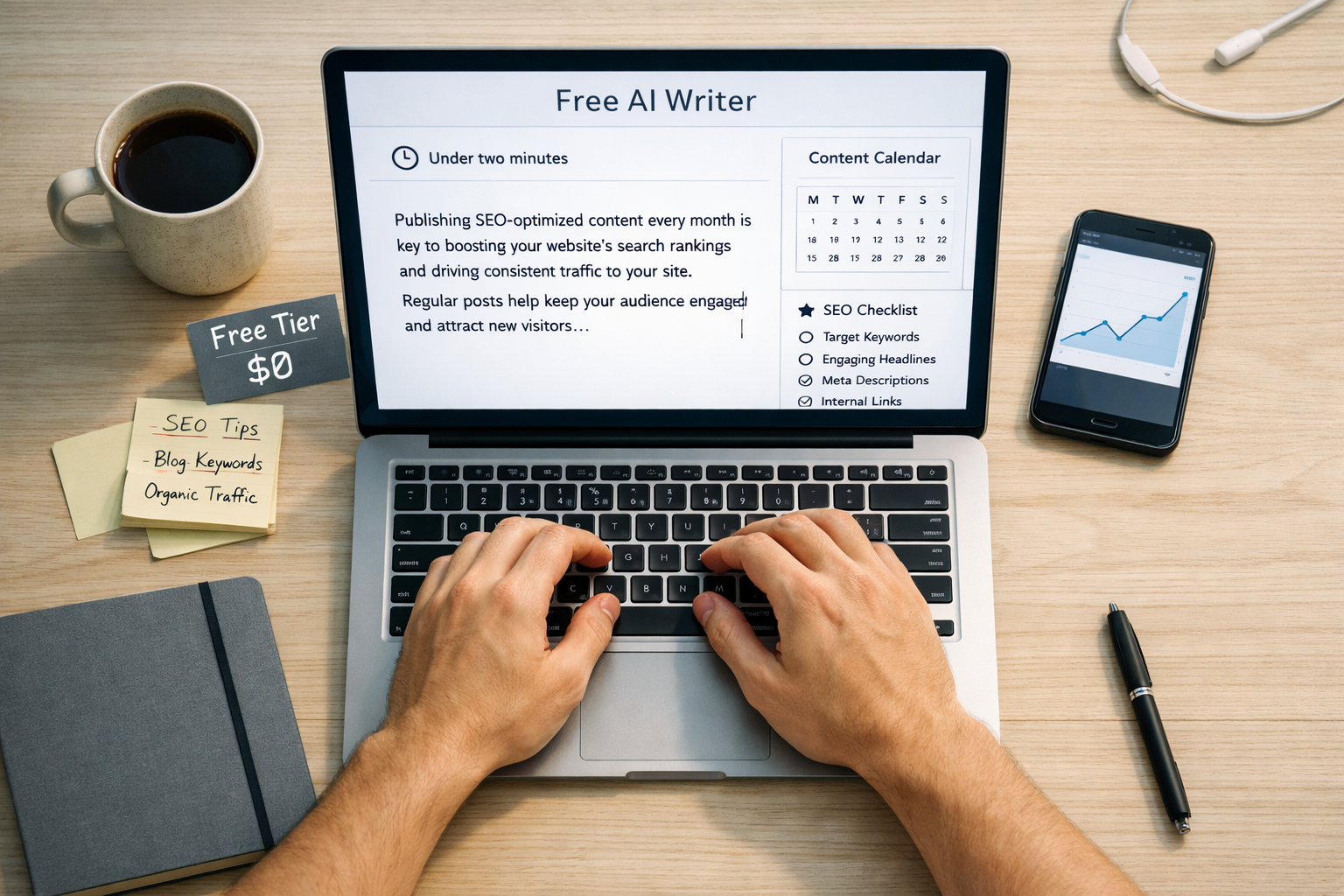
No. Writing AI-generated text does not guarantee Google rankings, and this is the single most common misconception among people evaluating free AI writers for SEO work. Ranking depends on proper article structure, keyword targeting, internal linking, page experience, and topical relevance — the writing itself is only one input.
Google's own public guidance on AI content has been consistent since the helpful content updates rolled out starting in 2022: content is evaluated on quality and usefulness, not on how it was produced. That means a poorly structured AI draft ranks poorly, and a well-structured one can perform fine. The tool isn't the variable. Structure is.
The SEO Elements a Raw AI Draft Usually Skips
Free AI writers, by default, tend to skip the technical scaffolding that actually helps a page rank. That includes proper H2/H3 hierarchy matched to search intent, schema markup, internal links to relevant existing pages, optimized meta titles and descriptions, and image alt text. A generic prompt gets you paragraphs. It doesn't get you an SEO-structured article.
This is why raw output from a general-purpose chatbot often needs a second pass specifically for SEO, on top of the editorial pass for accuracy and tone. Skipping that step is the most common reason free-tool content underperforms once it's published.
Keyword Research Still Has to Happen Somewhere
A free AI writer doesn't do keyword research on its own — you feed it a keyword, and it writes around that keyword. If your keyword targeting is off, the article will read well and still fail to attract search traffic. Tools built specifically for SEO content generation handle this differently: they tie the writing step to keyword and topic research so the article targets terms with actual search demand, rather than whatever phrase you happened to type into a prompt box.
For agencies managing multiple client sites, this distinction matters more, not less, at scale. Manually researching keywords for 30 articles a month across several clients is a job in itself, separate from the writing.
Publishing Automation: The Step Free Tools Almost Always Skip
Free AI writers give you text in a chat window or a document. They don't publish it to your site. That means every single article requires manual copy-paste into your CMS, reformatting for headings and images, and hitting publish yourself — a step that's easy to forget when you're comparing tools purely on writing quality.
For a single article, that's a five-minute task and nobody notices. For 30 articles across one WordPress site, or worse, across multiple client sites for an agency, it becomes a recurring operational job that somebody on the team has to own every month.
This is the gap that separates a writing tool from a content pipeline. Writing is the first half of the job. Getting the finished, formatted article live on the actual site, with images, headings, and internal links intact, is the second half, and it's the half most free tools ignore completely.
Here's what a typical manual publishing workflow looks like once you're past the writing stage:
- Copy the AI-generated draft out of the chat interface or document.
- Reformat headings, since most exports lose proper H2/H3 tagging.
- Add or generate a featured image and any inline visuals.
- Insert internal links to existing pages on the site.
- Write or rewrite the meta title and description for search snippets.
- Log into the CMS, paste the content, and fix any formatting breaks.
- Schedule or publish, then check the live page for layout issues.
Multiply that seven-step process by 30 articles and you've built yourself a part-time job that didn't exist when the tool was "free." A platform with CMS integration built in collapses most of those steps into the generation process itself. DraftSEO.ai, for instance, connects directly to popular CMS platforms so articles publish without the manual copy-paste cycle, which is the piece of the workflow that eats the most time once volume goes up.
Quality vs. Quantity: Where Most Free Workflows Break Down

The tradeoff isn't quality versus quantity in the abstract — it's that most free tools can give you one or the other, not both, at scale. A free AI writer can produce a solid single article. Ask it to produce 30 consistent, well-structured, SEO-targeted articles in a month, and the cracks in consistency start to show.
Consistency is the part people underestimate. Article three and article twenty-seven need the same heading depth, the same internal linking logic, and roughly the same tone, or your site starts to look like it was written by different people with different standards. That's exactly what happens when you're manually prompting a free tool 30 separate times across a month, tweaking instructions slightly each time because you forgot exactly what you asked for last time.
Signs Your Free-Tier Workflow Has Hit Its Limit
A few warning signs show up reliably once volume increases past what a free tool was built for. Articles start repeating the same intro phrasing across different topics. Heading structure gets inconsistent from post to post. You find yourself spending more time rewriting prompts than writing the actual content yourself.
If two or more of those are happening, the free tool isn't saving you time anymore — it's just moved the work from "writing" to "fixing."
What a Structured Monthly Workflow Looks Like Instead
A structured approach assigns the repetitive parts — keyword targeting, outline structure, formatting, publishing — to a system built for volume, so a human only needs to review, not rebuild, each article. This is the model behind platforms designed for recurring content output rather than one-off drafts.
DraftSEO.ai runs on this model specifically: it generates 30 articles a month for a connected site, using a consistent structure and keyword approach across all of them, and publishes through direct CMS integration rather than leaving that step to you. For anyone who's tried to hit that same volume manually with a free tool, the difference in hands-on time is the whole story.
Freemium vs. Paid AI Writers: Making the Actual Decision
The decision comes down to volume and consistency needs, not just budget. If you need one to three articles a month with flexible topics, a free AI writer is the reasonable choice and paying for a platform is overkill. Past that volume, the hidden editing and publishing time usually costs more than a paid plan.
Freemium tools are built to convert you eventually, and that's not a criticism — it's just the business model. The free tier exists to show you the product works before asking for money. The mistake is treating a freemium cap as if it's meant to support permanent, high-volume use. It isn't designed for that, and pretending otherwise leads to the 10-15 hours of monthly manual work described earlier in this piece.
Site owners running e-commerce stores or content-heavy blogs tend to hit this wall the fastest, since product pages, category content, and buying guides pile up quickly. Agencies hit it even sooner, because the math multiplies across every client account they manage.
The honest framing: free tools are a sampling mechanism, not a production system. Use them to test what AI-generated content looks like for your niche. Once you know you want a real monthly cadence, a structured platform pays for itself in saved editing and publishing time, not just in article count.
If you want to see this play out at real volume before committing anything, DraftSEO.ai's pricing page lays out the plans alongside the free trial credits, so you can compare what 30 automatically published articles a month actually costs against the manual-hours math above.
Frequently Asked Questions
Is a free AI writer good enough for a small blog?
Yes, for one to three posts a month it's a reasonable choice, especially if you're comfortable manually formatting and publishing each article yourself. Beyond that volume, editing time starts outweighing the cost of a paid plan.
How many articles can I generate with a free AI writer before hitting limits?
Most free tiers cap you at 5-10 generations a day or a fixed monthly word count, which usually runs out well before 30 articles. Check the specific plan's daily and monthly caps separately, since they're often marketed differently.
Does free AI-written content need to be edited before publishing?
Yes, always. Even clean drafts typically need SEO structuring (headings, internal links, meta tags) and a factual review, since no AI writer guarantees ranking-ready structure by default.
What's the real cost difference between free tools and a paid AI content platform?
At 30 articles a month, manual editing and publishing time for free-tool output often runs 10-15 hours, which at a modest hourly rate exceeds most paid platforms charging $50-150 monthly with built-in publishing automation.