Aug 8, 2026

CopyAI Alternative: DraftSEO.ai vs Copy.ai - Which Wins?
DraftSEO Team
Copy.ai raised over $10 million in venture funding to build one of the best-known AI copywriting tools on the market, yet it still won't publish a single article to your WordPress site. That gap is exactly why so many SEO teams go looking for a copyai alternative once their needs shift from ad headlines to full-length ranking content. If you're trying to scale organic traffic rather than polish product blurbs, the tool you need does a fundamentally different job.
Tool Overview: Two Products Built for Different Jobs
Copy.ai is a copywriting assistant. It was designed to generate short-form marketing text: ad copy, product descriptions, email subject lines, social captions. DraftSEO.ai is a different category entirely — an end-to-end SEO content pipeline that researches, writes, and publishes full articles without a human touching the CMS.
The confusion happens because both tools use large language models and both produce "content." But the workflow scope is not the same.
Copy.ai's Core Design
Copy.ai's editor is built around short prompts and templates: 90+ tools for taglines, product blurbs, and campaign variations. It has a long-form/blog mode, but it's a secondary feature bolted onto a tool optimized for punchy, quick-turnaround copy, not multi-thousand-word articles with keyword structure baked in.
DraftSEO.ai's Core Design
DraftSEO.ai starts from a niche input, then handles keyword targeting, article drafting, and formatting for search intent, then pushes the finished piece to a connected site. Users get 30 articles generated monthly for each connected site, with no manual export-and-paste step required. That's the structural difference worth weighing before you compare feature lists line by line.
SEO Article Automation: Where Copy.ai Falls Short
Copy.ai can draft a blog post, but it stops at the draft. There's no built-in publishing step, no CMS connection, and no recurring content schedule — you still copy the text out, format it, add images, and hit publish yourself, every single time.
That's fine for a five-post-a-month blog. It becomes a real bottleneck once you're managing multiple sites or client accounts.
DraftSEO.ai closes that loop. It integrates with popular CMS platforms for direct publishing, so the article that gets generated is the article that goes live, without a manual handoff. For agencies juggling a dozen client sites, that difference alone can save hours per week that would otherwise go into formatting and uploading.
Pricing is where the workflow gap becomes concrete. Copy.ai's paid plans are priced around unlimited word generation and seat count, which makes sense for copywriting teams generating lots of short variations. DraftSEO.ai's plans are structured around finished, published articles per site instead, and the current plan breakdown is worth checking against your article volume before you commit to either tool.
| Attribute | Copy.ai | DraftSEO.ai |
|---|---|---|
| Primary output | Short-form marketing copy | Full-length SEO articles |
| Publishing | Manual copy/paste | Automated CMS publishing |
| Monthly article volume | Not a defined metric | 30 articles per connected site |
| CMS integration | None built-in | Popular CMS platforms supported |
| Free trial | Free plan with word limits | Free trial with starter credits |
Long-Form vs. Short-Form: Matching the Tool to the Content
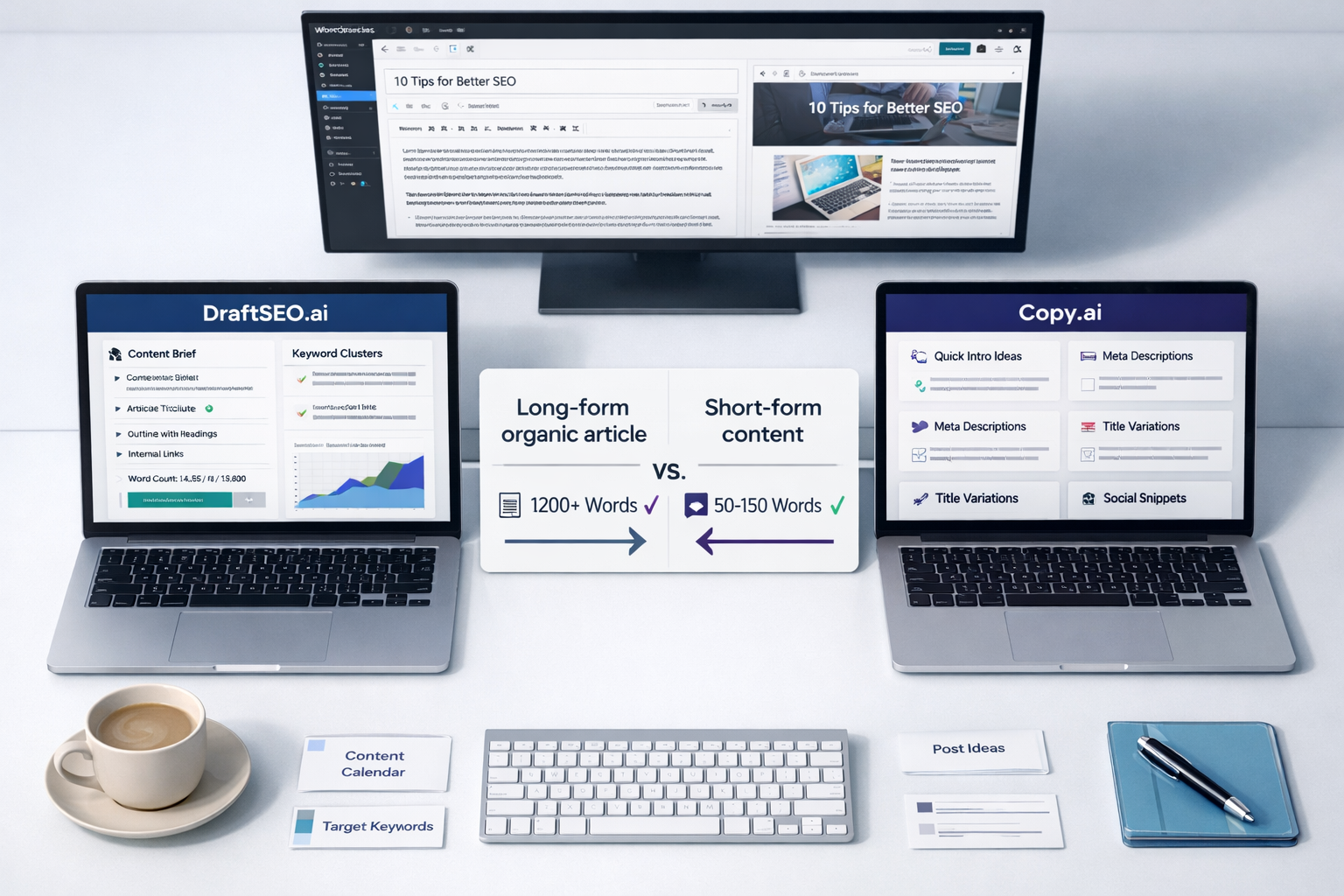
The core mistake teams make is assuming any AI writer can handle any content length equally well. It can't, not without real cost in editing time. Copy.ai's models are tuned for brevity and persuasion; ask them for a 2,000-word technical guide and you'll often get repetition, thin subheadings, and structure that doesn't map to how Google or ChatGPT parses long content.
DraftSEO.ai is built around the opposite assumption: articles need headings that carry search intent, internal structure that supports featured snippets, and length that matches what's already ranking for a given term.
- Define the target: short ad copy needs a hook and a call to action; a ranking article needs keyword coverage and depth.
- Check the output length Copy.ai defaults to for blog mode — usually shorter than competitive ranking pages.
- Compare that against DraftSEO.ai's article-length output, generated per niche input.
- Weigh editing time: short-form tools need light touch-ups; long-form SEO drafts need structural review.
- Decide based on your actual publishing cadence, not the tool's marketing page.
Skipping this step is how teams end up paying for a copywriting subscription, then still hiring a writer for the articles that actually move rankings.
Which Tool to Choose: Agency Workflows vs. Marketing Teams

Copy.ai fits marketers who need fast copy variations for ads, emails, and product pages, and who already have a publishing workflow in place. It's a reasonable pick if your bottleneck is ideation, not distribution.
DraftSEO.ai fits agencies, WordPress site owners, and ecommerce teams whose bottleneck is publishing volume, not writing ideas. If you manage several client sites or a content calendar with monthly quotas, an end-to-end pipeline beats a copywriting assistant every time, because the labor saved isn't in the writing, it's in the repetitive manual work around it.
Content quality and originality matter regardless of which tool you pick. Neither AI writer replaces editorial review entirely, and running a plagiarism check on early outputs from any tool is worth the ten minutes it takes.
If your priority is eliminating the publishing workload rather than drafting slightly better ad copy, start with the free trial and initial credits at DraftSEO.ai's pricing page and run it against one site for a month before deciding.
Frequently Asked Questions
Is Copy.ai good for long-form SEO blog posts?
It can produce long-form drafts, but it's optimized for short marketing copy, so blog output often needs heavier editing for structure and keyword coverage than a purpose-built SEO writer produces.
Does DraftSEO.ai publish articles automatically, or just draft them?
It does both. DraftSEO.ai generates the article and integrates with popular CMS platforms to publish it directly, producing 30 articles monthly per connected site without manual export steps.
Which tool costs less for a small agency running multiple client sites?
It depends on volume, not sticker price. Compare cost per published article, not per word, since Copy.ai's output still requires manual publishing time that DraftSEO.ai's plans already include.