Sep 6, 2026

Cleaning Services SEO for Local Leads in 2026
DraftSEO Team
Roughly 76% of people who search for a local service on their phone visit a business within a day, according to Google's own local search research from past years, and that habit hasn't reversed heading into 2026. For a cleaning company, that means the searcher typing "house cleaning near me" tonight could be on your doorstep tomorrow morning. Cleaning services SEO is how you make sure your business, not three competitors, shows up when that happens.
Most cleaning businesses treat SEO like a one-time website fix. Set up a homepage, add a few keywords, done. That approach stopped working years ago and it definitely won't hold up in 2026, when Google and AI search tools reward businesses that keep publishing fresh, location-specific proof of what they do.
Why Generic Local SEO Fails Cleaning Businesses
A single homepage trying to rank for "cleaning services" in an entire metro area is fighting an uphill battle. Google's local algorithm favors pages that match the specificity of the query, and "cleaning services" alone tells it almost nothing about who you serve or where.
Cleaning is a hyper-local, high-frequency-search category. People search by neighborhood, by service type, and by urgency ("same day carpet cleaning Plano TX," "move-out cleaning near Round Rock"). A generic homepage can't answer all of those intents at once, so Google has nothing specific to rank for any of them.
The Content Volume Problem
Ranking for a metro area with 10 suburbs and 5 service types means you theoretically need up to 50 distinct landing pages, plus ongoing blog content for seasonal demand. Most owner-operators write one page a month if they're lucky. That gap is exactly why automated, template-driven content production has become a practical necessity rather than a nice-to-have for small service businesses trying to compete with franchises that have in-house marketing teams.
What Google Actually Rewards Instead
Google's local ranking factors break down into three buckets: relevance, distance, and prominence. Relevance comes from matching page content to the query. Prominence comes from citations, reviews, and links. None of that happens from a single static page sitting untouched since launch.
Local Keyword Targeting and Service Area Pages
The fix is building pages around how people actually search, not around how your business describes itself internally. "Residential cleaning" is an internal term; "recurring house cleaning in Frisco" is a search term.
Structuring Service Area Pages Correctly
Each service area page should target one city or neighborhood combined with one primary service, include the specific ZIP codes or landmarks you cover, and answer pricing questions directly (even a range like $120-$250 for a standard 3-bedroom clean sets expectations). Thin, duplicate pages that swap only the city name get filtered by Google's algorithm, so each page needs unique content: local landmarks, typical home types, or neighborhood-specific pain points like older homes with hardwood floors needing different products.
Seasonal and Case Study Content
Seasonal posts (spring deep-cleaning checklists, post-holiday cleanups, move-in/move-out timing around lease cycles) capture search spikes tied to real calendar events. Before/after case studies, even a simple two-photo comparison with a short write-up, build trust and give Google fresh, unique content signals. This is where publishing volume matters most, and where a platform like DraftSEO.ai fits the workflow: it generates 30 articles a month for a connected site, which is roughly what's needed to cover a metro area's worth of neighborhood and seasonal pages without hiring a full content team.
Google Business Profile, Reviews, and Citations
Your Google Business Profile (GBP) often outranks your website in the local pack, so treating it as an afterthought is one of the costliest mistakes a cleaning business can make. GBP needs the same service categories, service areas, and photo updates as your site, updated on a regular schedule rather than once at signup.
Review Generation as a Ranking Signal
Reviews affect prominence directly, and review velocity (how often new reviews come in) matters as much as the star average. A business earning 3-4 new reviews a week signals ongoing activity to Google in a way that 200 reviews from three years ago doesn't. Responding to every review, good or bad, within 48 hours also feeds trust signals that show up in both Google's algorithm and in what customers see when they click through.
NAP Consistency Across Directories
Name, Address, and Phone number (NAP) need to match exactly across your website, GBP, Yelp, Angi, and any local chamber of commerce directory. A mismatched suite number or an old phone number on Yelp can quietly cap how much Google trusts your listing.
| Citation source | Typical cost | Impact on local trust |
|---|---|---|
| Google Business Profile | Free | Highest — primary ranking surface |
| Yelp | Free / paid ads optional | High — heavy consumer traffic |
| Angi | Free listing, paid leads optional | Medium-high — service-specific audience |
| Local Chamber of Commerce | $150-$500/year | Medium — trust and backlink value |
| Industry directories (e.g., cleaning associations) | Varies, often free | Medium — niche relevance |
Technical SEO and Schema for Service Businesses
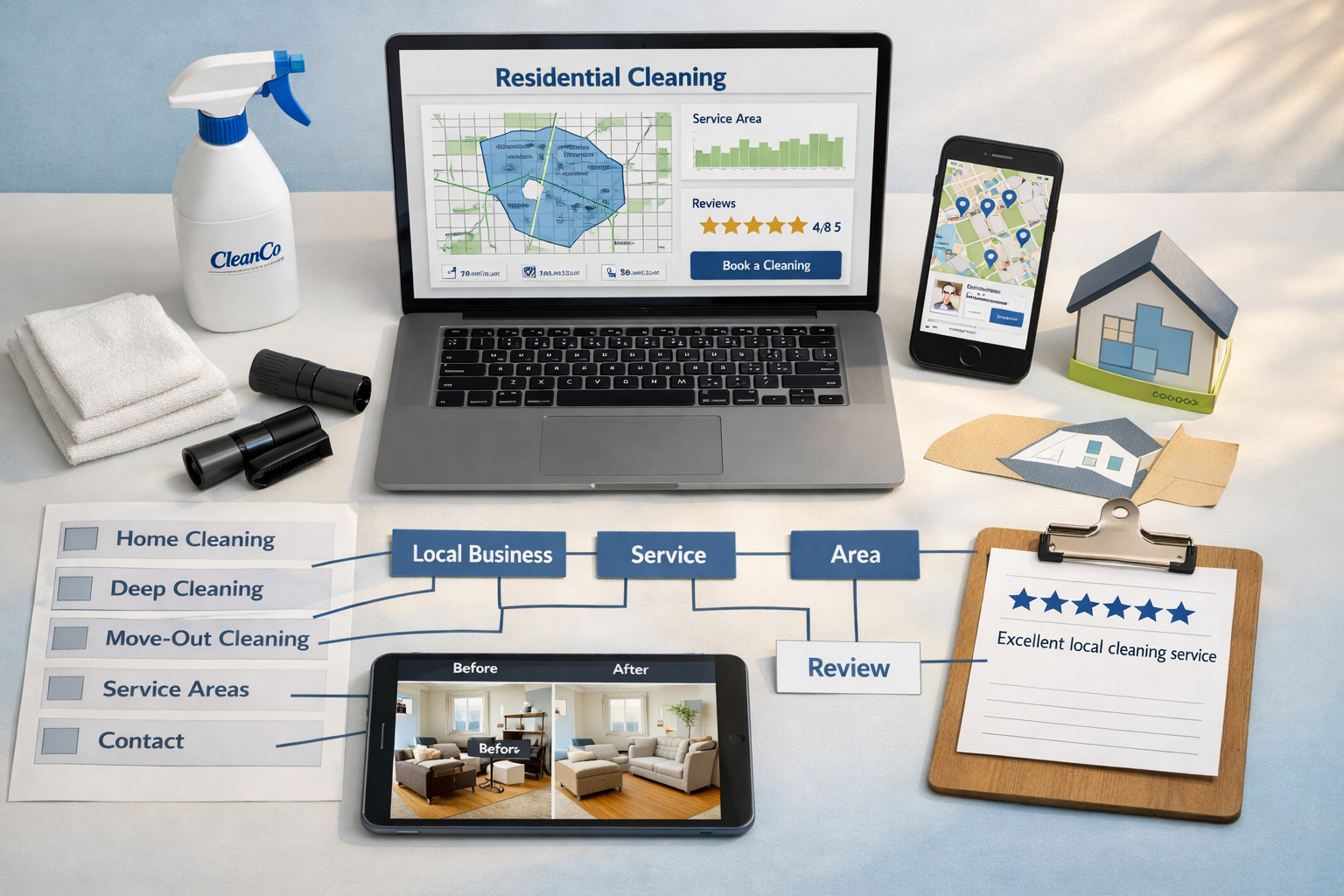
A slow, non-mobile site undoes all the content work above, since over half of local searches happen on mobile and Google uses mobile page experience as a ranking input. Pages need to load in under 3 seconds and render cleanly on a phone without pinch-zooming.
LocalBusiness schema markup tells search engines and AI answer engines exactly what you are, where you serve, and what you charge, in a format machines parse faster than plain text. For cleaning businesses, that means marking up service area, price range, and aggregate review rating on every relevant page.
Voice search and AI search (think ChatGPT or Google's AI Overviews) pull from structured, direct-answer content more than from long marketing copy. A page that opens with a clear answer, like stating your standard cleaning turnaround time in the first sentence, gets quoted more often than a page that buries the answer under three paragraphs of company history.
- Audit GBP categories and service areas for accuracy
- Add or fix LocalBusiness schema on every service page
- Compress images and test mobile load time
- Build unique service-area pages for each neighborhood served
- Add clear calls-to-action (phone number, quote form) above the fold
- Set up review request automation after each job
- Publish one seasonal or case-study post per month minimum
Turning Local Traffic Into Booked Jobs
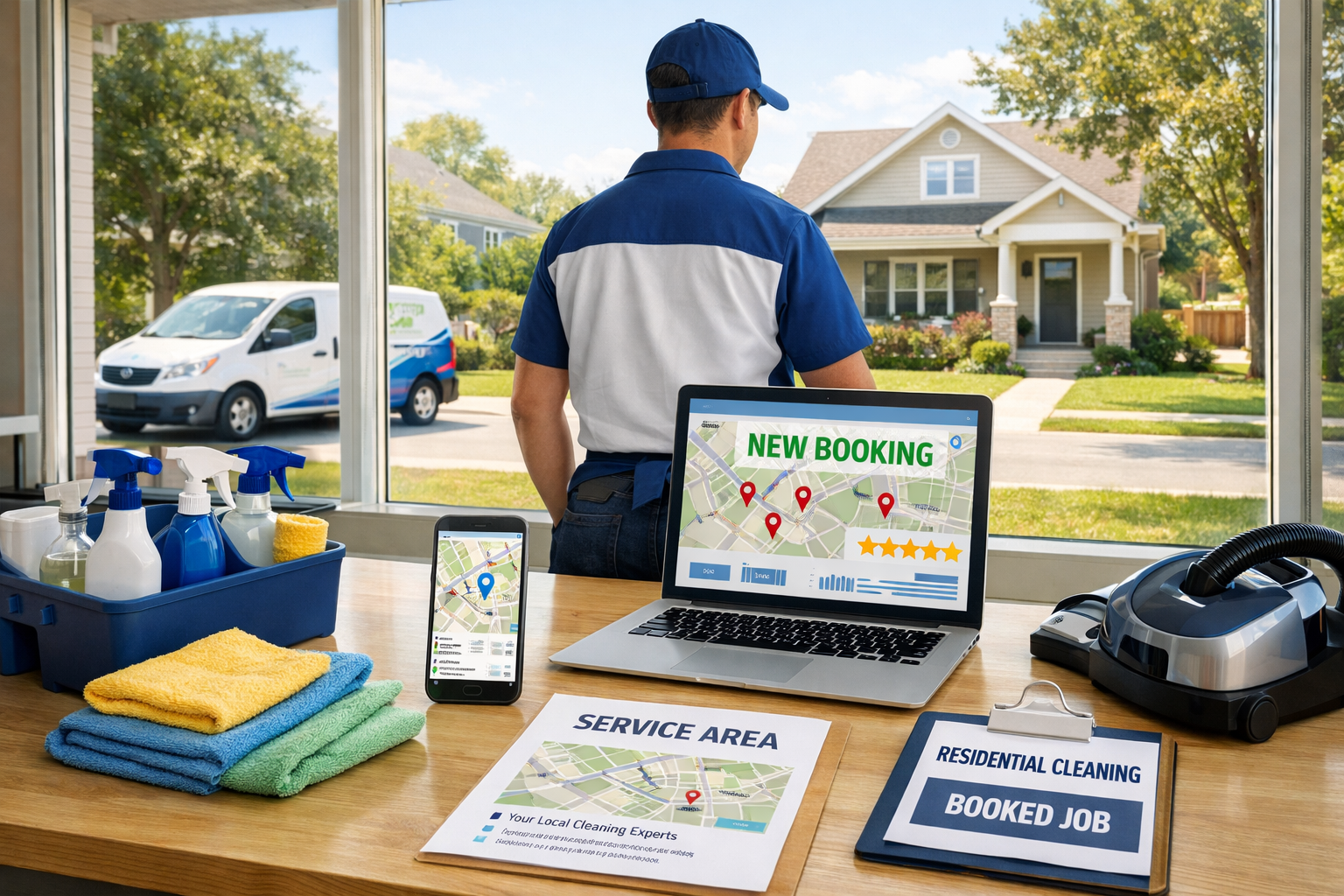
Traffic without conversions is wasted work, so the last piece is making sure the page itself sells the job. A phone number that's clickable on mobile, a quote form with three fields instead of ten, and a visible price range all reduce the friction between a search and a booked appointment.
Trust elements close the gap that price alone can't. Insurance and bonding badges, a short line about background-checked staff, and real (not stock) photos of your crew all push conversion rates up on service pages, since cleaning is a business people let into their homes.
Keeping this content current, and adding new neighborhood and seasonal pages every month, is the part most owner-operators can't sustain by hand. If you want to test whether automated content production fits your workflow before committing, DraftSEO.ai's pricing page includes a free trial with starter credits, so you can see the output on your own site before deciding to scale it up.
Frequently Asked Questions
How long does cleaning services SEO take to show results?
Expect 3-6 months for meaningful local pack movement, and closer to 6-12 months in competitive metro markets. GBP changes and review responses can show smaller ranking shifts within a few weeks.
Do I need a separate page for every neighborhood I serve?
Yes, if that neighborhood generates enough search volume on its own; for smaller suburbs, group two or three into one page rather than creating thin, near-duplicate content.
Does posting on social media help cleaning SEO?
Not directly for Google rankings, but it supports citation and review signals indirectly by driving branded searches and referral traffic, which are secondary trust signals for local search algorithms.